
How does drive-through warehouse racking improve storage efficiency?
Drive-through warehouse racking improves storage efficiency by allowing pallets to be loaded from one end and retrieved from the other, supporting first-in, first-out stock rotation while reducing handling and travel distances. Its accessible-through design makes better use of warehouse floor space and is particularly effective where high-volume goods require organised, streamlined pallet movement.
Drive-through warehouse racking improves storage efficiency by allowing pallets to enter from one side of a storage lane and leave from the opposite side. This creates a controlled first-in, first-out (FIFO) flow, reduces unnecessary pallet movements and helps warehouses use available floor space more effectively. It is particularly suitable for high-throughput operations handling consistent pallet loads and goods that need reliable stock rotation.
Unlike systems accessed from only one operating face, drive-through warehouse racking separates loading and retrieval activities. Pallets can be replenished at the loading side while older stock is collected at the dispatch side. This reduces the need for operators to move around stored pallets to reach the required load and can help maintain a more predictable flow through the warehouse.
The main efficiency benefits include:
- Improved stock rotation: FIFO access helps ensure that older pallets are dispatched before newer pallets, which is important for dated, perishable or batch-controlled goods.
- Reduced travel distances: Forklift movements can be organised around dedicated loading and unloading aisles, reducing unnecessary travel within the storage area.
- Higher storage density: Pallets are stored in lanes rather than separate individually accessed locations, making better use of the available footprint.
- More consistent handling: Defined entry and exit points make pallet flow easier to plan, monitor and manage.
- Less disruption: Replenishment and retrieval can take place from different sides, reducing conflict between incoming and outgoing pallet movements.
Space efficiency comes from the way the lanes use the depth of the warehouse. Conventional selective storage generally requires an access aisle in front of each pallet position, whereas drive-through warehouse racking allows several pallets to be stored behind one another. Removing some of the duplicated access space can increase the proportion of the warehouse dedicated to storage, although the final result depends on aisle widths, building dimensions, fire protection requirements and the equipment used.
Forklift productivity can also improve when the layout is planned around the direction of product movement. Vehicles do not need to reverse through a lane or repeatedly reposition pallets to access stock at the rear. Clear traffic routes and defined loading and unloading areas help operators work more efficiently while reducing the likelihood of congestion at the storage face.
However, the efficiency of drive-through warehouse racking depends on using it for the right stock profile. It works best where pallets are relatively uniform in size, weight and handling requirements, and where each lane is allocated to a product, batch or stock category. It is less suitable where a warehouse needs immediate access to many different individual stock-keeping units, because placing several products in the same lane can complicate stock control and reduce selectivity.
Good warehouse planning is essential to achieving the expected benefit. The design should consider:
- the number and type of pallets to be stored;
- the required stock rotation method;
- forklift dimensions, turning space and operating clearances;
- the height, weight and stability of each load;
- the location of receiving, dispatch and inspection areas;
- the likely movement of people and vehicles around the storage system;
- the need for future changes in product range or throughput.
Correct load placement is especially important in deep storage lanes. Pallets should be positioned squarely, with suitable clearances and without contact that could damage the structure or load. Operators should follow the system’s safe working procedures and never use a lane for loads that exceed its design specification. Poorly aligned pallets, inconsistent pallet quality and unsuitable forklift attachments can all reduce handling efficiency and increase the risk of impact.
Regular inspections support continued efficiency as well as safety. Damage to frames, rails, guides or protective components can restrict access, slow handling and create unsafe operating conditions. Any impact should be reported promptly, the affected area isolated where necessary and repairs completed using appropriate components and methods. Routine checks should also confirm that load notices remain visible, lanes are not obstructed and the system is being used as designed.
In practical terms, drive-through warehouse racking is most efficient when stock moves regularly in one direction, pallets are compatible with the system and the warehouse can maintain disciplined loading and retrieval procedures. When these conditions are met, the system combines dense pallet storage with a clear FIFO workflow, helping reduce handling effort and make warehouse operations more orderly and predictable.
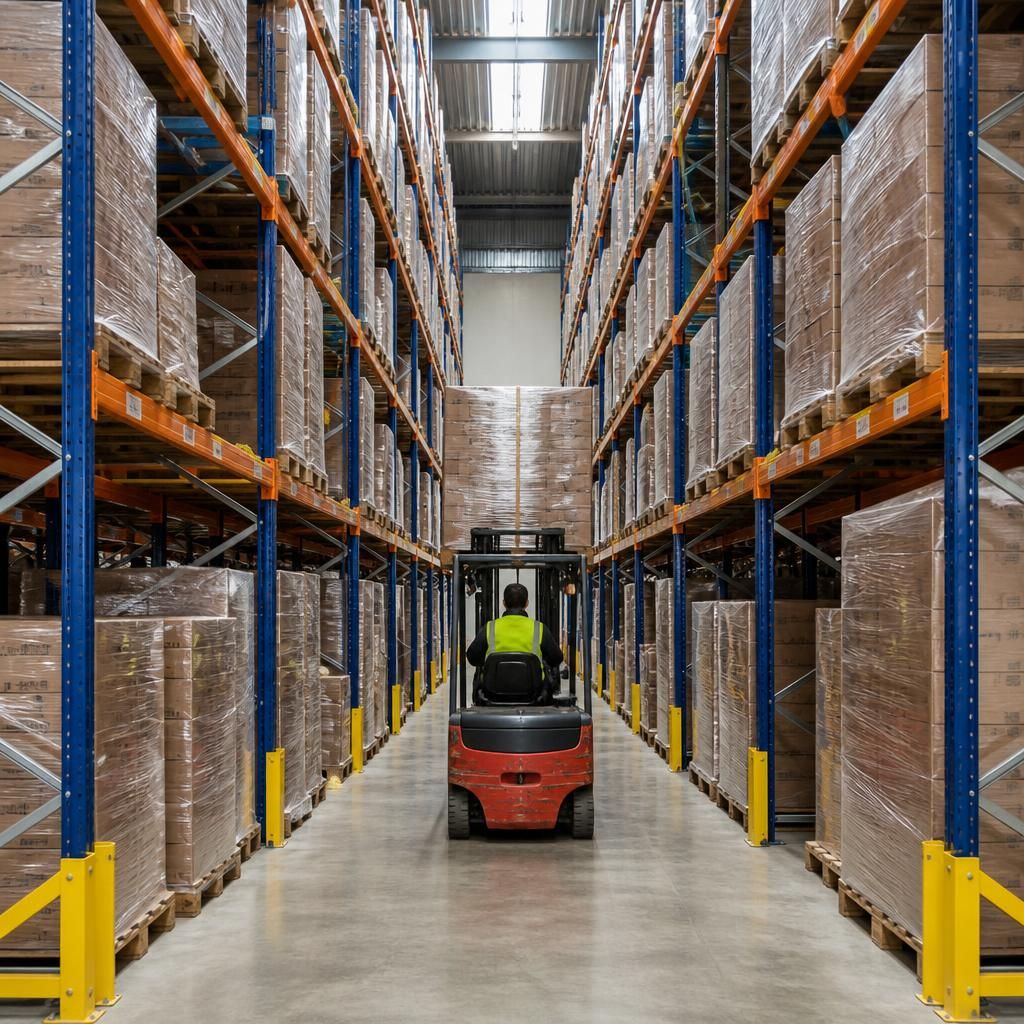
Drive-through warehouse racking improves efficiency by separating pallet replenishment from retrieval. New stock can be loaded at one end of a storage lane while older stock is collected from the opposite end, creating a practical first-in, first-out (FIFO) flow.
This arrangement reduces the need to move pallets to reach stock positioned behind them and helps organise forklift traffic around defined loading and dispatch areas. It is particularly useful for dated, perishable or batch-controlled goods, provided pallets are compatible, lanes are allocated correctly and operators follow the system’s loading sequence.
Plan More Efficient Drive-Through Warehouse Racking
Speak to Able Racking about planning a drive-through warehouse racking layout that supports efficient stock flow, safe pallet handling and reliable FIFO rotation. Our experienced team can assess your storage requirements and recommend a suitable solution.