
How do automated racking and ASRS systems impact warehouse safety?
Automated racking and ASRS systems can improve warehouse safety by reducing manual handling, limiting access to operational areas and controlling the movement of stored goods through software and guarding. They also introduce risks involving machinery, isolation, maintenance and system failure, so effective safety depends on suitable design, trained operators, documented procedures and regular inspections.
Automated racking and ASRS (Automated Storage and Retrieval System) installations can improve warehouse safety by reducing manual handling, separating people from moving equipment and controlling the movement of loads through software, sensors and guarding. They do not remove the need for risk management: machinery movement, stored-load failure, access during maintenance, isolation errors and system faults must be controlled through suitable design, competent operation, inspection and documented procedures.
How automation reduces workplace risk
- Less manual handling: cranes, shuttles, conveyors and lifts move goods that might otherwise be lifted, carried or retrieved manually. This can reduce exposure to repetitive handling, awkward postures, falling items and collisions during picking activities.
- Restricted access: automated storage areas can be enclosed with guarding, doors and controlled access points. Keeping people outside active operating zones reduces the likelihood of contact with moving machinery or falling loads.
- Controlled load movement: software can manage storage locations, travel paths, load weights and retrieval sequences. When correctly configured, this reduces incorrect placement, overloading and uncontrolled movement.
- Improved traffic separation: automated processes can reduce the number of forklift trucks and pedestrians working in the same storage aisles. This may help minimise vehicle-pedestrian interaction, although access routes and remaining vehicle movements still require formal control.
- More consistent operation: automated equipment follows programmed sequences rather than relying entirely on individual judgement. Interlocks, presence sensors and control systems can prevent certain actions when a door is open, a load is incorrectly positioned or an operating zone is occupied.
These benefits depend on the system being properly specified and integrated with the building, the goods being stored and the way the warehouse operates. Automation can transfer risk rather than eliminate it, so the original design risk assessment must be reviewed whenever equipment, software, loads, layouts or operating procedures change.
Key safety risks introduced by ASRS equipment
- Moving machinery: storage and retrieval cranes, shuttles, conveyors, lifts and transfer cars can create crushing, shearing, trapping and impact hazards. Fixed guarding and correctly designed safety distances should prevent routine access to dangerous moving parts.
- Unexpected start-up: equipment may restart automatically after a reset, power restoration or control-system command. Start-up warnings, access controls, reset procedures and effective isolation arrangements are essential.
- Falling or displaced loads: damaged packaging, unsuitable pallets, incorrect load dimensions, poor positioning or excessive weight can cause a load to fall or obstruct equipment. Load acceptance checks and clear rejection criteria are therefore important.
- Access during faults: staff may be tempted to enter an operating area to remove a trapped load or clear a blockage. Only authorised, trained personnel should carry out these tasks under a documented safe system of work.
- Control-system failure: sensor faults, communication errors, incorrect data or software problems can cause a machine to stop in an unsafe position or attempt an unsuitable movement. Safety-related control functions, fault indication and tested recovery procedures must be maintained.
- Fire and emergency events: automated systems can affect evacuation routes, fire-service access, smoke control and the retrieval of stock during an emergency. The installation must be considered within the warehouse fire risk assessment and emergency plan.
- Interaction with other equipment: forklifts, pallet trucks, conveyors, loading areas and maintenance equipment may operate near the automated installation. Physical separation, barriers, traffic rules and clear signage help prevent conflicting movements.
Design features that support safe operation
A safe ASRS installation normally combines physical safeguards with control measures. Guarding should prevent access to hazardous zones while allowing suitable inspection and maintenance access. Access doors and gates should be interlocked where necessary, with reliable emergency-stop devices positioned so that they can be reached quickly. Light curtains, scanners or other presence-sensing devices may be appropriate at transfer points and access openings, but they must be correctly selected, positioned and tested.
Safety devices should not be treated as a substitute for good layout or sound procedures. Guards must remain in place, emergency stops must be clearly identified and bypassing an interlock must be prohibited except under a controlled maintenance process. The design should also allow safe access for cleaning, inspection, fault diagnosis and planned maintenance without exposing workers to avoidable hazards.
Safe operation depends on competent people
Operators should understand the normal operating sequence, system alarms, load restrictions, pedestrian controls and emergency actions. Training should cover what to do when a load is misaligned, a door will not close, a machine stops unexpectedly or the control system reports a fault. Operators should never enter a restricted area, reach through guarding or reset a safety device to restore production.
Maintenance staff and contractors require additional instruction because they may work inside hazardous zones. Their procedures should cover isolation, lock-off and verification of stored energy, including electrical, mechanical, hydraulic, pneumatic and gravitational energy. A control-system stop is not necessarily an energy isolation. Before work begins, the equipment should be made safe, isolated from all relevant energy sources and proved dead or otherwise incapable of movement.
Authorisation levels should be clear. A person who can acknowledge an alarm or restart a system is not automatically competent to diagnose a fault or enter the equipment. Access records, permits and handover arrangements are particularly important when several teams work across shifts.
Inspection and maintenance requirements
Regular maintenance helps preserve the safeguards that make automation safe. Checks should include guarding, doors, interlocks, emergency stops, sensors, scanners, limit switches, brakes, cables, chains, drive systems, conveyor components, pallet supports and load-handling devices. The inspection scope should reflect the manufacturer’s instructions, the system design, operating conditions and the findings from previous examinations.
Visual checks by trained site personnel can identify obvious damage, unusual noise, leaking components, displaced guards, damaged pallets and recurring alarms. These checks do not replace planned preventive maintenance or a detailed examination by a suitably competent person. Defects affecting safety should be assessed promptly, recorded and controlled until repaired. If a safeguard is defective, the equipment may need to be taken out of service rather than operated with a temporary workaround.
Where lifting equipment forms part of the system, the relevant examination and inspection requirements should be identified and completed at appropriate intervals. In the UK, duties may also arise under PUWER for work equipment and under LOLER where lifting equipment is used to lift or lower loads. The precise application depends on the equipment and its use, so the responsible person should confirm the requirements for the particular installation rather than relying on a generic checklist.
Warehouse racking within an automated installation should also be assessed for impact damage, distortion, loose components, corrosion, deterioration and signs of overloading. Any damage should be reported through the site’s safety system and dealt with according to its severity. Repairs and alterations should be completed by competent specialists using components and methods suitable for the original design.
Emergency arrangements and recovery from faults
Every site should define how to respond to an emergency stop, trapped load, power failure, fire alarm, equipment collision and loss of communication with the warehouse management system. The response should state who can stop the system, who can enter the area, how stock is made safe and when equipment may be restarted.
Emergency procedures should be practical rather than limited to written instructions. They should account for evacuation, first aid, communication with emergency services, alternative access routes and the possibility that automated equipment has stopped across an aisle or doorway. Drills and reviews can identify problems with access, lighting, alarms or staff understanding before an actual incident occurs.
After a collision, unexpected movement, safety-device failure or significant software or layout change, the system should not simply be reset and returned to service. The cause should be investigated, affected components examined and the risk assessment reviewed. Restart approval should be given by an authorised person once the necessary corrective action has been completed.
Managing changes safely
Changes to pallet types, packaging, load weights, storage profiles, control software, conveyor routes, guarding, building services or operating hours can alter the original risk profile. A management-of-change process should assess the proposed change before implementation, identify affected documents and training, and confirm that safety functions still operate as intended.
Integration with warehouse management software also requires careful control. Product dimensions, weights and storage rules should be accurate, and data changes should be subject to authorisation. A system that is mechanically sound can still create a safety risk if it is instructed to store an unsuitable load or send equipment to an incorrect location.
Practical checks for warehouse managers
- Confirm that the installation has a current risk assessment covering normal operation, foreseeable misuse, maintenance and emergency access.
- Keep operating instructions, electrical and control-system information, layout drawings and manufacturer documentation available to relevant staff.
- Define restricted areas and prevent unauthorised entry through physical barriers, controlled access and clear signs.
- Record daily or shift-based checks, planned maintenance, safety-device tests, defects, repairs and return-to-service decisions.
- Check that loads, pallets and packaging meet the specifications used when the system was designed.
- Review training and authorisation whenever roles, equipment or procedures change.
- Investigate alarms, near misses, dropped loads and repeated stoppages rather than treating them as routine interruptions.
- Arrange competent inspections of both the automated equipment and the supporting warehouse racking, with repair priorities based on risk.
In summary, automated racking and ASRS systems can make warehouse operations safer by controlling access, reducing manual handling and limiting uncontrolled load movement. The strongest safety performance comes from combining engineered safeguards with suitable load controls, competent people, effective isolation, planned maintenance, regular inspections and tested emergency procedures. Able Racking can help review warehouse racking condition and safety controls as part of a wider preventative programme, supporting reliable operation and evidence of ongoing compliance.
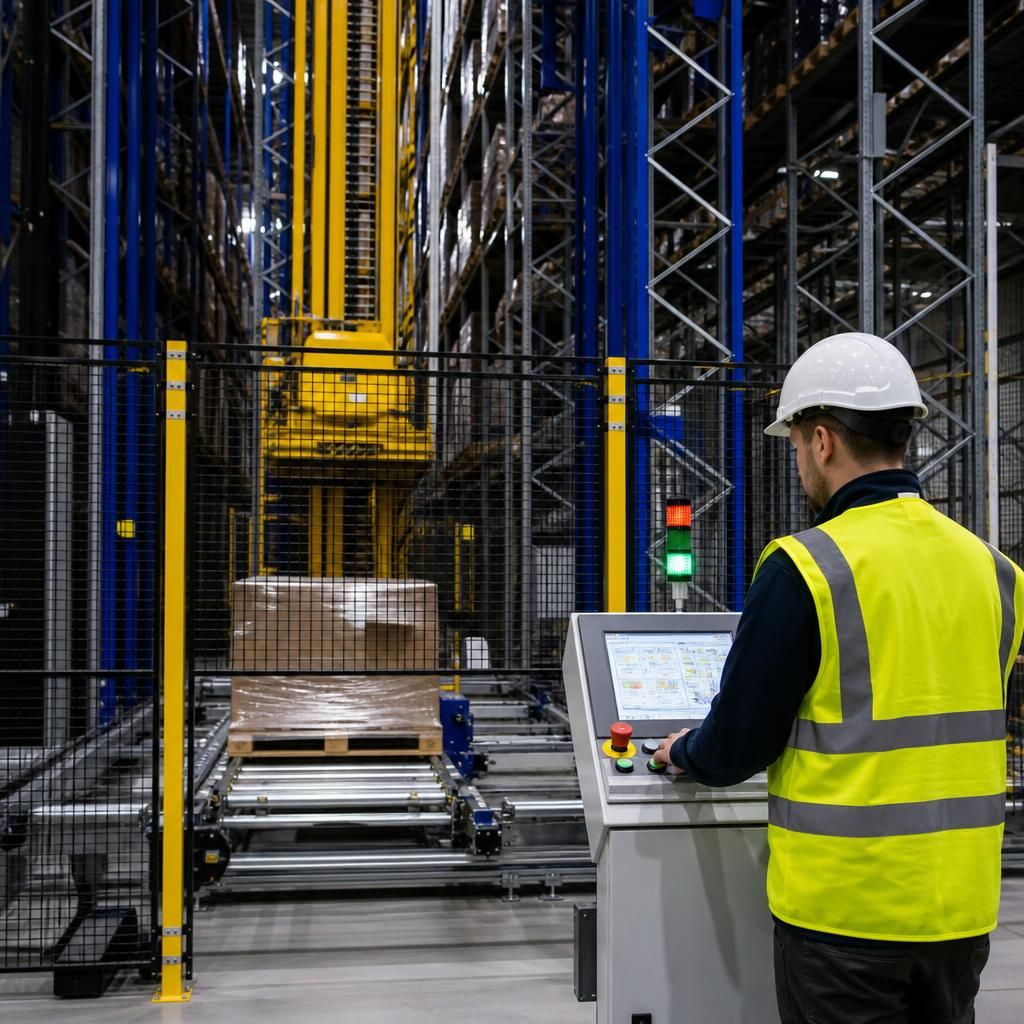
Automated racking and ASRS safety depends on keeping people away from moving machinery and controlling access to operational areas. Fixed guarding, interlocked doors, emergency stops and presence sensors help prevent contact with cranes, shuttles, conveyors and lifts during normal operation.
These safeguards must remain functional and must not be bypassed to clear faults or recover stock. Only authorised, trained personnel should enter restricted areas, using documented isolation and lock-off procedures. Regular checks of guarding, access points and safety devices help identify defects before they lead to injury or unplanned downtime.
Review your automated warehouse racking safety controls
Arrange a review of your automated warehouse racking safety controls to identify defects, access risks and inspection requirements. Able Racking can help assess the installation and supporting warehouse racking, then advise on practical corrective action.