
What are the key indicators of wear and damage in warehouse racking uprights?
Key indicators of wear and damage in warehouse racking uprights include bent or twisted sections, dents, splits, corrosion, loose or missing fixings, damaged footplates and uprights that are no longer vertical or properly anchored. Any visible damage should be reported and assessed promptly by a competent person, with the affected area isolated if stability or load capacity may be compromised.
Key indicators of wear and damage in warehouse racking uprights include bending, twisting, dents, buckling, cracking, corrosion, damaged footplates, loose anchors and any loss of vertical alignment. These defects can reduce the upright’s ability to carry its intended load, so visible damage should be reported promptly and assessed by a competent person. Where stability or load capacity may be affected, the affected bay should be isolated until it has been made safe.
Deformation and impact damage
Forklift and pallet-handling impacts are among the most common causes of upright damage. Look for:
- Bent or twisted upright sections, particularly at low level where vehicles operate.
- Dents, tears, gouges or flattened sections in the steel profile.
- Local buckling, rippling or folds around the upright or its perforations.
- Distorted frame bracing, horizontal ties or connections attached to the upright.
- Damage that has been painted over or partially concealed during previous work.
An upright does not need to be visibly collapsed to present a concern. A relatively small impact can deform the section, alter the load path or weaken the connection between the upright and its bracing. Damage at the base is particularly important because forces are transferred through this area into the footplate and floor.
Loss of alignment and stability
Warehouse racking uprights should remain substantially vertical and in their intended positions. Signs of movement include a frame leaning forwards, backwards or sideways; gaps developing between connected components; displaced bracing; or bays that no longer align with adjacent sections. A change in alignment may indicate impact, overloaded components, loose fixings, floor movement or failure of an anchor.
Do not rely only on visual judgement from the main aisle. Check the upright from several angles and compare it with neighbouring frames. If the frame appears to be moving, has pulled away from its anchors or is visibly out of plumb, prevent further use until it has been inspected.
Cracks, splits and damaged perforations
Inspect the upright profile and its perforations for cracks, splits, elongated holes and torn steel. Pay close attention to areas where beams, ties or bracing connect, as damage around these points can affect the security of the whole frame. Missing, distorted or damaged perforations may prevent a beam connector from seating correctly and can increase the risk of accidental disengagement.
Cracked paint alone is not necessarily a structural defect, but it can reveal movement, corrosion or a previous impact. Any crack in the steel, separated weld, torn section or sharp fracture should be treated as serious until assessed by a competent inspector.
Corrosion and deterioration
Rust can reduce the effective thickness and strength of an upright, particularly where moisture, chemicals, salt, cleaning products or damaged protective coatings are present. Inspect for:
- Surface rust that is spreading from scratches, impact marks or cut edges.
- Flaking scale, pitting or deep localised corrosion.
- Corrosion around the base, footplate, anchors and floor interface.
- Rust inside enclosed or difficult-to-view areas.
- Coating failure caused by persistent dampness or chemical exposure.
Light surface discolouration may only require monitoring and controlled treatment, but corrosion that has caused pitting, section loss or distortion requires a professional assessment. Simply applying paint over active corrosion can conceal deterioration rather than resolve it.
Footplates, anchors and floor connections
The footplate transfers load from the upright to the warehouse floor. It should be flat, secure and correctly connected to the upright. Warning signs include a bent or cracked footplate, missing washers, loose or damaged anchor bolts, holes that have become enlarged, or a footplate lifting away from the floor.
Also check for cracked or damaged concrete around anchors, evidence that an anchor has pulled out, and obstructions that prevent the footplate from sitting correctly. Anchors should not be tightened, replaced or relocated without confirming that the repair is suitable for the upright, floor construction and applied loads.
Loose, missing or incompatible components
Upright damage is sometimes associated with missing or incorrectly fitted components. Check that bracing, beam connectors, locking pins, bolts and other specified fixings are present, secure and undamaged. A missing locking pin or an incorrectly seated connector can allow a beam to disengage, placing additional stress on the upright and frame.
Replacement parts should be compatible with the original system and installed in accordance with the manufacturer’s instructions or an appropriate engineering assessment. Substituting visually similar components can change the capacity or connection behaviour of the storage system.
Signs of overloading or changed loading conditions
Look for bowed beams, distorted connections, deflection that has increased, damaged load notices or pallets that exceed the stated configuration. Although these signs may not originate in the upright, they can transfer excessive forces into the frame. Uprights can also be affected when beam levels have been altered, bracing has been removed, pallet sizes have changed or the system is being used for loads different from those originally assessed.
Load notices should be legible and reflect the current arrangement. If the layout, beam levels, pallet weights or handling equipment have changed, the system should be reviewed before continued use.
What to do when damage is found
- Report the defect immediately to the person responsible for warehouse safety.
- Prevent loading or unloading in the affected bay where there is any doubt about stability or capacity.
- Use suitable barriers or clear warning controls so the area is not used accidentally.
- Record the location, component, type of damage and likely cause, with photographs where appropriate.
- Arrange an assessment by a competent warehouse racking inspector or suitably qualified engineer.
- Do not straighten, weld, drill, heat or improvise repairs to a damaged upright unless this has been specifically designed and authorised.
The appropriate remedy may be removal from service, replacement of the damaged component, installation of an approved repair, or monitoring where the inspector confirms that the defect does not affect safe use. Repairs should be completed by competent operatives and the bay should only return to service after the repair and any required reinspection have been confirmed.
Routine checks and professional inspections
Operators should report new impacts and obvious defects during routine workplace checks. These checks do not replace a formal inspection. A competent person should examine warehouse racking uprights at suitable intervals, with additional checks after a significant impact, alteration, overloading event, fire, flooding or other unusual occurrence.
Good inspection records identify the exact bay and component, describe the defect, state the risk response, name the person responsible and confirm when corrective work was completed. Consistent records help identify recurring vehicle impacts, poor housekeeping, unsuitable traffic routes or other causes that need to be addressed rather than repeatedly repairing the same damage.
Early reporting is the most effective way to prevent a local defect becoming a wider frame problem. If an upright is bent, cracked, corroded, poorly anchored or no longer aligned, treat it as a safety issue and obtain a competent assessment before relying on the storage position again.
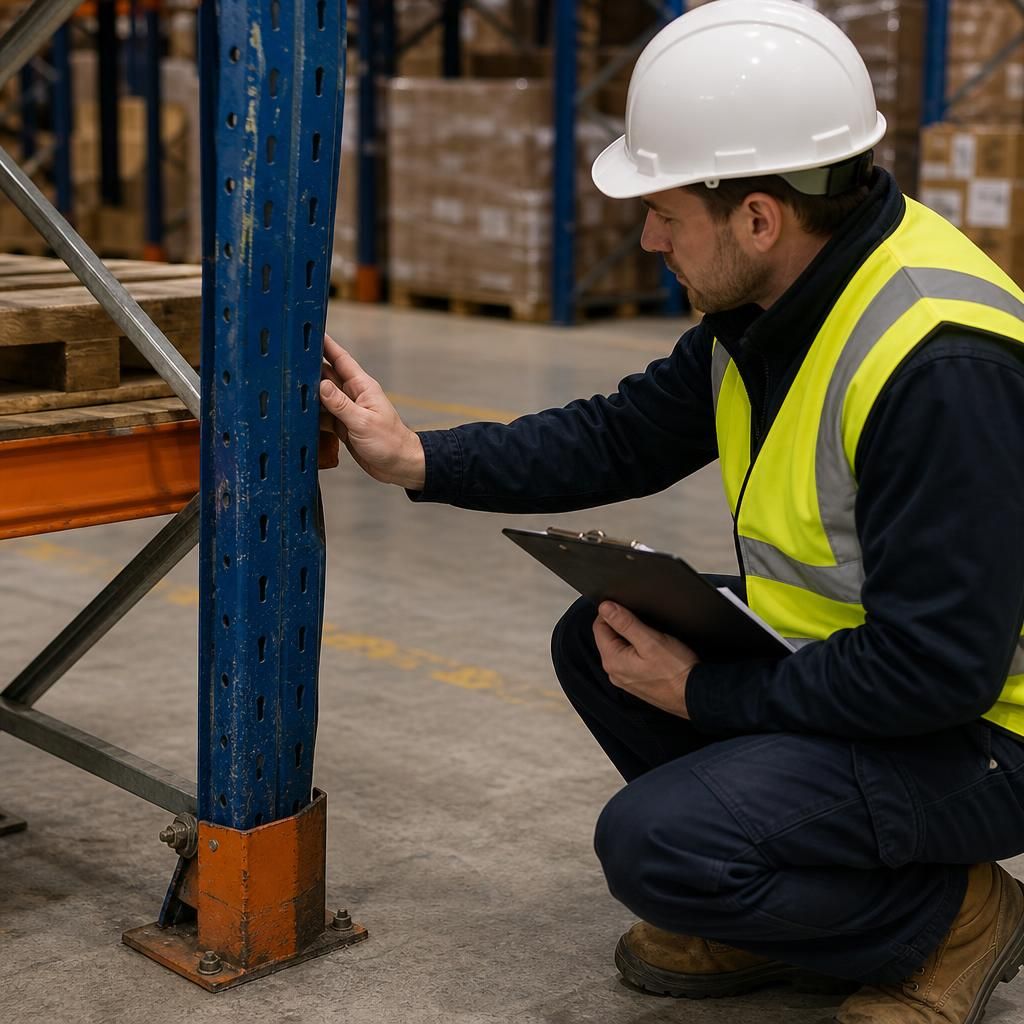
Impact damage is a key indicator of wear in warehouse racking uprights and is often caused by forklifts or pallet-handling equipment. Inspect the lower sections for bends, dents, gouges, flattened steel, local buckling and damage around perforations, bracing connections or the footplate.
An upright does not need to be visibly collapsed to present a safety concern. Even a small deformation can alter the frame’s load path and reduce its stability. Report any suspected impact immediately, prevent use of the affected bay where stability or capacity may be in doubt, and arrange assessment by a competent warehouse racking inspector before loading resumes. Do not straighten, weld or drill the damaged section without an approved repair specification.
Arrange a warehouse racking upright inspection
Arrange a warehouse racking upright inspection with Able Racking to identify damage, assess structural risk and confirm the appropriate corrective action. Our competent inspectors provide clear findings to help you keep your storage system safe and compliant.