
What safety standards should be upheld in maintaining longspan racking systems?
Maintaining longspan racking systems should follow BS EN 15635, HSE guidance such as HSG76, the manufacturer’s instructions and a suitable warehouse risk assessment. This includes routine visual checks, prompt isolation and repair of damaged components, documented inspections by a competent person at appropriate intervals, and a formal expert inspection at least every 12 months unless the risk assessment requires more frequent checks.
Maintaining longspan racking systems in the UK should follow BS EN 15635, relevant Health and Safety Executive guidance such as HSG76, the manufacturer’s instructions and a suitable warehouse risk assessment. In practice, this means carrying out routine visual checks, reporting and isolating damaged sections, using competent people for inspections and repairs, and arranging a formal expert inspection at least every 12 months unless the risk assessment requires more frequent inspections.
These requirements work together rather than acting as a single certification scheme. The risk assessment should consider the system’s design, loading, age, operating environment and foreseeable hazards, including forklift impact, overloading, poor housekeeping, corrosion, unauthorised alterations and changes to the stored goods. It should also define who is responsible for checks, how defects are reported and when affected areas must be taken out of service.
Routine checks and reporting
Warehouse operatives should be encouraged to report damage as soon as it is noticed. A responsible person should carry out regular visual checks at an interval determined by the risk assessment and operating conditions. Checks should look for:
- Bent, twisted, cracked or visibly distorted uprights, beams, bracing, frames and connectors.
- Missing, loose or displaced locking pins, bolts, safety clips and other retaining components.
- Impact damage caused by handling equipment or stored goods.
- Signs of corrosion, deterioration, instability or movement.
- Loads that are overhanging, incorrectly positioned or unsuitable for the stated capacity.
- Missing, damaged or illegible capacity notices and identification labels.
- Changes to the layout or components that do not match the approved design.
Findings should be recorded, communicated to the person responsible for warehouse safety and assessed promptly. A damaged section should not simply be monitored indefinitely. Where there is a risk of collapse or further damage, it should be unloaded, clearly isolated and protected from further use until a competent person has assessed it.
Formal expert inspections
BS EN 15635 calls for a systematic safety inspection by a technically competent person at intervals of no more than 12 months, unless the risk assessment specifies a shorter interval. Additional inspections may be appropriate where there has been a significant impact, a change of use, relocation, alteration, unusual loading, fire, flooding or exposure to a particularly harsh environment.
The inspection should be independent and sufficiently detailed to assess the condition and safe operation of the complete system. It should cover structural components, connections, protection, load information, clearances, stability, installation quality and any previous repair work. The inspection report should identify defects clearly, set priorities for action and confirm whether areas can remain in use while remedial work is arranged.
Damage classification and remedial action
Industry guidance commonly classifies damage according to its severity and the urgency of the response. Serious damage requires immediate unloading and isolation. Less severe damage may require prompt repair and increased monitoring, while minor issues should still be recorded and corrected before they develop. The precise response depends on the component, location, loading and system design; damage should not be judged solely by appearance or by comparing it with a previous defect.
Repairs should be completed using suitable components and methods approved by the original manufacturer or an appropriately qualified specialist. Straightening, welding, drilling or substituting components without design approval can alter the system’s capacity and introduce new risks. After repair, the affected area should be inspected before it is returned to service, with updated records retained.
Loading, alterations and safe use
Every system should display clear and current load information. Operators must follow the stated capacities, loading arrangements and bay configuration. Loads should be stable, evenly distributed and suitable for the deck or support arrangement. Capacity information must be reviewed whenever the layout, beam levels, components, stored goods or operating method changes.
Unauthorised alterations are not acceptable. Adding sections, changing beam positions, removing bracing or replacing components with different types can affect the design assumptions. Proposed changes should be reviewed by a competent person and, where necessary, confirmed by the manufacturer or a suitably qualified designer before work begins.
Safe maintenance also depends on controlling the surrounding operation. Suitable forklift routes, impact protection, housekeeping, lighting and operator training reduce the likelihood of damage. Staff should understand the capacity notices, reporting procedure and the importance of not using damaged components or removing protective devices.
Records and ongoing compliance
Keep inspection reports, defect logs, repair details, photographs where useful, training records, risk assessments, layout drawings and manufacturer information together. Records should show what was inspected, when it was inspected, who carried it out, what defects were found, what action was taken and when the work was closed out. A documented audit trail helps demonstrate that defects are managed rather than merely identified.
For most warehouses, the most reliable approach is a planned programme combining routine user checks, documented inspections, formal expert examinations, prompt repairs and periodic review of the risk assessment. This approach supports BS EN 15635 and HSE expectations while helping maintain the capacity, stability and serviceability of the longspan racking system throughout its working life.
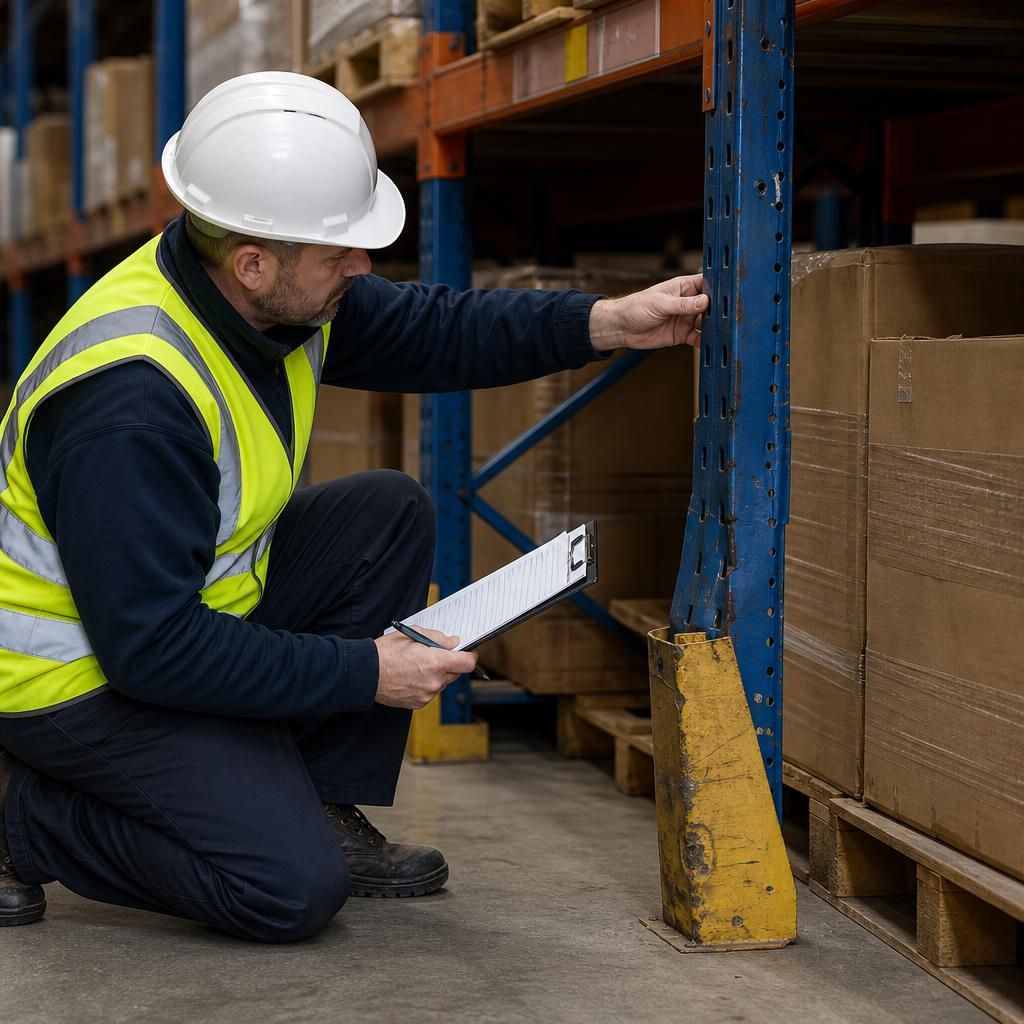
Promptly isolating damaged longspan racking is a key safety control. If an upright, beam, connector, brace or locking component has been struck, distorted, displaced or weakened, the affected bay should be unloaded where safe to do so, clearly marked and prevented from further use until a competent person has assessed it.
Damage should not be judged by appearance alone or corrected by straightening, welding or drilling without suitable technical approval. The assessment should consider the component affected, its position, the applied load and the overall stability of the system. Repairs should use compatible components and approved methods, with the area inspected before it is returned to service. Recording the defect, action taken and repair completion also provides a clear audit trail for ongoing safety management.
Arrange a longspan racking safety inspection
Arrange a professional longspan racking safety inspection to identify defects, confirm safe operation and support ongoing compliance. Contact Able Racking to plan an inspection suited to your warehouse and risk assessment.