
What are the essential protective measures for maintaining warehouse racking safety?
Essential protective measures for maintaining warehouse racking safety include regular inspections, clearly displayed load limits, suitable protection against impact, prompt repairs and effective staff training. These controls help identify damage early, prevent unsafe loading or handling, and keep warehouse racking compliant and fit for continued use.
Essential protective measures for maintaining warehouse racking safety are planned inspections, clearly displayed load information, physical protection from vehicle impacts, controlled loading and unloading, prompt repairs, good housekeeping and effective staff training. Used together, these measures help prevent damage, overloading and unsafe working practices while supporting compliance and reliable warehouse operations.
Inspect warehouse racking regularly
Routine checks are the foundation of a safe storage system. Staff should carry out frequent visual checks for obvious damage, such as bent uprights, distorted beams, loose components, missing locking devices, damaged bracing, displaced pallets and signs that a load is unstable. These checks should be supported by a formal inspection programme carried out by a competent person at appropriate intervals.
Inspections should consider the condition of the complete installation, including frames, beams, bracing, base plates, anchors, protection equipment, decking and safety accessories. The surrounding area should also be assessed for obstructions, poor visibility, uneven floors and vehicle routes that could increase the risk of impact. Findings should be recorded clearly so that defects can be tracked through to completion.
Act immediately when damage is identified
Damaged warehouse racking should not simply be monitored indefinitely. The affected area should be assessed promptly, and it may need to be unloaded, isolated or taken out of service until a suitable repair is completed. A temporary workaround, such as moving stock or straightening a damaged component without technical approval, can create further risk.
Repairs and replacements should use compatible components and follow the original design requirements or the advice of a suitably qualified specialist. Damaged structural members should not be cut, welded, drilled or modified without appropriate engineering approval. Once work is complete, the installation should be checked before it returns to normal use.
Display accurate load information
Every warehouse racking installation should have load notices that are visible to the people using it. The information should reflect the actual configuration, including beam levels, bay arrangement, pallet type and any relevant restrictions. It should identify safe working loads and explain any conditions that affect capacity, such as uneven loading or changes to the layout.
Load limits must be understood as maximum permitted loads, not targets. Operators should never assume that a similar-looking bay has the same capacity, particularly where beam lengths, frame heights or component specifications differ. Any change to the layout or loading arrangement should be reviewed before use, and the load notice should be updated when necessary.
Prevent impact from handling equipment
Forklift trucks and other handling equipment are a common source of damage. Suitable protection can include upright guards, end-of-aisle barriers, corner protection and other impact-resistant measures selected for the warehouse layout and traffic conditions. Protection should be correctly positioned, securely fixed and maintained so that it does not introduce a new obstruction or interfere with access.
Physical protection should support, rather than replace, safe traffic management. Vehicle routes should be defined where practical, pedestrian and vehicle movements should be separated where the risk assessment requires it, and aisles should provide sufficient clearance for the equipment in use. Drivers should be trained to approach storage locations carefully and report contact or suspected damage immediately, even when no defect is obvious.
Control loading and unloading practices
Loads should be suitable for the storage system, stable on their pallets and positioned evenly across the supporting beams. Operators should avoid placing damaged pallets, overhanging loads or poorly secured goods into storage. Loads should be placed and removed without dragging them across beams or striking frames, and they should not be pushed into position using the handling equipment.
Loading rules should cover pallet condition, maximum load, permitted overhang, load distribution and the order in which goods are stored or retrieved. Fast-moving areas may need additional supervision because repeated handling increases the opportunity for impact and poor placement. Any change in stock type, pallet dimensions or handling equipment should be reviewed for its effect on the installation.
Maintain clear aisles and good housekeeping
Clear, well-maintained working areas reduce collisions, trips and unstable loading. Aisles, escape routes, access points and areas around fire-fighting equipment should remain unobstructed. Spilled materials, broken pallets, loose packaging and discarded wrapping should be removed promptly rather than left for the next shift.
Good housekeeping also makes damage easier to see. Floor defects, poor lighting, water ingress and obstructions can affect the stability of loads and the safe movement of handling equipment. These issues should be included in workplace checks and corrected through the site’s maintenance process.
Use a clear defect reporting process
Everyone who works near warehouse racking should know how to report damage, unsafe loads and other concerns. Reports should identify the location, type and apparent severity of the issue, with photographs or other supporting information where useful. Staff should understand when an area must be isolated immediately and who has authority to release it for use.
A consistent colour-coded approach may be used to distinguish damage requiring immediate action from damage requiring planned monitoring, provided that the site rules are understood and applied by trained personnel. The system should never allow a significant defect to remain in service simply because it has been recorded.
Train staff and supervise safe working
Training should be specific to the warehouse environment and the storage system in use. It should cover load limits, safe placement and removal of pallets, impact prevention, defect reporting, access restrictions and the actions to take after a collision. Forklift operators need appropriate equipment training, while other staff need enough awareness to work safely around vehicle routes and stored loads.
Refresher training is appropriate when procedures change, new equipment or stock is introduced, an incident occurs, or inspections show repeated unsafe practices. Supervision and periodic observation help confirm that the agreed methods are being followed in day-to-day operations rather than only during formal training.
Keep records and control changes
Inspection reports, repair records, load information, training records and incident reports provide evidence that warehouse racking safety is being actively managed. Records should show the date, location, findings, actions required, responsible person and completion status. They also help identify repeated impact points or recurring problems that may require changes to the layout, equipment or working method.
Unauthorised alterations can undermine the design of an installation. Beams, ties, bracing, decking, protection and other components should not be removed, repositioned or replaced with unsuitable alternatives. Proposed changes should be assessed by a competent person, and the installation should be rechecked and relabelled where the change affects its safe working capacity.
Apply a planned maintenance programme
Preventative maintenance should address both structural components and the conditions around them. It may include checking anchors and fixings, replacing damaged protection, maintaining lighting, repairing floors and keeping load notices legible. Maintenance should be planned according to inspection findings, operating conditions and the manufacturer’s or designer’s requirements.
The most effective approach combines daily awareness by warehouse staff, formal periodic inspections, competent technical assessment and prompt corrective action. This layered protection helps detect problems early, limits the consequences of accidental impact and keeps warehouse racking safe, compliant and fit for continued service.
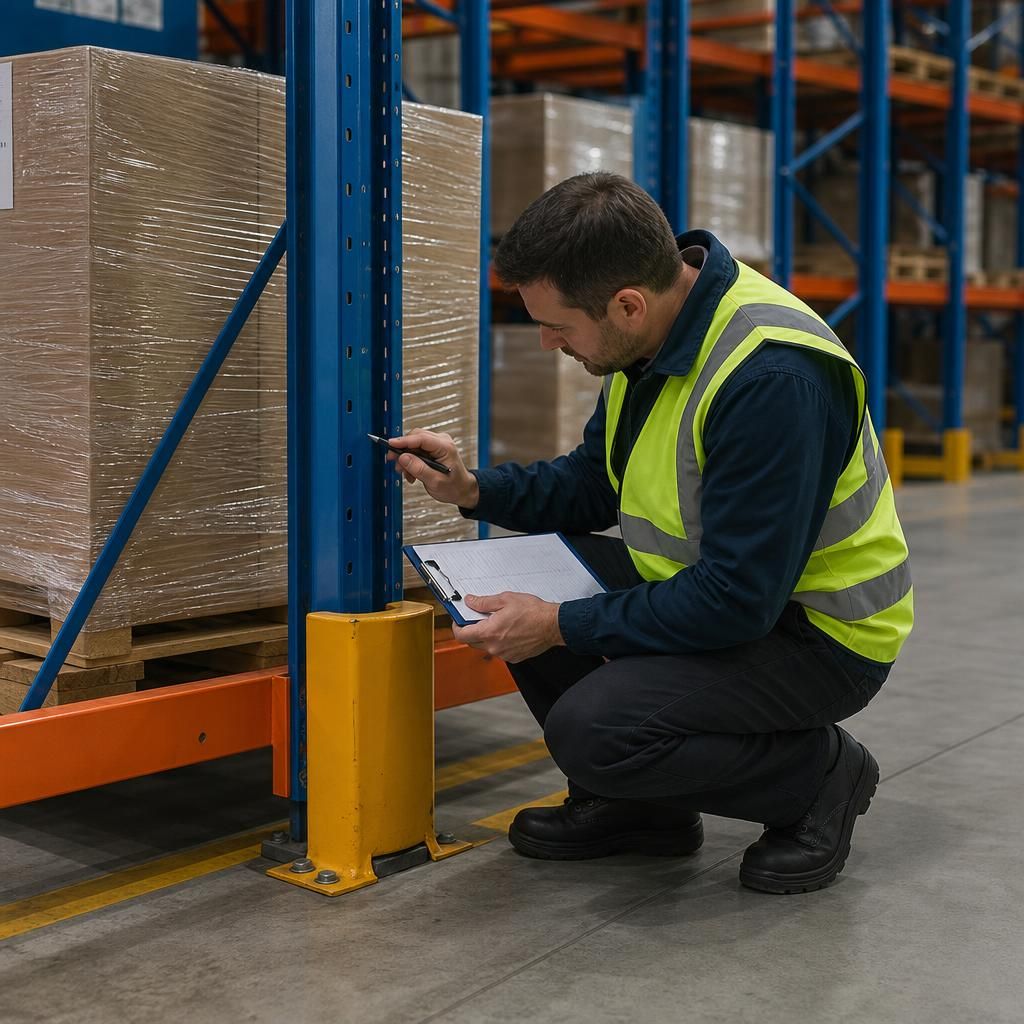
Prompt action after damage is an essential protective measure for maintaining warehouse racking safety. Any bent upright, distorted beam, damaged bracing, displaced component or suspected impact should be reported immediately, even if the installation appears stable.
The affected area may need to be unloaded, isolated and assessed by a competent person before use continues. Repairs should use compatible components and follow the original design requirements; structural members should not be straightened, welded, drilled or modified without suitable technical approval. After the repair, the installation should be checked and formally cleared before it returns to service.
Arrange a warehouse racking safety inspection
Arrange a warehouse racking safety inspection with Able Racking to identify damage, compliance issues and maintenance requirements before they affect safe operation.