
What materials are warehouse racking safety guards made from?
Warehouse racking safety guards are commonly made from steel, impact-resistant polymers, or a combination of materials. Steel provides robust structural protection, while polymer and rubber guards absorb impact and help reduce damage to storage equipment, floors and vehicles.
Warehouse racking safety guards are made from materials selected to absorb, deflect or withstand impact from handling equipment while protecting storage-system components, loads and people. The most common materials are formed steel, impact-resistant polymer, high-density polyethylene (HDPE), polyurethane and rubber. Some guards use a combination of materials, such as a steel core with a polymer outer layer, to provide both structural strength and impact absorption.
Steel is widely used for heavy-duty warehouse racking safety guards, including upright protectors, end-of-aisle barriers, safety rails and column protection. It has high load-bearing capacity and can resist repeated contact from forklifts and other vehicles. Steel barriers are usually manufactured from box section, tubular or formed components and are fixed securely to the floor or another suitable structural surface.
Steel guards are appropriate where there is a significant risk of forceful impact or where a barrier must protect a large area. They can also provide a clear, permanent physical separation between vehicle routes, pedestrian areas and warehouse racking. However, an unprotected steel guard can transfer impact energy directly into the floor or storage structure. Its design, dimensions, fixings and clearance from the warehouse racking therefore need to be assessed rather than selected on material alone.
Impact-resistant polymers are used where the guard needs to absorb energy and reduce the force transmitted to the protected component. Common examples include HDPE and other engineered plastics designed for industrial environments. These materials can deform under impact and return towards their original shape, helping to reduce damage caused by lower-speed contact.
Polymer guards are often used around warehouse racking uprights, corners and other areas exposed to vehicle movements. They are generally lighter than steel, do not corrode and can be easier to handle during installation or replacement. Their performance depends on the grade of material, wall thickness, design, temperature range and method of fixing. A polymer guard should not be assumed to be suitable for every impact risk simply because it is marketed as impact-resistant.
Polyurethane is valued for its combination of flexibility, abrasion resistance and durability. It is commonly found in impact-absorbing protectors, bumpers and profiles. Polyurethane can cushion contact while remaining more resistant to wear than many softer materials. It is useful in busy warehouse areas where guards may experience repeated light impacts, scraping or contact with pallet loads.
Rubber is also used as an impact-absorbing material, particularly for bump strips, buffers and protective edging. It can help reduce noise and cushion contact between vehicles, loads and fixed surfaces. Rubber is flexible and practical for applications where the primary requirement is to soften contact rather than provide a rigid physical barrier. Its suitability can be affected by exposure to oils, cleaning chemicals, ultraviolet light and temperature changes, so the operating environment should be considered.
Composite guards combine materials to balance strength, flexibility and maintenance requirements. For example, a steel element may provide a rigid framework while a polymer or rubber facing absorbs impact. This arrangement can reduce damage to the guard and the warehouse racking, although the complete assembly must be assessed as a system. The quality of the fixings, joints and baseplates is just as important as the visible protective material.
Guard finishes also have a practical purpose. Powder-coated or painted steel can improve visibility and provide protection against general environmental exposure, although damaged coatings may need attention to prevent corrosion. High-visibility colours, contrasting markings and reflective elements can make barriers easier for vehicle operators and pedestrians to identify. These features support safe working practices but do not compensate for inadequate design or poor positioning.
When choosing a material, consider the likely impact energy, vehicle type, traffic direction, available clearance, floor construction, loading pattern and environmental conditions. A guard beside a warehouse racking upright may need a different solution from a barrier at the end of an aisle. The guard must protect the vulnerable component without obstructing access, reducing aisle width unnecessarily or creating a new trip or collision hazard.
Material selection should also take account of inspection and replacement. Steel may show dents, distortion or damaged coatings after impact. Polymer and rubber guards may show splitting, deep gouging, permanent deformation or loosened fixings. Any guard that has moved, cracked, become detached or no longer provides the intended clearance should be isolated from further risk and assessed by a competent person.
The correct material is therefore determined by the site risk assessment and the guard’s intended function, not by appearance or cost alone. A competent inspection can identify the areas most exposed to vehicle impact, check whether existing protection is suitable and confirm that guards are installed without compromising the stability or safe use of the warehouse racking.
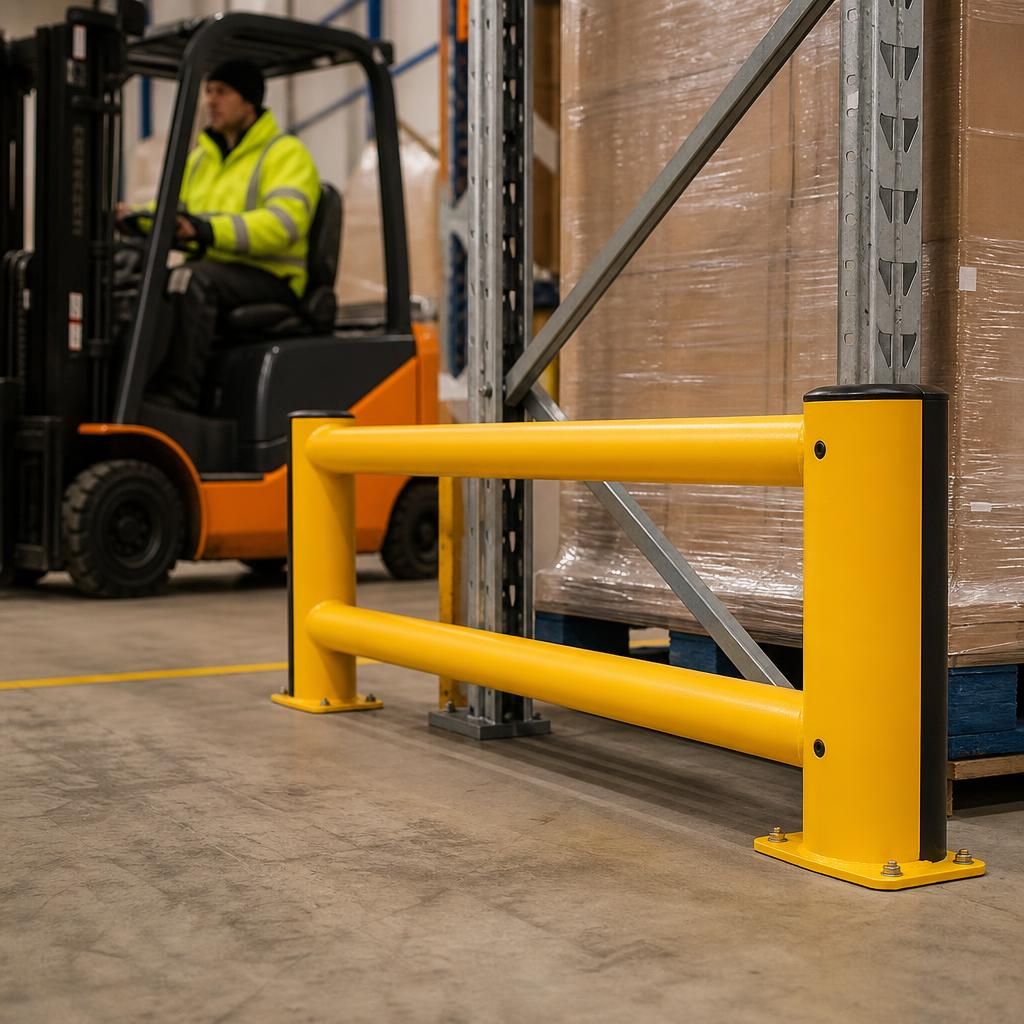
Warehouse racking safety guards are made from materials chosen to absorb, deflect or withstand impact from forklifts, pallet trucks and loads. Steel provides rigid, heavy-duty protection, while HDPE, polyurethane and rubber can absorb contact and reduce the force transferred to warehouse racking uprights and surrounding surfaces.
Material choice should reflect the site’s impact risk and operating conditions. A steel barrier may be suitable at an exposed aisle end, whereas a polymer or rubber protector may be more appropriate around an upright where flexibility, low maintenance and impact absorption are important. Composite guards combine these properties, using a strong internal structure with a softer outer layer. The complete guard, including its fixings and clearance, should be assessed by a competent person rather than judged on material alone.
Arrange an expert warehouse racking safety guard assessment
If you need to confirm whether your warehouse racking safety guards are suitable for the site conditions, arrange an expert warehouse racking safety guard assessment with Able Racking. Our competent team can review impact risks, materials, fixings and clearance, then recommend appropriate action.