
What maintenance is required for warehouse racking safety guards to ensure their effectiveness?
Warehouse racking safety guards should be checked routinely for impact damage, loose fixings, distortion, corrosion and movement, with defects recorded and repaired or replaced promptly. Include them in scheduled warehouse racking inspections, keep them securely fixed and clean, and reassess their condition after any collision, layout change or handling-equipment incident.
Warehouse racking safety guards require routine visual checks, planned maintenance and prompt repair or replacement when they are damaged, loose, distorted, corroded or no longer securely protecting the structure. Effective maintenance keeps guards capable of absorbing or deflecting foreseeable impacts, prevents minor defects from becoming failures and supports safe use of the warehouse racking system.
Maintenance should form part of the site’s wider warehouse racking safety arrangements rather than being treated as a one-off task. The appropriate frequency depends on vehicle movements, traffic routes, loading activity, the type of guard and the likelihood of impact. Guards in busy areas or beside loading and unloading points may need more frequent attention than those in low-traffic locations.
Key maintenance checks include:
- Impact damage: Look for dents, cracks, splits, buckling, sharp edges and other signs that a guard has been struck by handling equipment or falling stock.
- Fixings and connections: Check that anchors, bolts, brackets and other connections remain present, tight and correctly positioned. A guard can appear intact while providing limited protection if its fixings have pulled out or loosened.
- Alignment and stability: Confirm that the guard remains upright, stable and correctly aligned with the part of the warehouse racking it is intended to protect. Movement, tilting or gaps can reduce its effectiveness.
- Corrosion and deterioration: Inspect for rust, coating failure, chemical damage, water ingress and other deterioration. Corroded components may have reduced strength and should be assessed by a competent person.
- Clearance and access: Make sure guards have not been obstructed, repositioned or surrounded by stored goods in a way that prevents them from performing their protective function.
- Cleanliness and visibility: Remove accumulated dirt, shrink wrap and debris where these could conceal damage or interfere with inspection. Warning markings should remain visible and be renewed when they become unclear.
Any defect that could affect protection should be reported and controlled immediately. Where practical, the affected area should be isolated from vehicle traffic or loading activity until a competent person has assessed it. Do not straighten, weld, drill or modify a damaged guard as an informal repair. Unauthorised alterations can weaken the component, affect clearances or invalidate the manufacturer’s installation requirements.
Repairs and replacements should use suitable components and follow the original design, installation instructions and site risk assessment. The replacement guard must be compatible with the warehouse racking layout and the likely impact exposure. Check that new anchors are installed into suitable flooring, that fixings are correctly torqued where required and that the completed installation does not create trip hazards, sharp edges or access problems.
Safety guards should also be reassessed after a collision, a change to vehicle routes, a warehouse racking alteration, relocation of equipment or any incident involving falling or displaced loads. Even when visible damage appears minor, the guard and the adjacent structure may have been affected. A competent warehouse racking inspector can determine whether the guard, its fixings or the protected components require further investigation.
Keep clear maintenance records for identified defects, photographs where useful, temporary controls, repair decisions and completed works. Records should show which guard was checked, what condition was found, who carried out the assessment and whether any follow-up action remains outstanding. This provides an auditable history and helps identify repeated impact locations that may require improved traffic management, revised protection or operator training.
Routine operator checks are useful for identifying obvious damage, but they do not replace formal warehouse racking inspections by a suitably competent person. Planned inspections should consider the guard itself, its fixings, the surrounding structure and the way the area is being used. Findings should be reviewed by the responsible person, with defects prioritised according to their potential effect on people, stock and operations.
Good maintenance is therefore preventative: keep guards securely fixed, clean and visible; investigate movement or impact damage promptly; repair or replace unsuitable components; and review protection whenever the working environment changes. These measures help ensure warehouse racking safety guards continue to provide reliable protection throughout their service life.
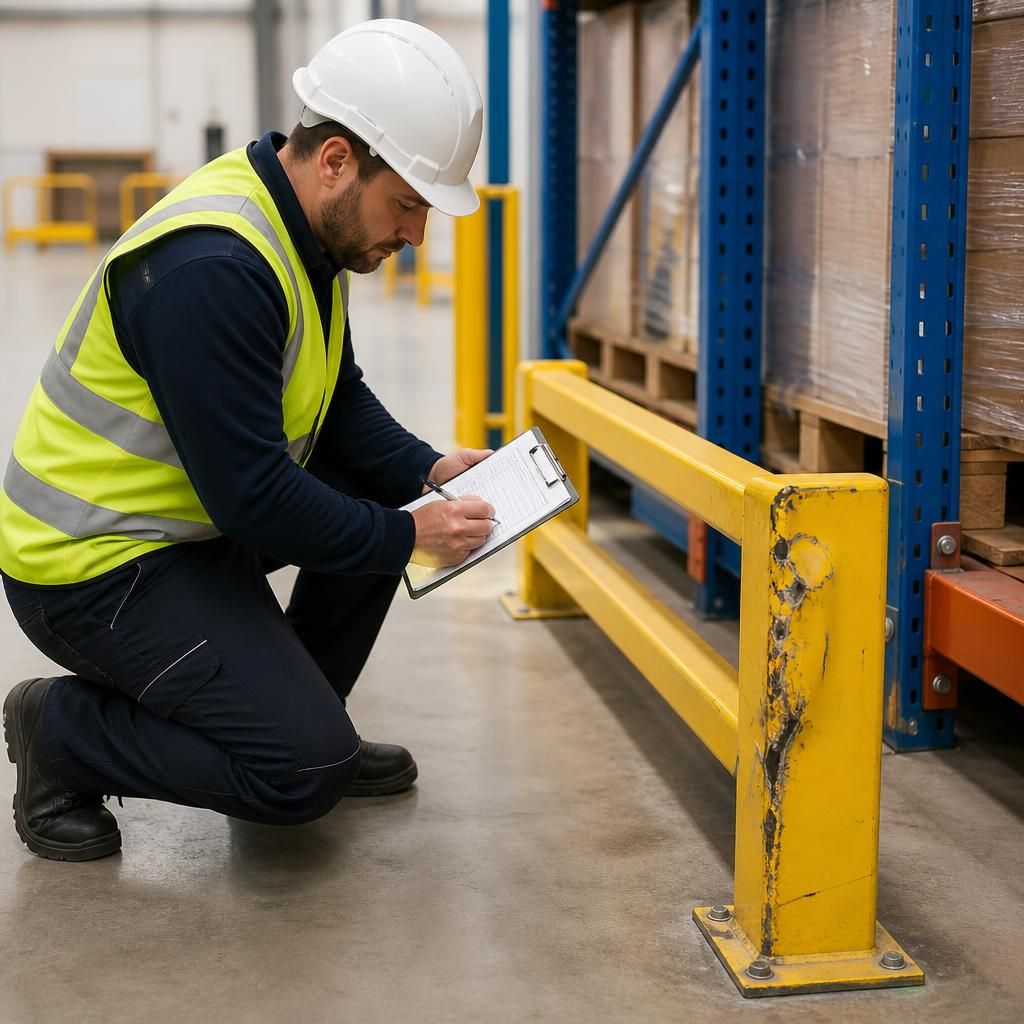
After any collision, warehouse racking safety guards should be taken out of service or isolated until they have been assessed by a competent person. Check the guard, its fixings and the adjacent warehouse racking for dents, distortion, looseness or movement, as visible damage may not show the full extent of the impact.
Do not straighten, weld or alter a damaged guard as an informal repair. Record the defect, complete suitable repairs or replacement in line with the original design, and review the traffic route if repeated impacts occur in the same location.
Arrange a warehouse racking safety guard maintenance assessment
Arrange a warehouse racking safety guard maintenance assessment with Able Racking to identify damage, loose fixings and other defects before protection is compromised. We can advise on suitable repairs, replacement and ongoing inspection requirements.