
What is the role of warehouse racking safety guards in compliance with industry safety standards?
Warehouse racking safety guards support compliance by protecting uprights and other vulnerable components from impact, helping storage systems remain safe and structurally sound. They should be selected, installed and maintained as part of a wider warehouse racking safety programme that includes risk assessment, competent inspections and prompt repair of damage.
Warehouse racking safety guards support compliance by reducing the likelihood and severity of impact damage to uprights, frames and other vulnerable components. They are a physical control within a wider warehouse racking safety system, not a substitute for suitable design, competent inspection, risk assessment, staff training or prompt repair of damaged equipment.
Industry safety standards and guidance generally require employers to identify foreseeable risks, provide suitable work equipment and maintain it in a safe condition. In the UK, this duty is supported by the Health and Safety at Work etc. Act, the Provision and Use of Work Equipment Regulations (PUWER), relevant workplace regulations and HSE guidance such as HSG76 Warehousing and storage. BS EN 15635 also provides widely used guidance for the application and maintenance of steel static storage systems.
These requirements do not mean that every warehouse racking installation must use an identical type of guard. The appropriate protection depends on the layout, vehicle movements, loading method, pallet dimensions, equipment in use and the consequences of a collision. A risk assessment should therefore establish where protection is needed and whether the selected guard is suitable for the foreseeable impact and operating conditions.
How safety guards contribute to compliance
- They control impact risks: Upright guards, end-of-aisle protection and other barriers help separate warehouse racking from forklift trucks, pallet trucks and other mobile equipment. This reduces the chance of direct contact with structural members.
- They help preserve structural capacity: Damage to an upright or frame can affect the load-bearing performance of the system. Guards can help prevent avoidable distortion, dents and abrasion, although they cannot make damaged warehouse racking safe or restore its original capacity.
- They support a safer workplace layout: Correctly positioned protection can define traffic routes, protect exposed corners and reduce the likelihood of vehicles entering areas where contact with warehouse racking is more likely.
- They provide a visible safety control: High-visibility guards can make hazards easier for operators to recognise. Their visibility is useful, but colour alone is not a suitable control where vehicle routes, clearances or operating procedures are inadequate.
- They assist preventative maintenance: A guard that is correctly fitted and routinely checked can help identify recurring collision points, poor traffic management or unsuitable operating practices before more serious damage develops.
What a compliant protection arrangement should consider
Protection should be selected as part of the design and risk assessment for the particular warehouse racking installation. Important considerations include the type and speed of vehicles, turning areas, aisle widths, pedestrian routes, loading activity, floor condition, visibility, the position of corners and ends, and the potential for falling or displaced loads. The guard must also be compatible with the rack design and must not obstruct load placement, inspection access, sprinkler coverage or emergency routes.
Protection should be securely installed in accordance with the manufacturer’s instructions or an appropriately engineered specification. It should not be attached in a way that weakens the upright, prevents normal movement where the system is designed to accommodate it, or transfers an impact force into another vulnerable part of the structure. Where the required protection is unclear, a competent warehouse racking specialist should assess the arrangement rather than relying on a general-purpose product.
Inspection and maintenance requirements
Warehouse racking safety guards form part of the equipment that should be monitored during routine workplace checks and formal warehouse racking inspections. Operators should report impacts and visible defects immediately. A responsible person should also carry out regular visual checks for displacement, cracks, severe deformation, loose fixings, missing components, sharp edges and signs that the guard has been bypassed or removed.
Formal inspections should be completed by a technically competent person at appropriate intervals, with the frequency determined by the risk assessment, operating environment and manufacturer’s guidance. An inspection should consider both the condition of the guards and the warehouse racking behind them. Protection can hide damage, so guards should not be treated as evidence that the protected structure is undamaged.
Where damage is found, the affected area should be controlled immediately. This may involve isolating a location, preventing access, unloading the affected bay where safe to do so, installing a temporary restriction and arranging assessment or repair. Damaged components should not be straightened, welded or altered without an approved repair method. Replacement parts should be suitable for the original system and installed by competent operatives.
Inspection findings, reported impacts, repairs and follow-up actions should be recorded. Clear records demonstrate that risks are being actively managed and help identify repeated incidents. If the same guard is regularly damaged, the underlying cause may be inadequate clearance, poor visibility, unsuitable vehicle routes, insufficient operator training or a loading process that needs review.
What safety guards cannot do
- They cannot compensate for overloaded or incorrectly configured warehouse racking.
- They cannot remove the need for load notices, safe loading procedures or operator training.
- They cannot make a damaged upright, beam or frame safe to use.
- They cannot replace formal inspections by a competent person.
- They cannot justify reducing aisle clearances or ignoring manufacturer requirements.
The most reliable approach is to combine suitable protection with correctly specified warehouse racking, controlled vehicle and pedestrian movement, visible load information, regular housekeeping, competent inspections and timely repairs. Able Racking can help assess impact risks, review existing protection and identify defects that require attention, supporting a documented and preventative warehouse racking safety programme.
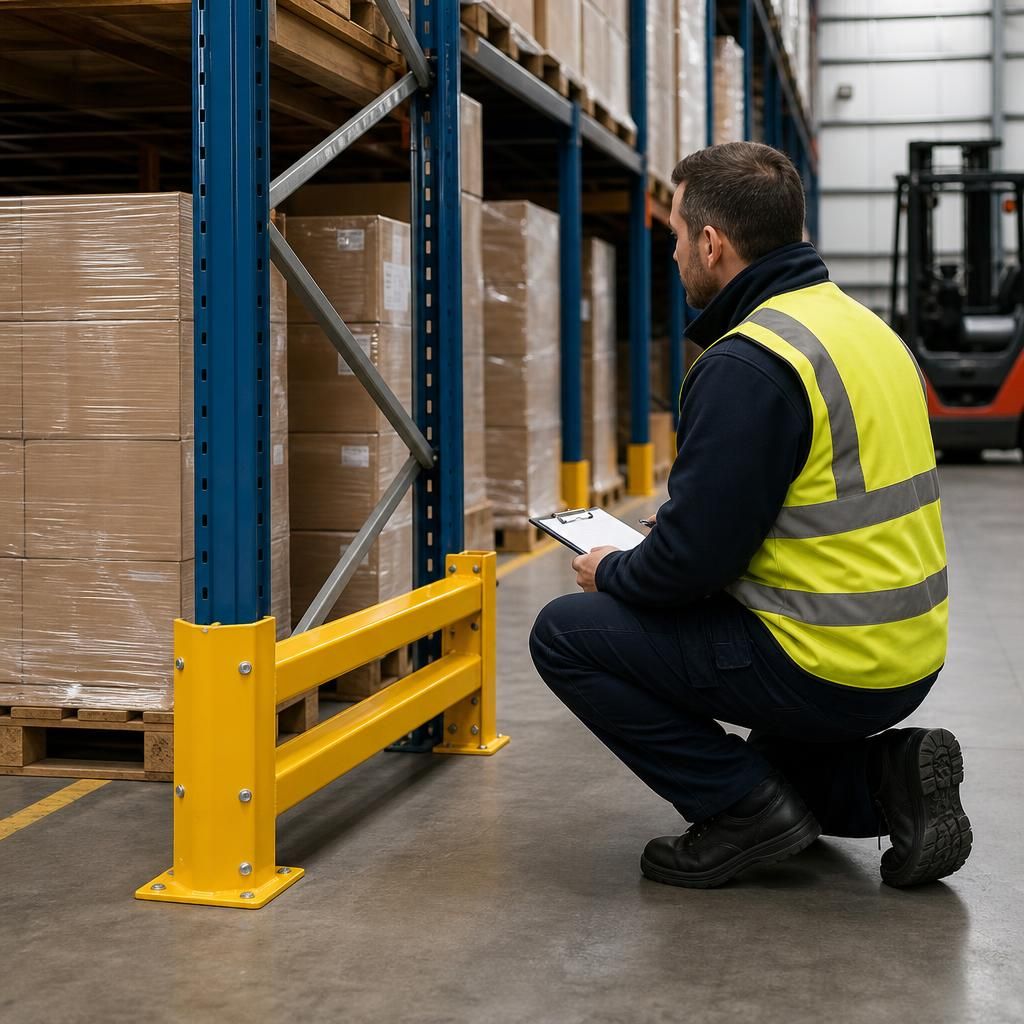
Warehouse racking safety guards support compliance by reducing the risk of impact damage to uprights, frame components and exposed corners. They are a physical protective measure, but they do not replace suitable design, safe operating procedures, competent warehouse racking inspections or prompt repairs.
Protection should be selected following a site-specific risk assessment that considers vehicle movements, aisle clearances, pedestrian routes, loading activity and the likely consequences of a collision. Guards must be securely installed, compatible with the warehouse racking system and checked routinely for displacement, damage or loose fixings. If an impact occurs, inspect the guard and the protected structure before the location is returned to service.
Arrange a warehouse racking safety guard assessment
Arrange a warehouse racking safety guard assessment with Able Racking to review your existing protection, identify impact risks and confirm whether repairs or improvements are required.