
What factors should be considered when choosing warehouse racking safety guards? Choose guards according to the level of impact risk, the type and condition of the storage system, available space, vehicle movements, fixing requirements, durability, visibility and compliance with relevant safety standards.
When choosing warehouse racking safety guards, consider the likely impact risk, the type and condition of the storage system, available space, vehicle movements, fixing requirements, durability, visibility and compatibility with relevant safety standards. The guards should provide suitable protection without obstructing access, reducing capacity or creating additional hazards, and should be easy to inspect and maintain.
Choosing warehouse racking safety guards requires an assessment of the impact risk, the storage system, vehicle movements, available space, fixing method, guard performance and inspection requirements. The most suitable guard is not necessarily the largest or strongest option; it must provide effective protection while allowing safe access, maintaining storage capacity and avoiding new hazards.
Start with a site-specific risk assessment rather than selecting a product based only on appearance or price. Review where damage is most likely to occur, which vehicles operate nearby and how severe a collision could be. Forklift trucks, pallet trucks and other handling equipment may strike uprights, frames, end sections or exposed corners when travelling, turning, positioning loads or reversing.
Consider the following factors when selecting warehouse racking safety guards:
- Impact risk: Assess the frequency, direction and likely force of contact. Areas beside vehicle routes, loading points, junctions and turning spaces may require more substantial protection than locations with limited traffic.
- Parts requiring protection: Identify whether the principal concern is an upright, end frame, corner, barrier line or another vulnerable section. Guards should protect the appropriate component without interfering with beams, pallets, access points or adjustable storage positions.
- Storage system condition: Guards should not be used to conceal existing damage or compensate for an unstable installation. Inspect the warehouse racking first and arrange any necessary repairs, realignment or further assessment before fitting protective equipment.
- Vehicle movements: Map pedestrian routes, vehicle lanes, reversing areas and loading activities. The guard position should reflect the actual path of equipment, including possible overhangs and turning movements rather than only the marked aisle.
- Available space: Check the guard’s overall footprint and clearance requirements. A poorly positioned guard can narrow an aisle, obstruct pallet handling, reduce visibility or create a trip and collision hazard.
- Fixing method: Confirm how the guard is secured and whether the floor, upright or surrounding structure is suitable for that method. Fixings must be installed correctly and should not weaken, drill or alter structural members unless the system designer or a competent specialist has confirmed that this is acceptable.
- Material and construction: Select a material and design that are appropriate for the expected impact, environment and level of use. Steel, polymer and other solutions have different characteristics, including rigidity, energy absorption, corrosion resistance, visibility and ease of replacement.
- Durability and environment: Account for moisture, temperature, cleaning chemicals, outdoor exposure and abrasive warehouse conditions. A guard that deteriorates, becomes brittle or corrodes may provide less reliable protection and become more difficult to inspect.
- Visibility: High-visibility colours, contrasting finishes and suitable positioning can help drivers and pedestrians identify protected areas. Visibility should support, not replace, good traffic management, lighting, training and clearly defined routes.
- Inspection and maintenance: Choose guards that can be checked easily for movement, distortion, cracks, corrosion, loose fixings and other signs of damage. Replacement parts and repair arrangements should also be considered before installation.
- Compatibility: Confirm that the selected guard suits the dimensions, profile and layout of the existing warehouse racking. A universal-looking product may not provide adequate coverage or may obstruct the normal operation of the storage system.
Impact performance should be considered alongside the consequences of damage. Protection around a heavily trafficked end frame may need to withstand repeated contact, whereas a lightly used location may require a different solution. However, no guard should be treated as permission for vehicles to make contact deliberately. Operators should still follow site traffic rules and report every impact or suspected impact.
The guard’s position is as important as its construction. It should cover the vulnerable area without preventing inspection of the upright, obstructing pallet placement or reducing access to safety equipment. Where protection is needed at the end of a run, the arrangement should account for the full exposed area and the approach angle of handling equipment. Additional barriers may be appropriate where a single upright guard cannot adequately separate vehicle routes from the storage system.
Check the installation requirements before ordering. Some products rely on floor anchors, while others use a different fixing arrangement or require specific clearances. The floor condition, services beneath the surface, slab thickness and surrounding layout may affect what can be installed. Fixings should be checked after installation and following any significant impact, as a guard can appear intact while its anchors or supporting surface have been affected.
Compliance should be built into the selection process. Warehouse racking should be designed, installed and maintained in accordance with the manufacturer’s instructions, the relevant technical information and applicable health and safety duties. BS EN 15635 provides guidance on the use and maintenance of steel static storage systems, including the importance of damage reporting and inspection. Safety guards support this process, but they do not remove the need for regular inspections by trained or competent personnel.
Before making a final choice, document the reasons for selecting the guard and record its location. Include the relevant traffic risks, protection required, fixing details, inspection arrangements and any limitations. This information helps warehouse staff understand the purpose of the protection and makes future checks, repairs or changes to the layout more consistent.
After installation, inspect the warehouse racking safety guards as part of routine workplace checks and during formal storage-system inspections. Look for displaced guards, damaged surfaces, loose fixings, corrosion, sharp edges and changes to clearance. Any significant impact should be reported immediately, even where there is no obvious damage. The affected guard and nearby warehouse racking should be assessed before the area returns to normal use.
In practice, the best selection combines competent risk assessment with accurate measurements and an understanding of daily operations. Able Racking can assess the storage layout, traffic movements and condition of the installation, then advise on protection that is suitable for the level of risk and practical to maintain. This helps ensure that warehouse racking safety guards contribute to a safer, compliant and efficient warehouse rather than creating access or inspection problems.
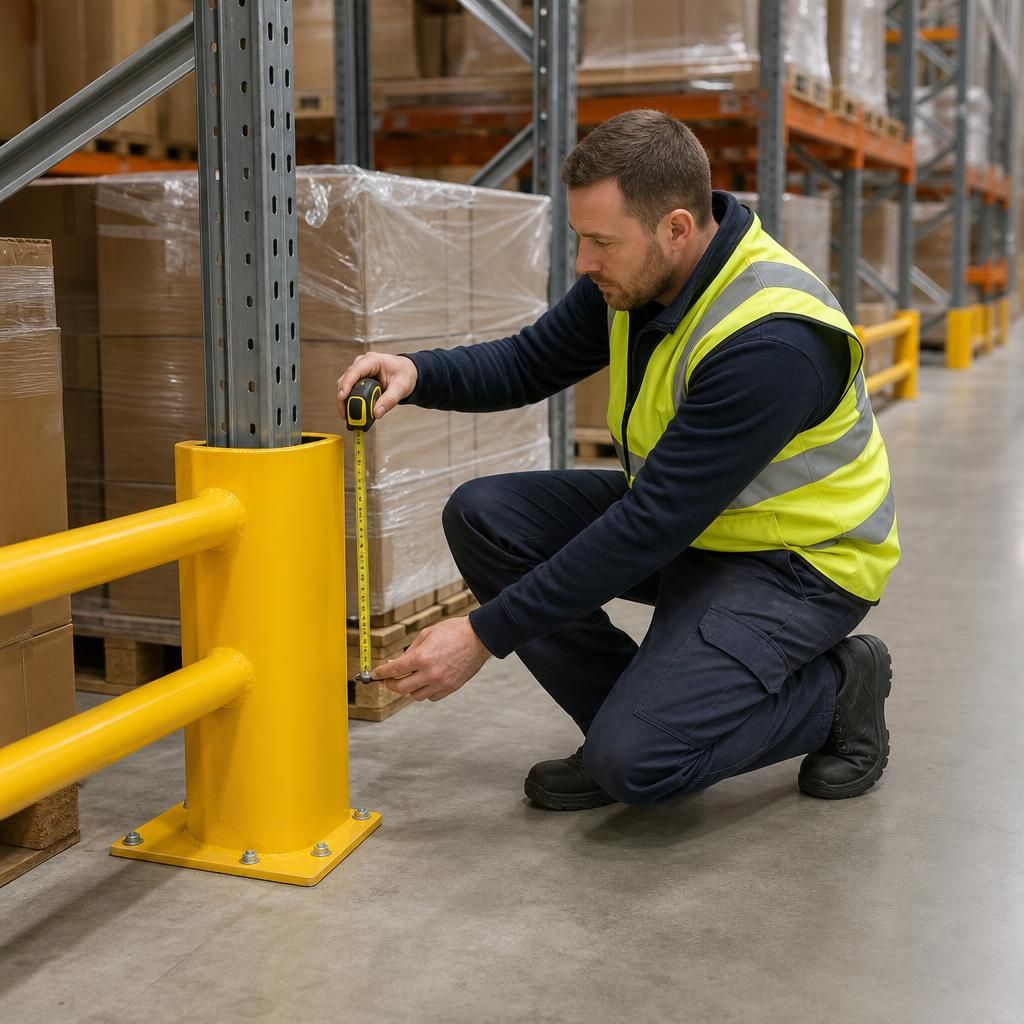
Warehouse racking safety guards should be selected and positioned to protect vulnerable uprights without obstructing pallets, access routes or routine inspections. Accurate measurements are essential: check the upright profile, guard height, aisle clearance, vehicle approach and fixing requirements before installation.
A guard that is too small may leave the exposed section unprotected, while one with an excessive footprint can reduce manoeuvring space or create a new collision hazard. Confirm that the floor and fixings are suitable, and inspect the guard after installation for movement, damage or changes in clearance. Any impact should be reported so the guard and nearby warehouse racking can be assessed by a competent person.
Discuss your warehouse racking safety guard requirements
Discuss your warehouse racking safety guard requirements with Able Racking for practical advice on suitable protection, installation and inspection arrangements.