
What are the benefits of using different types of warehouse racking safety guards? Different warehouse racking safety guards protect uprights, end frames and aisles from vehicle impact, helping reduce damage, repair costs and disruption. Selecting the right guard for each location improves warehouse safety, supports compliance and helps maintain the performance of the storage system.
Different warehouse racking safety guards provide targeted protection for uprights, end frames, aisles and vulnerable loading areas, helping absorb vehicle impacts and prevent damage to storage equipment, stock and buildings. Choosing the appropriate guard for each location can reduce repair costs and operational disruption while supporting safer working practices and ongoing compliance.
Different types of warehouse racking safety guards provide protection in different locations and against different impact risks. Upright protectors help shield vertical frames, end-of-aisle guards protect exposed row ends, and barrier systems create a stronger separation between warehouse racking, vehicles, people and other equipment. Using the right guard in each location can reduce impact damage, limit repair costs, protect stock and support safer, more reliable warehouse operations.
The main benefit is targeted protection. A guard should be selected according to the part of the warehouse racking most at risk, the vehicles operating nearby and the likely direction and severity of contact. A product that is suitable for a frame upright may not provide adequate protection for a busy aisle end or a loading area.
Upright protectors are fitted around individual vertical frames or posts. They are useful where forklifts, reach trucks or pallet trucks operate close to the warehouse racking. Their purpose is to absorb or deflect contact before it reaches the upright, helping reduce dents, deformation and damage to the frame. This can help preserve the alignment and load-carrying performance of the storage system, provided the guard is correctly installed and the frame itself remains undamaged.
Upright protectors can also make vulnerable frame positions easier for operators to identify. High-visibility finishes, where appropriate, help draw attention to the edge of the warehouse racking and may support better vehicle positioning. They are particularly helpful at aisle entrances, transfer points and locations where operating space is restricted.
End-of-aisle guards protect the exposed ends of warehouse racking rows. These areas are vulnerable because turning vehicles can approach from several directions and may swing into the frame when entering or leaving an aisle. End guards typically cover a wider area than a single upright protector, helping protect the end frame, lower bracing and nearby components from side-on or angled impacts.
The benefits of end-of-aisle protection include:
- Reducing the likelihood of damage where vehicles turn or manoeuvre.
- Protecting the most exposed end frame from repeated contact.
- Helping separate vehicle routes from storage locations and pedestrian areas.
- Reducing the chance that a minor impact causes wider disruption to an aisle.
- Making warehouse traffic routes and potential hazards more visible.
Barrier guards provide broader protection than individual post guards. They can be installed along the face or ends of warehouse racking, around loading areas, beside walkways or near equipment that must be kept separate from vehicle movements. Their main benefit is creating a physical boundary that prevents vehicles, pallets or handling equipment from reaching the protected structure.
Barrier systems are valuable where impacts may be more forceful or where there is a consistent risk of vehicles leaving their intended route. They can also help protect pedestrians by defining a clear separation between people and powered handling equipment. The barrier must, however, be positioned so that it does not create a new obstruction, restrict emergency access or reduce the safe width of an operating route.
Corner and column guards protect isolated structural points that may be vulnerable to contact. These guards can be suitable around building columns, exposed corners and other fixed obstructions located close to vehicle routes. Protecting these points can reduce damage to the building as well as to warehouse equipment, helping prevent localised impacts from becoming a wider operational problem.
Flexible or impact-absorbing guards are designed to move, flex or absorb energy when contacted. Their benefit is that they may reduce the force transferred to the warehouse racking or surrounding structure during a low-speed impact. Some designs can return to their original position after contact, reducing the need for immediate replacement after every minor incident. They must still be checked after an impact, as visible recovery does not prove that the guard or its fixings remain serviceable.
Steel guards and heavy-duty protection systems provide a more rigid physical defence in areas exposed to frequent or higher-energy contact. They can be appropriate for busy loading points, aisle ends and locations where vehicles carry heavy loads. Their strength can offer effective protection, but rigid systems need careful design and installation. An incorrectly positioned guard may transfer impact forces into the floor, fixings or warehouse racking rather than absorbing them safely.
Protective guards can deliver several operational benefits when they are correctly specified:
- Lower damage risk: guards help prevent vehicle contact from reaching uprights, frames, building features and other vulnerable components.
- Reduced disruption: limiting damage can help avoid blocked aisles, emergency unloading, temporary access restrictions and unplanned repair work.
- Improved stock protection: keeping frames and loading areas in good condition helps reduce the risk of instability, falling goods and product damage.
- More predictable maintenance: replaceable guards can take the wear associated with minor impacts, allowing damage to be identified and addressed before it affects the main structure.
- Clearer traffic control: barriers and visible protectors help define vehicle routes, protected zones and pedestrian interfaces.
- Support for compliance: physical protection forms part of a broader risk-control programme and can support the requirements of workplace safety procedures and warehouse racking inspections.
The choice of guard should be based on a site assessment rather than appearance or price alone. Consider the layout, aisle widths, vehicle types, travel speeds, load dimensions, turning movements, floor condition, fixing method and the parts of the warehouse racking that are exposed. It is also important to consider whether a guard will obstruct pallets, reduce usable clearance, create a trip hazard or interfere with cleaning and inspection access.
Compatibility is essential. The guard must be suitable for the dimensions and configuration of the warehouse racking and should be installed in accordance with the manufacturer’s instructions. Fixings must be appropriate for the floor and surrounding structure, while the position of the guard should provide protection without compromising the stability or operation of the storage system. Guards should not be treated as a substitute for correct loading, trained operators, suitable vehicle routes or routine inspections.
Following any significant impact, the affected guard and the warehouse racking behind it should be examined by a competent person. Damage may include bent uprights, displaced frames, loosened fixings, cracked floors, damaged bracing or changes in alignment that are not immediately obvious. A damaged guard should not simply be repainted or pushed back into position; it may need repair or replacement, and the protected structure may require further assessment before the location is returned to normal use.
In practice, the most effective arrangement often combines several guard types. Individual upright protectors may be used at vulnerable frame positions, end-of-aisle protection at turning points and barrier systems where people, vehicles or critical equipment need stronger separation. This layered approach provides protection where it is most needed while avoiding unnecessary obstruction throughout the warehouse.
Warehouse racking safety guards therefore provide the greatest benefit when they are matched to the site’s actual risks, installed correctly and included within regular inspection and maintenance procedures. They help protect the storage structure and surrounding workplace, but their effectiveness depends on continued monitoring, prompt action after impact and safe warehouse operating practices.
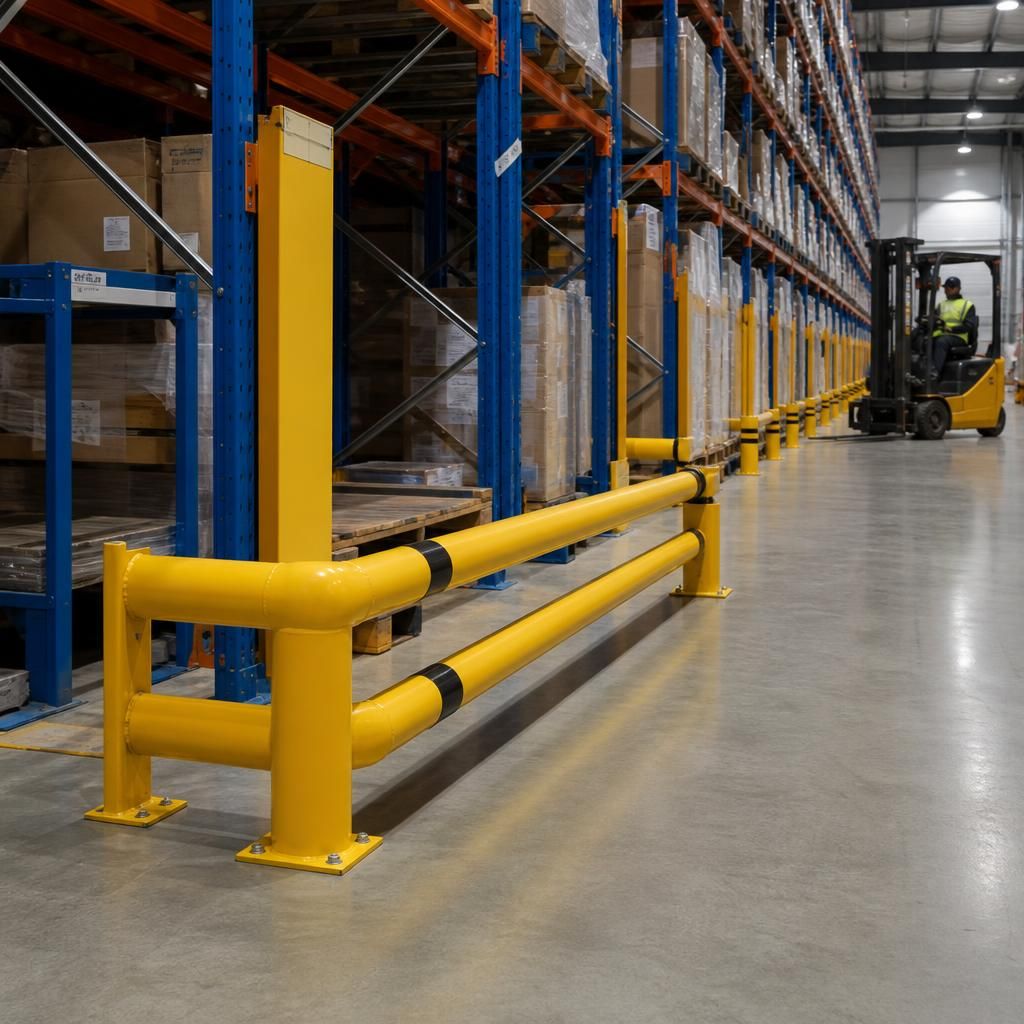
Different warehouse racking safety guards provide protection for different impact risks. Upright protectors suit individual frame posts, end-of-aisle guards protect exposed row ends, and barrier systems create a wider separation between vehicles, pedestrians and vulnerable storage areas.
Matching the guard to the location helps prevent impact forces reaching the warehouse racking, stock or building structure. A suitable combination can reduce damage, limit repair requirements and help keep aisles operational after minor contact. Guards should be selected following a site assessment that considers vehicle movements, turning areas, aisle clearance, load sizes and the likely severity of impact.
Protection remains effective only when guards are correctly installed and checked after contact. Following an impact, both the guard and the warehouse racking behind it should be assessed by a competent person, as damage to uprights, fixings, bracing or floors may not be immediately visible.
Choose the Right Warehouse Racking Safety Guards
Ask Able Racking to assess your warehouse layout, vehicle movements and vulnerable storage areas so the most suitable warehouse racking safety guards can be specified.
Our experienced team can also advise on installation, inspections and any repairs required after an impact.