
How should warehouse racking safety guards be selected to match specific logistics needs?
Warehouse racking safety guards should be selected according to the site’s traffic levels, handling equipment, layout, load risks and the parts of the storage system most exposed to impact. Choose guards that are compatible with the rack design, provide suitable protection without obstructing access, and can be inspected and maintained as part of the warehouse’s safety programme.
Warehouse racking safety guards should be selected by assessing the specific risks around each storage area, rather than applying one guard type throughout the site. Traffic levels, handling equipment, aisle layout, rack configuration, floor conditions, load characteristics and the likely direction of impact should all inform the choice. The selected protection must reduce damage without obstructing access, affecting load placement or preventing proper inspection of the storage system.
Start with a site-specific risk assessment
A suitable selection process begins with a review of how the warehouse operates. This should consider the movement of counterbalance trucks, reach trucks, pallet trucks and other handling equipment, including their turning areas, travel routes and reversing points. Protection is particularly important where vehicles operate close to rack uprights, aisle ends, corners, doorways and areas where loads are transferred between storage and dispatch.
Previous impact damage is also valuable evidence. Bent uprights, scraped paint, damaged baseplates and repeated repairs can show where existing protection is inadequate or where traffic controls need improvement. A guard should address the likely cause of damage, not simply cover the visible defect.
Match the guard to the exposed part of the system
Different parts of a warehouse racking system require different forms of protection:
- Upright protectors: These are designed to shield individual uprights from contact with handling equipment. They should be suitable for the upright profile and installed without interfering with the frame, baseplate or floor fixings.
- End-of-aisle protection: This is appropriate where the ends of runs are exposed to turning vehicles or passing traffic. A continuous barrier may be more suitable than separate upright protectors where the risk extends across several structural points.
- Corner and impact barriers: These can protect vulnerable corners, access points and other locations where vehicle movement is difficult to control.
- Frame and lower-level protection: Where pallets, forks or loads can strike the lower sections of a frame, the guard should protect the area actually exposed while leaving the structure accessible for inspection.
Protection should never be used to conceal damaged components. Any impact damage must be assessed and dealt with in line with the site’s warehouse racking safety procedures before a guard is fitted.
Consider the handling equipment and impact risk
A guard suitable for low-speed pallet truck activity may not provide enough protection in an area used by powered trucks. Consider the vehicle’s size, turning radius, operating speed, fork position, visibility and typical load. A guard that is too light, too low or poorly positioned may offer limited protection against the actual impact risk.
The direction of likely contact is equally important. A barrier designed for a direct frontal impact may not protect against side-swipe damage during turning. In busy areas, protection may need to extend around the end of a run or along a traffic-facing side rather than being installed only on the front face of an upright.
Choose materials according to the environment
Steel guards can provide robust physical protection in demanding industrial areas, but their dimensions and fixing arrangements must be compatible with the storage system and floor. Polymer guards may absorb or deflect certain impacts and can be useful where reducing damage to vehicles or the guard itself is a consideration. Other materials may be appropriate for particular hygiene, corrosion or temperature requirements.
Material choice should take account of moisture, cleaning methods, temperature, chemical exposure and the likelihood of repeated contact. The strongest-looking option is not automatically the most suitable. A guard must perform as part of the complete layout and must not introduce sharp edges, trip hazards or additional obstruction.
Check compatibility with the storage system
Before installation, confirm the guard’s dimensions, fixing method and clearances against the rack manufacturer’s information and the existing layout. It should not prevent the upright from being secured correctly, restrict access to baseplates or alter the designed load path. It must also leave enough clearance for pallets and handling equipment to operate safely.
Where protection is attached to the structure, the effect of the fixing method should be understood. Where floor-fixed barriers are used, the floor condition, anchoring requirements and access to services below the floor should be checked. Any alteration that affects the rack design or its configuration should be reviewed by a competent person.
Protect safety without reducing operational efficiency
Warehouse racking safety guards should not narrow aisles unnecessarily, block fire equipment, obstruct pedestrian routes or make stock locations difficult to reach. Their position should allow operators to see the rack, load and surrounding traffic clearly. In some areas, improving segregation between vehicles and pedestrians may be more effective than adding protection directly to the storage system.
Consider how pallets are placed and removed, whether loads overhang, and whether operators need access for inspection or maintenance. A guard that regularly catches pallets or causes awkward manoeuvres can create a new risk and may be removed or damaged in service.
Include inspection and maintenance in the selection
Select guards that can be checked easily during routine warehouse racking inspections. The condition of the guard, its fixings, floor anchors and surrounding structure should all be visible. Replaceable components can be advantageous where impact is likely, provided replacement parts remain compatible with the original installation.
Routine checks should look for distortion, cracks, loose fixings, movement, corrosion and damage to nearby uprights or floor surfaces. The frequency should reflect the level of activity and the likelihood of impact. Formal inspections should be carried out by a competent person in accordance with the site’s risk assessment and relevant guidance, including the principles set out in BS EN 15635 where applicable.
Use a documented selection process
For each protected area, record the identified hazard, the equipment operating nearby, the guard selected, its fixing arrangement and any limitations. This gives warehouse teams a clear basis for checking that protection remains suitable when the layout, vehicles, loads or working practices change.
A competent assessment should also confirm whether damaged storage components require immediate isolation, unloading, repair or replacement. Guards are an important control measure, but they work best alongside operator training, clearly managed traffic routes, suitable housekeeping and prompt reporting of impacts. Selecting protection in this way provides a practical balance between impact resistance, accessibility, compliance and the continued safe operation of the warehouse racking system.
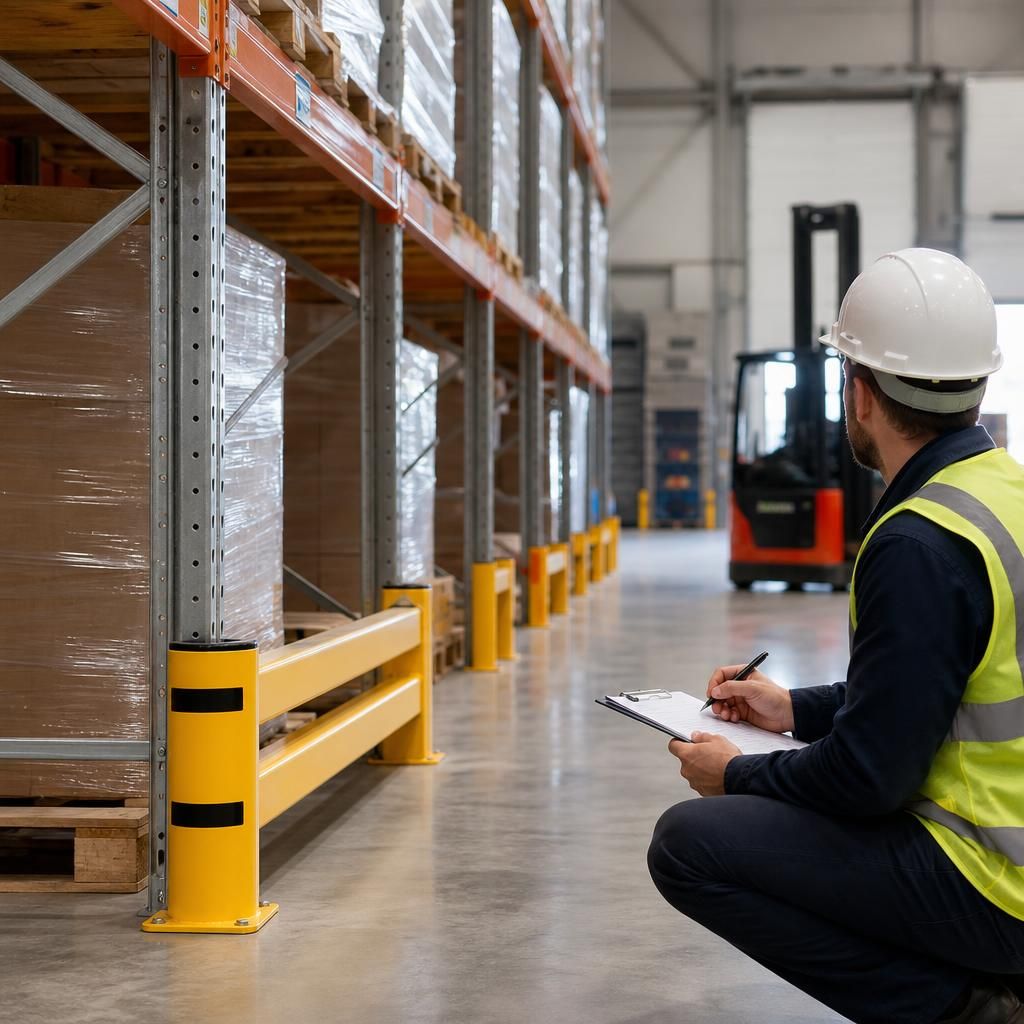
Warehouse racking safety guards should be selected through a site-specific risk assessment, not applied uniformly across every aisle. Review the handling equipment, traffic routes, turning points, rack configuration, load movements and previous impact damage to identify where protection is needed and what type of impact it must withstand.
For example, individual upright protection may suit a low-traffic area, while end-of-aisle barriers may be more appropriate where powered trucks turn close to several uprights. The selected guard must also maintain safe clearances, allow access for inspections, avoid obstructing pallets or pedestrians, and remain compatible with the storage system and floor. Any damaged warehouse racking should be assessed and made safe before a guard is installed, as protection must not conceal structural defects.
Arrange your warehouse racking safety guard assessment
Arrange a warehouse racking safety guard assessment with Able Racking to identify impact risks and select protection suited to your handling equipment, layout and storage system.