
How often should warehouse racking safety guards be inspected and maintained?
Warehouse racking safety guards should be checked visually during routine warehouse inspections and formally assessed by a competent person at intervals based on risk, with a thorough expert inspection at least every 12 months. Repair or replace damaged, loose or displaced guards promptly, and carry out additional checks after impacts, alterations or other events that could affect their protection.
Warehouse racking safety guards should be visually checked as part of routine warehouse inspections, formally assessed by a competent person at intervals determined by risk, and thoroughly inspected by a specialist at least every 12 months. Any guard that is damaged, loose, displaced or no longer providing effective protection should be repaired or replaced promptly. Additional checks are necessary after an impact, layout change, installation work or any other event that could affect the guard’s performance.
The inspection frequency should reflect the conditions in your warehouse rather than relying on a single timetable. Factors to consider include vehicle movements, forklift traffic, the likelihood of pallet or load impacts, the type of guard installed, the condition of the surrounding warehouse racking and the consequences of a failure. Areas exposed to frequent traffic or repeated minor impacts may need more frequent checks than quieter storage locations.
Routine visual checks
Warehouse staff should look at guards during routine housekeeping and safety checks. These checks should identify obvious signs of damage or movement, including:
- Cracks, splits, dents, distortion or other impact damage.
- Loose, missing or damaged fixings.
- Guards that have moved away from their intended position.
- Gaps, breaks or changes that reduce protection around uprights, frames or vulnerable components.
- Sharp edges or damaged surfaces that could injure people or damage loads.
- Signs that a guard is interfering with access, pallet placement or safe vehicle movements.
Routine checks are not a substitute for a competent inspection. They provide an early warning so that defects can be isolated and addressed before they contribute to a more serious incident.
Competent inspections
A competent person should carry out a more detailed assessment at intervals based on the warehouse risk assessment. This inspection should consider whether guards remain correctly positioned, securely fixed and suitable for the foreseeable impact risks. The inspector should also check whether changes to the warehouse racking layout, load arrangements, handling equipment or working practices have altered the level of protection required.
Industry guidance recommends that a thorough examination of warehouse racking safety should be completed by a technically competent person at intervals of no more than 12 months. A shorter interval may be appropriate where the environment is particularly demanding, where previous damage has been recorded or where the risk assessment identifies a need for closer monitoring.
Checks after impact or alteration
A guard should be checked immediately after a known impact, even when the damage appears minor. Impact can loosen fixings, deform the guard or transfer force to the warehouse racking behind it. Damage may therefore not be limited to the visible section of the protection.
Additional inspection is also appropriate after:
- Changes to warehouse racking configuration or aisle arrangements.
- Installation, relocation or removal of safety equipment.
- Changes to forklift routes, loading methods or operating procedures.
- Significant movement of stored loads.
- Any incident, near miss or report of instability.
Where there is doubt about the condition of a guard or the warehouse racking it protects, the affected area should be made safe until it has been assessed. Damaged components should not simply be straightened, drilled or welded on site unless the repair method has been approved by the manufacturer or a suitably qualified specialist.
What maintenance should involve
Maintenance is more than cleaning a guard. It involves keeping the protection securely installed, in the correct position and capable of absorbing or deflecting foreseeable impacts. Depending on the guard type, maintenance may include tightening or replacing approved fixings, replacing damaged components, removing obstructions, restoring protective surfaces and checking that nearby warehouse racking has not been affected.
Replacement parts should be compatible with the original system and installed in accordance with the manufacturer’s instructions. Mixing components without confirming compatibility can reduce the guard’s performance or create new hazards. If a guard has been repeatedly damaged, the underlying cause should also be investigated. Relocating the protection, improving traffic control, changing loading practices or reviewing operator training may be more effective than repeatedly replacing the same component.
Records and follow-up
Inspection findings should be recorded clearly, including the location, condition of the guard, severity of any defect, action required and date of completion. Photographs and marked-up warehouse layouts can help identify recurring problem areas. Defects should be prioritised according to risk, with serious damage dealt with immediately and lower-risk issues monitored until permanent corrective work is completed.
Inspection records support the warehouse’s safety management system and provide evidence that protective equipment is being monitored. They also help identify patterns, such as repeated impacts in a particular aisle or damage associated with a specific handling activity. These findings should feed back into the risk assessment and the site’s preventative maintenance programme.
A practical arrangement is to combine routine visual checks by trained warehouse staff, scheduled competent-person inspections and a specialist examination at least annually. The exact frequency should be documented in the risk assessment and reviewed whenever operating conditions change. This approach helps keep warehouse racking safety guards effective, reduces avoidable damage and supports continued compliance with workplace safety duties.
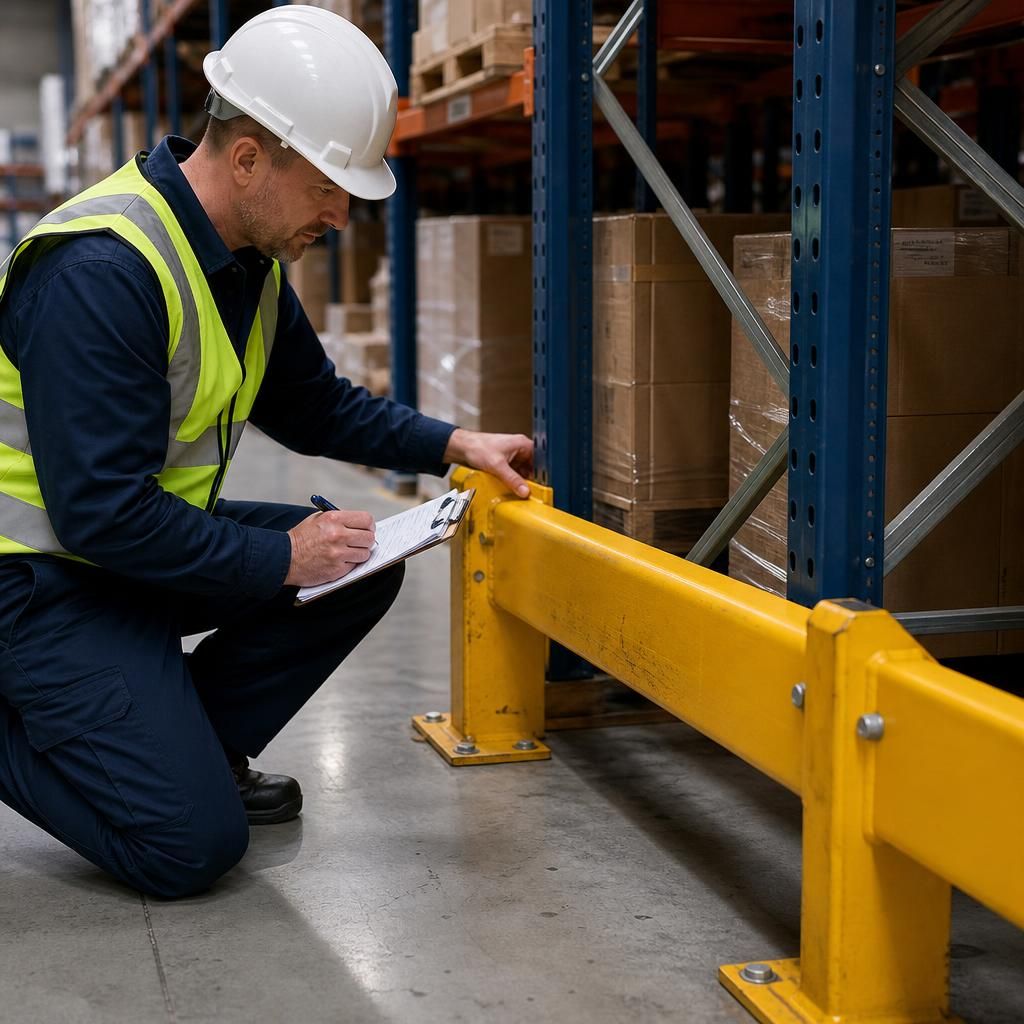
The most important additional inspection of warehouse racking safety guards is the check carried out immediately after an impact. Even when a guard appears only slightly marked, the force may have loosened its fixings, moved it out of position or affected the warehouse racking it is intended to protect.
Isolate the affected area and assess the guard before allowing normal operations to continue. Check for cracks, distortion, loose fixings, sharp edges and gaps in protection. If the guard or nearby warehouse racking is damaged, it should be repaired or replaced using compatible components in line with the manufacturer’s instructions. The impact should also be recorded and reviewed to determine whether vehicle routes, loading practices or operator controls need to be improved.
Arrange a warehouse racking safety guard inspection
Arrange a warehouse racking safety guard inspection with Able Racking to identify damage, confirm effective protection and prioritise any required repairs.