
How do warehouse racking safety guards enhance operational efficiency? Warehouse racking safety guards improve efficiency by protecting upright frames and other vulnerable areas from vehicle impact, reducing damage, disruption, stock loss and unplanned repair work. Properly selected and maintained guards help keep warehouse operations safe, organised and productive.
Warehouse racking safety guards enhance operational efficiency by protecting upright frames and other vulnerable areas from vehicle impact, helping to reduce damage, stock loss, disruption and unplanned repair work. Correctly selected and maintained guards support safer traffic flow, protect storage capacity and help keep warehouse operations productive.
Warehouse racking safety guards enhance operational efficiency by protecting upright frames, end frames and other exposed parts of a storage system from impacts involving forklifts, pallet trucks and other handling equipment. By limiting damage, they help reduce disruption, protect stored goods, preserve usable storage capacity and support a more predictable warehouse workflow.
Efficiency is not simply a matter of moving pallets quickly. It also depends on preventing avoidable interruptions and keeping storage equipment in a safe, serviceable condition. A damaged upright or frame can require an area to be isolated, stock to be relocated and repairs to be arranged. Appropriate guards provide a physical barrier between likely impact points and moving vehicles, reducing the likelihood that routine handling incidents will develop into wider operational problems.
They reduce damage and unplanned downtime
Warehouse traffic is most likely to contact racking at aisle ends, corners, access points and locations where vehicles turn or position loads. Guards absorb, deflect or withstand some of the force created by these low-level impacts, depending on their design, material, installation and the severity of the collision.
This protection can help to:
- Reduce dents, distortion and abrasion to upright frames and other vulnerable components.
- Limit the need for emergency unloading, isolation and repair work.
- Keep affected aisles available for normal operations where the equipment remains safe to use.
- Reduce interruptions caused by moving stock away from damaged areas.
- Make damage easier to identify during routine inspections.
Safety guards do not make a storage system impact-proof. Any significant contact should still be reported and assessed by a competent person. A guard may be damaged while the protected component appears unaffected, or the force of an impact may have transferred beyond the protected area. Prompt reporting and inspection remain essential.
They support safer and more consistent traffic flow
Clearly protected corners and aisle ends help define the boundary between vehicle routes and storage equipment. This can make the warehouse layout easier for operators to read, particularly in busy areas where vehicles, pedestrians and loads share working space.
When guards are correctly positioned, securely fixed and suitable for the traffic conditions, they can help operators judge clearance and approach storage locations more consistently. This supports controlled manoeuvring and reduces the likelihood of repeated contact with the same part of the warehouse. Guards should not, however, be used to compensate for inadequate aisle widths, poor visibility, unsuitable vehicle selection or ineffective traffic management.
Operational efficiency is improved when protection is considered alongside:
- Defined vehicle and pedestrian routes.
- Suitable speed controls and site rules.
- Good lighting and clear visibility at junctions.
- Appropriate training for forklift and handling-equipment operators.
- Clear access to storage locations and emergency routes.
- Regular housekeeping to prevent pallets, packaging and debris obstructing movement.
They help protect stock and storage capacity
Damage to racking can affect the position, stability or safe loading of pallets. Even where no immediate collapse occurs, a distorted component may require a bay to be taken out of service until it has been assessed. This can reduce available storage locations and create additional handling because stock must be placed elsewhere.
By helping to protect the structure around storage locations, guards support the continued use of planned capacity. They also help reduce the risk of damaged pallets, falling goods and product loss caused by contact with the storage system. Guards should be selected and installed so that they do not obstruct beam connections, reduce required clearances or create new loading and handling problems.
They make preventative maintenance more effective
Well-maintained guards provide a visible first line of protection, while inspections identify whether that protection remains effective. During a warehouse racking inspection, the condition of guards should be considered together with the condition of the protected uprights, frames, beams, fixings, floor connections and surrounding operating area.
Inspection and maintenance should check for:
- Cracks, splits, bending, severe wear or other damage to the guard.
- Loose, missing or damaged fixings and anchors.
- Movement, poor alignment or inadequate contact with the floor.
- Corrosion or deterioration that could affect performance.
- Obstructions that prevent the guard from protecting the intended area.
- Evidence that an impact has reached or affected the racking behind the guard.
Damaged guards should be reported and dealt with promptly. Depending on the findings, the appropriate action may include replacing the guard, securing it correctly, removing an obstruction or arranging a more detailed assessment of the storage system. Painting over damage or returning a visibly affected area to service without assessment can conceal a developing safety issue and lead to greater disruption later.
They reduce avoidable repair and handling costs
Preventing damage is generally more efficient than responding to repeated impacts after they occur. A suitable guard can reduce the frequency or severity of repairs to expensive structural components, while a consistent inspection process helps identify minor defects before they become more difficult to manage.
The wider operational benefit comes from avoiding secondary work. A single impact may otherwise involve isolating an aisle, unloading affected locations, finding temporary storage, arranging replacement parts, completing repairs and checking the area before use resumes. The exact response depends on the damage and the site risk assessment, but effective protection can reduce the chance of this chain of disruption.
They improve the reliability of warehouse processes
Reliable storage equipment helps warehouse teams plan receiving, put-away, replenishment, picking and despatch with fewer unexpected changes. When storage locations remain accessible and the layout is not repeatedly altered because of damage, operators can work to established procedures and stock movements are easier to control.
This is particularly important in areas with frequent vehicle movements, narrow turning spaces, high pallet throughput or limited alternative storage. In these locations, protection should be based on observed risks rather than applied as a standard item without assessment. End-of-aisle protection, upright guards, corner protection and barrier systems each serve different purposes and must be positioned so they protect the likely impact zone without interfering with normal handling.
Correct selection is essential to achieving the benefit
A guard improves efficiency only when it is compatible with the warehouse environment and the storage system. Selection should take account of the type of handling equipment, impact risks, traffic routes, floor condition, available clearances, load-handling practices and the dimensions of the racking components.
Important considerations include:
- Whether the guard is intended for an upright, an end frame, an aisle end or another exposed location.
- How the material and construction are expected to respond to common impacts.
- Whether the fixing method is suitable for the floor and installation conditions.
- Whether the guard can be inspected, cleaned and replaced without unnecessary disruption.
- Whether its dimensions preserve access, visibility and required operating clearances.
- Whether the design creates trip hazards, sharp edges or points where pallets can snag.
Installing a guard in the wrong position can restrict access, encourage poor vehicle approaches or leave the actual impact area unprotected. A site assessment and competent installation help ensure that protection supports, rather than obstructs, warehouse operations.
They work as part of a wider safety system
Safety guards are one control measure within a broader warehouse racking safety programme. They should be supported by suitable system design, operator training, clear reporting procedures, planned inspections and prompt corrective action. Routine visual checks by warehouse staff can identify obvious damage, while scheduled inspections by a competent person provide a more detailed review of the storage system and its use.
Records of impacts, defects, repairs and replacements can also reveal recurring problem areas. If the same guard is repeatedly struck, the underlying cause may be an unsuitable route, poor visibility, inadequate clearance, a damaged floor surface or a handling practice that needs to change. Addressing that cause is more effective than repeatedly replacing the guard alone.
In practice, warehouse racking safety guards enhance efficiency by preventing minor vehicle contact from becoming major structural damage, protecting stock and storage availability, and supporting orderly traffic movement. Their effectiveness depends on appropriate design, correct installation, regular inspection and prompt action after any impact. Used as part of a preventative warehouse racking safety process, they help maintain safe, reliable and productive operations.
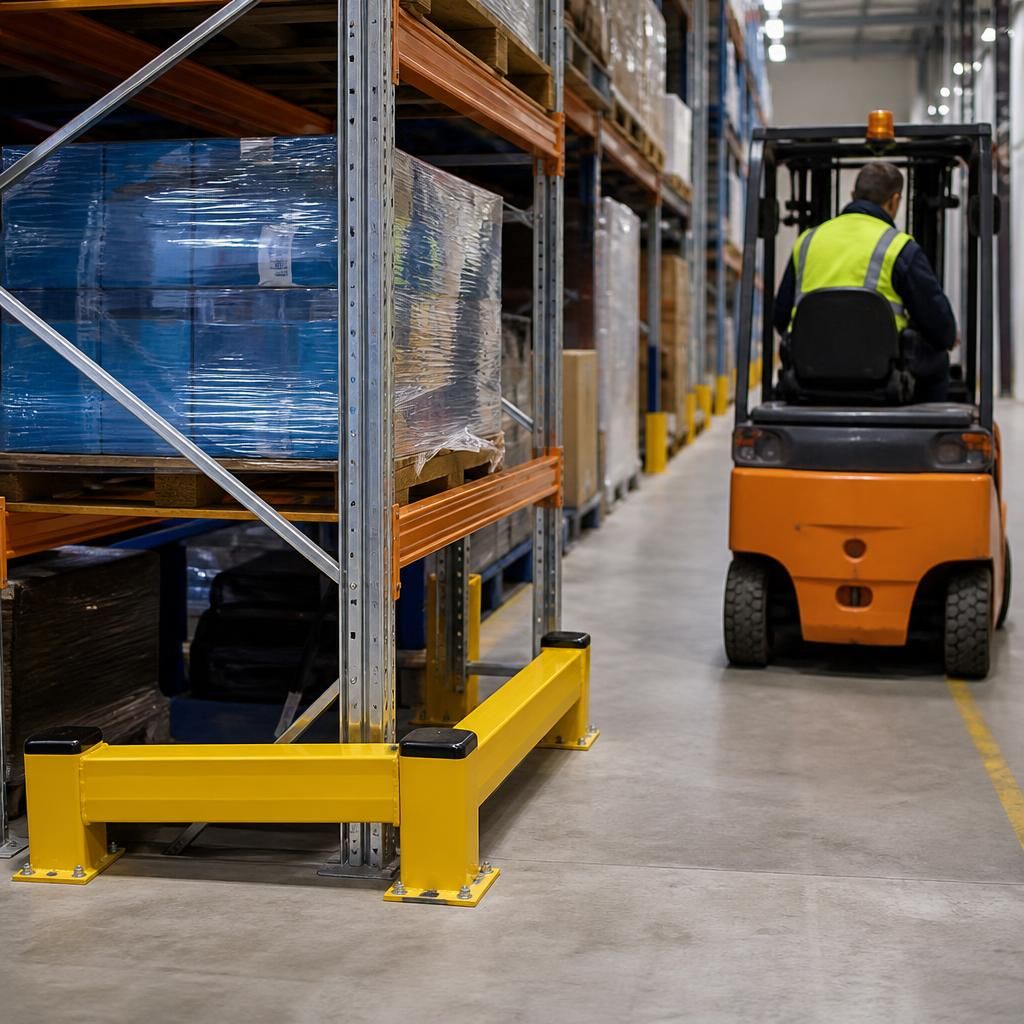
Warehouse racking safety guards improve operational efficiency by reducing the likelihood that vehicle impacts will damage upright frames, end frames and other exposed components. By protecting these vulnerable areas, they can help keep storage locations available and reduce interruptions caused by isolating damaged bays, relocating stock or arranging urgent repairs.
The benefit depends on more than fitting a guard. It must be suitable for the likely impact risk, correctly positioned and securely installed without restricting access or visibility. Guards should also be checked during routine warehouse racking inspections for movement, wear, damaged fixings and signs that an impact has reached the protected structure. Prompt reporting and corrective action help maintain safe, reliable storage operations.
Book a Warehouse Racking Safety Guard Assessment
Book a warehouse racking safety guard assessment with Able Racking to identify vulnerable impact areas and confirm that existing protection is correctly selected, installed and maintained.