
What role do safety accessories play in the prevention of damage to warehouse racking systems and how can they be effectively utilised?
Safety accessories help prevent impact, overload and instability from damaging warehouse racking by protecting vulnerable uprights, improving load security and making hazards more visible. They should be selected for the specific storage layout, installed correctly, checked during routine inspections and replaced promptly if damaged.
Safety accessories prevent damage to warehouse racking systems by absorbing or deflecting impacts, controlling loads, improving visibility and reducing the likelihood of incorrect use. When selected for the layout and risk profile of the warehouse, correctly installed and included in routine inspections, they help protect uprights, beams, pallets and surrounding work areas from avoidable damage.
How safety accessories prevent damage
Warehouse racking is vulnerable to contact from lift trucks, pallet trucks, handling equipment and poorly positioned loads. Even a relatively minor impact can deform an upright, loosen a connection or reduce the system’s capacity. Accessories provide an additional layer of protection by separating vulnerable structural components from common sources of damage and by making hazards easier for operators to see.
- Upright protectors help shield the lower sections of frames from vehicle impact. They are particularly important at aisle ends, corners and locations where handling equipment changes direction.
- End-of-aisle barriers protect exposed frame ends and help prevent vehicles or loads from travelling beyond the intended operating area.
- Guide rails and floor barriers establish a clear path for handling equipment and can reduce the risk of contact with the racking structure.
- Back protection and pallet supports help prevent pallets, cartons or loose goods from being pushed through the rear of a bay or falling into an adjoining aisle.
- Load notices and identification labels communicate safe working loads, bay references and operating requirements, helping warehouse teams avoid overloading or placing goods incorrectly.
- Safety mesh and containment panels help retain smaller items where there is a risk of goods falling from stored positions.
- Column and corner guards improve visibility and provide additional protection at particularly exposed points.
Choosing the right protection
Protection should be based on a documented assessment of how the warehouse operates rather than installed as a standard package. Consider the type of handling equipment in use, vehicle speeds, aisle width, traffic direction, turning points, pallet dimensions, load weights, storage heights and the consequences of a potential impact.
Review the complete layout, including frame ends, corners, loading areas, crossing points, dispatch zones and locations where pedestrians and vehicles work close together. A protector that is suitable in one area may be unsuitable elsewhere if it restricts access, interferes with pallets or creates a new trip or obstruction risk. Accessories must also be compatible with the particular warehouse racking design and securely fixed in accordance with the manufacturer’s instructions.
Protection should not be used to justify tighter manoeuvring spaces or poor operating practices. Where impacts are frequent, investigate the underlying cause. The solution may require improved traffic management, clearer floor markings, revised storage arrangements, operator training or changes to the handling process as well as physical protection.
Effective installation and utilisation
- Survey the working environment. Identify impact points, pedestrian routes, blind corners, loading and unloading areas, and any locations where goods could fall or be displaced.
- Specify suitable equipment. Select accessories with the appropriate dimensions, strength, visibility and fixing method for the warehouse racking and the expected hazards.
- Install without compromising the structure. Follow the supplier’s instructions and ensure fixings do not damage structural members or obstruct beam connectors, bracing, pallets or access points.
- Make protection visible. High-visibility finishes, clear labels and suitable lighting help operators recognise frame ends, barriers and restricted areas.
- Keep access clear. Do not allow stock, packaging or equipment to build up around protectors, barriers or emergency routes. Obstructions can reduce the effectiveness of the protection and introduce additional hazards.
- Explain the purpose to employees. Operators should understand traffic routes, safe loading methods, load limits and the requirement to report contact or damage immediately.
- Review performance. Check whether impacts continue to occur and whether the accessory remains appropriate as vehicles, loads, layout or working methods change.
Inspection and maintenance requirements
Safety accessories are not maintenance-free. Include them in routine warehouse racking inspections and in daily or shift-based visual checks where the risk justifies this. Look for dents, cracks, distortion, loose fixings, missing components, corrosion, damaged mesh, faded markings and movement from the intended position. Check that barriers remain anchored, protectors have not been pushed against structural members and labels remain legible.
Any impact should be reported, even when the accessory appears to have absorbed the contact. Inspect the accessory and the protected warehouse racking frame, beam, bracing and connections for signs of damage. A protector can conceal deformation, so it should not simply be reset or painted over without assessing the underlying structure.
Damaged accessories should be isolated or replaced promptly, using compatible components. Do not straighten, weld, drill or modify a damaged protective component unless this has been specifically assessed and authorised by a competent person. Temporary repairs can alter how an accessory absorbs impact and may create further risks.
Using accessories alongside safe procedures
Physical protection works best as part of a wider warehouse racking safety system. Maintain clear vehicle and pedestrian routes, enforce suitable speed controls, keep pallets in good condition and train operators to approach bays squarely. Loads should be stable, within the stated safe working limits and positioned so that they do not project into aisles or contact adjacent components.
Load notices should match the current configuration. If beam levels, bay arrangements or stored loads change, review the notices and obtain appropriate technical advice before putting the revised layout into service. Do not assume that an accessory increases the load capacity of the warehouse racking; its purpose is generally to reduce the likelihood or severity of accidental damage, not to strengthen the storage system.
Regular inspections remain essential because accessories cannot prevent every cause of damage. They do not correct overloading, poor pallet placement, unauthorised alterations, inadequate clearances or deterioration caused by age and operating conditions. A competent inspection should assess the complete system and identify whether protection remains effective for the way the warehouse is actually being used.
Practical approach for warehouse operators
Maintain a simple record of installed accessories, their locations, inspection findings, reported impacts and replacement actions. This makes recurring problem areas easier to identify and supports preventative decisions. Where the same barrier or upright protector is repeatedly damaged, consider changing the traffic route, improving visibility or separating vehicles from the exposed area instead of repeatedly replacing the component.
Safety accessories are therefore most effective when they are risk-assessed, compatible, correctly positioned and actively maintained. Used with competent warehouse racking inspections, sound operating procedures and prompt repair of any damage, they help reduce impact-related failures, protect stored goods and support a safer, more reliable warehouse.
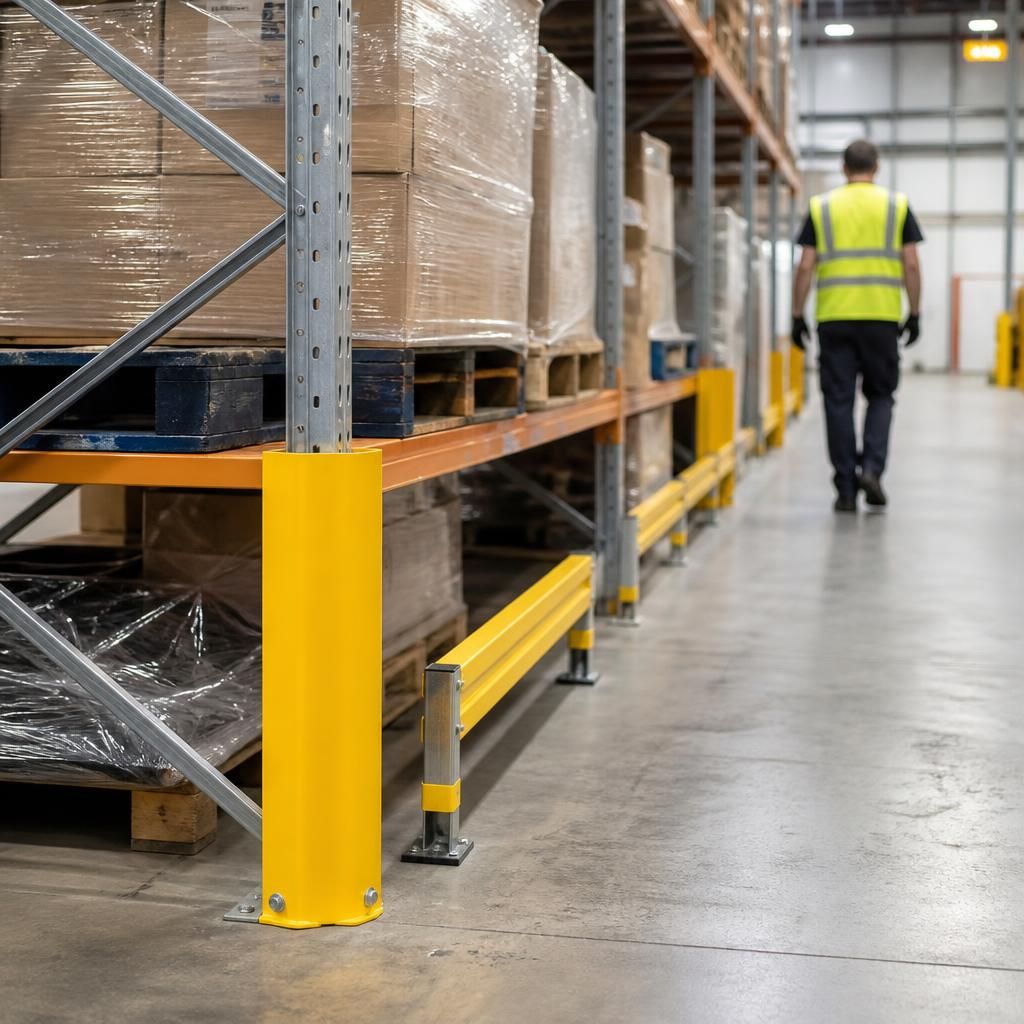
Safety accessories help prevent damage to warehouse racking by absorbing or deflecting impacts, controlling vehicle movement and retaining loads. Upright protectors, end-of-aisle barriers, guide rails, back protection and safety mesh should be selected for the specific layout, handling equipment and storage risks.
They must be securely installed, kept visible and included in routine checks. After any impact, inspect both the accessory and the protected warehouse racking for distortion, loose fixings or other damage. Replace damaged components promptly and investigate recurring impacts, as changes to traffic routes, visibility or operator procedures may be needed alongside physical protection.
Arrange a warehouse racking safety assessment
Arrange a warehouse racking safety assessment with Able Racking to identify vulnerable areas, review existing protection and address damage risks before they affect your operations.