
What is the importance of regular warehouse racking inspections?
Regular warehouse racking inspections identify damage, instability and other safety risks before they lead to product loss, equipment damage or injury. They also help businesses meet UK workplace safety duties, maintain structural integrity and plan necessary repairs or preventative maintenance.
Regular warehouse racking inspections are important because they identify damage, instability and unsafe conditions before they cause a collapse, injury, stock loss or operational disruption. Inspections also provide evidence that the warehouse racking system is being managed in line with UK workplace safety duties and the manufacturer’s requirements.
Warehouse racking can deteriorate without an obvious warning. Forklift impacts, overloading, poorly positioned pallets, missing components, building movement and general wear can all affect the system’s structural integrity. A component may appear serviceable while still being bent, displaced or weakened. Regular inspections provide a consistent method for finding these issues and deciding what action is needed.
Inspections help protect employees and visitors. Damaged warehouse racking can create falling-object hazards, obstruct aisles or become unstable during loading and unloading. Identifying defects early allows the business to isolate an unsafe area, remove affected stock and arrange suitable repairs before people are exposed to unnecessary risk.
They support compliance with UK safety requirements. Employers must maintain work equipment and take reasonably practicable steps to protect people affected by their operations. Warehouse racking should be inspected as part of the site’s wider risk-management arrangements, with the frequency based on factors such as usage, impact risk, loading patterns, the working environment and any history of damage. HSE guidance recommends regular visual checks and a more detailed inspection by a technically competent person at intervals appropriate to the risk, with the expert inspection taking place at least every twelve months unless a different risk-based arrangement is justified.
A suitable inspection normally considers:
- uprights, frames, beams, braces, connectors and baseplates;
- impact damage, bending, twisting, cracking, corrosion or other visible deterioration;
- loose, missing or incorrectly fitted components;
- anchors, floor fixings, shims and the condition of the supporting floor;
- beam levels, deflection, alignment and signs that loads are not being supported correctly;
- load notices, safe working loads and whether the warehouse racking configuration matches the approved design;
- pallet condition, load placement, aisle clearance and evidence of overloading;
- protection systems and any previous repairs; and
- changes to the warehouse layout, traffic routes or working practices that may introduce new risks.
Inspections are most effective when they lead to clear action. Findings should be recorded in a formal report, with each defect assessed according to its seriousness. A serious risk may require the affected warehouse racking to be unloaded and taken out of service immediately. Less urgent defects should still be assigned to a responsible person, given a suitable completion date and checked after repair. Simply recording damage without controlling the risk does not make the system safe.
Warehouse operators should also carry out routine visual checks between formal inspections. Employees and forklift operators are often best placed to report new impact damage, unusual movement, missing safety components or changes in loading conditions. They should know how to report concerns and understand that damaged warehouse racking must not be used until it has been assessed by a competent person.
Regular inspections also help prevent avoidable costs. Early repair is generally more manageable than responding to a major failure. Prompt attention can reduce stock damage, equipment downtime, emergency repair work and disruption to picking and dispatch operations. Inspection records can also reveal repeated impact locations or recurring loading problems, allowing the business to improve traffic management, operator training, load controls or protective measures.
A competent inspection should be completed by someone with suitable knowledge, training and experience of warehouse racking systems. The inspection process should be impartial and based on the system’s design information, safe working loads, manufacturer guidance and the conditions found on site. Where damage or uncertainty is identified, the correct response may involve unloading the affected area, obtaining technical advice or arranging a repair using compatible components and an approved method.
For an effective inspection programme:
- Set inspection frequencies through a documented risk assessment.
- Carry out routine visual checks and record reported damage.
- Arrange periodic inspections by a competent warehouse racking specialist.
- Keep current layout drawings, load information and previous inspection reports available.
- Use a consistent defect classification and escalation process.
- Prevent use of unsafe areas until corrective action has been completed.
- Review recurring defects to identify underlying causes rather than repeatedly treating the symptoms.
In practice, regular warehouse racking inspections are not just a compliance exercise. They are a preventative control that confirms whether the system remains suitable for the loads, equipment and working conditions in the warehouse. A structured programme gives site managers a reliable basis for maintenance decisions, safer working practices and timely repairs.
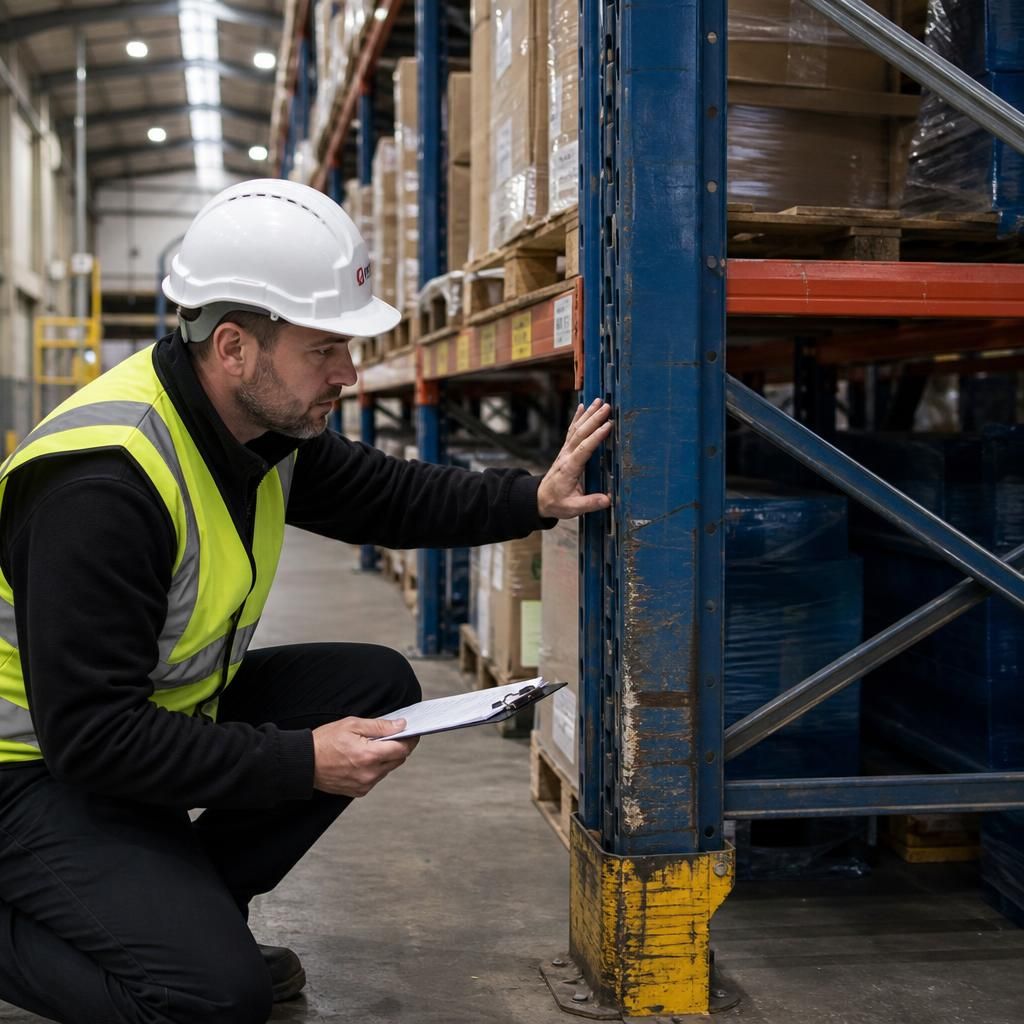
Regular warehouse racking inspections are important because they turn early signs of damage into controlled corrective action. A competent inspection can identify bent uprights, displaced beams, loose fixings, impact damage, corrosion or unsafe loading conditions before they develop into a more serious failure.
Inspection findings should be recorded and prioritised according to risk. Unsafe areas may need to be isolated and unloaded immediately, while less urgent defects should be assigned to a responsible person with a clear repair deadline. This process helps protect employees, preserve stock and maintain the structural integrity of the warehouse racking system.
Arrange Your Warehouse Racking Inspection
Arrange a competent warehouse racking inspection with Able Racking to identify defects, assess risk and plan any necessary repairs or preventative maintenance.