
What are the most common causes of damage to warehouse racking systems, and how can they be effectively prevented?
The most common causes of damage to warehouse racking systems are forklift impacts, overloading, incorrect loading, poor installation, unauthorised alterations and inadequate maintenance. Prevent it through trained vehicle operators, clear load limits, suitable protection, correct installation, routine inspections and prompt repair or isolation of damaged components.
Damage to warehouse racking systems is most commonly caused by forklift or other material-handling equipment impacts, overloading, incorrect loading, poor installation, unauthorised alterations and inadequate maintenance. Effective prevention depends on combining competent design and installation with operator training, clearly displayed load information, suitable protection, routine inspections and immediate action when damage is identified.
Forklift and vehicle impacts
Vehicle impact is one of the most frequent causes of damage. Forklift trucks can strike uprights, bracing, beams and protective components when manoeuvring in aisles, positioning pallets or reversing from storage locations. Even a minor collision can distort a component, loosen a connection or reduce the system’s ability to carry its intended load. Repeated low-level contact may also cause progressive damage that is not immediately obvious.
Prevention starts with a suitable warehouse layout and well-controlled traffic routes. Keep aisles clear, provide adequate operating space and separate pedestrians from vehicles wherever practicable. Use trained and authorised operators, enforce appropriate speed controls and ensure loads do not obstruct the driver’s view. Upright guards, end-of-aisle protection, barriers and other suitable safety accessories can reduce the consequences of foreseeable contact, but they do not remove the need for careful driving and regular checks.
Any impact should be reported and assessed rather than dismissed because the damage appears minor. Affected areas should be unloaded or isolated where necessary until a competent person has determined whether the system remains safe to use.
Overloading and uneven load distribution
Warehouse racking is designed for specified loads, beam spans, bay arrangements and operating conditions. Exceeding the stated capacity can overstress beams, uprights, connections and floor fixings. Loads that are concentrated in one position, stored unevenly or placed outside the intended pallet support area can create additional stress even when the total load appears to be within the stated limit.
Prevent overloading by displaying current load notices where they can be seen by operators and by ensuring the information matches the installed configuration. Staff should know the permitted load for each relevant beam level and bay, including any restrictions created by changes to the layout or equipment. Pallets and stored goods should be suitable for the system, stable, evenly positioned and fully supported. Do not assume that a stronger-looking component or an empty neighbouring bay increases the permitted capacity.
Review the system whenever stored goods, pallet types, handling equipment, beam levels or bay layouts change. A competent assessment may be required before introducing heavier, wider or differently shaped loads.
Incorrect loading and poor housekeeping
Damage can occur when pallets are placed off-centre, dropped onto beams, pushed against uprights or left projecting into aisles. Unstable goods may fall and strike the structure, while damaged pallets can fail or transfer loads unevenly. Debris, broken packaging and poorly managed stock can also obstruct access and increase the likelihood of impact.
Operators should place loads carefully, keep pallets square and centred, and avoid dragging or forcing them into position. Establish clear rules for pallet condition, load stability and stock placement. Remove damaged pallets and deal promptly with leaking, unstable or protruding goods. Good housekeeping should include keeping aisles, access routes and emergency areas free from obstructions.
Incorrect installation or unsuitable configuration
Installation defects can reduce the stability and capacity of a warehouse racking system from the outset. Examples include incorrectly fitted beams, missing locking devices, inadequate floor fixings, damaged components, incorrect bay dimensions and failure to install required bracing or protection. A system may also become unsuitable if its configuration is changed without checking the design assumptions.
Use experienced, competent installers and ensure the completed installation is checked against the approved design and manufacturer’s instructions. Components should be inspected before installation, connections should be secured correctly and the system should be installed on a suitable floor. Keep installation records, layout information and load details available so that future inspections and alterations can be based on accurate information.
Unauthorised alterations and unsuitable repairs
Removing bracing, relocating beams, replacing components with incompatible parts or modifying bays without technical approval can compromise structural performance. Improvised repairs, such as straightening damaged steel or welding without an appropriate assessment, may conceal weaknesses rather than restore the system safely.
Restrict alterations to authorised, competent personnel and record every approved change. Replacement components should be compatible with the existing system and installed in accordance with the relevant design requirements. If a component is bent, split, heavily deflected or otherwise damaged, do not attempt to return it to service without a competent assessment and an appropriate repair or replacement decision.
Inadequate inspections and delayed repairs
Small defects can worsen when they are not identified and controlled. Routine visual checks by trained staff can identify obvious issues such as impact damage, missing locking pins, displaced loads, loose protection and damaged pallets. These checks should be supported by scheduled expert inspections that assess the overall condition, configuration, use and protection of the system.
Inspection findings should be recorded clearly, with the location, defect, risk classification and required action stated. Repair or isolation should be completed within an appropriate timescale. Where damage presents an immediate risk, the affected bay or area should be unloaded and taken out of service without waiting for a routine repair visit. After repairs or alterations, verify that the work has been completed correctly before normal use resumes.
Environmental and operational conditions
Corrosion, moisture, temperature changes, poor lighting and restricted visibility can contribute to damage or make existing defects harder to detect. Certain goods, cleaning processes or industrial environments may also expose components to chemicals or conditions for which they were not intended. Changes in working methods, shift patterns or storage demands can increase the risk of impact and overloading.
Include environmental conditions in the original assessment and subsequent inspections. Maintain suitable lighting, control leaks and moisture, protect components from corrosive substances and keep access routes visible. Reassess the system when the warehouse use changes, new equipment is introduced or operating conditions become more demanding.
A practical prevention process
- Confirm the design information: keep current layout drawings, load notices, equipment details and records of approved changes.
- Control access and use: ensure operators are trained, authorised and familiar with loading rules, traffic routes and damage-reporting procedures.
- Protect vulnerable areas: use suitable upright protection, end-of-aisle barriers and other controls based on the site’s impact risks.
- Inspect routinely: combine ongoing checks by warehouse personnel with periodic inspections by a competent specialist.
- Act on defects: identify, classify, record and repair damage promptly; isolate unsafe areas where required.
- Review after change: reassess capacity, stability and protection whenever the layout, loads, equipment or operating method changes.
The most effective approach is preventative rather than reactive. Warehouse racking should be treated as a working safety-critical structure: it must be correctly specified, installed and used, protected from foreseeable impacts, inspected at suitable intervals and maintained in a condition that supports its intended loads. Consistent training, accurate records and prompt control of defects help prevent avoidable damage while supporting safe, compliant and efficient warehouse operations.
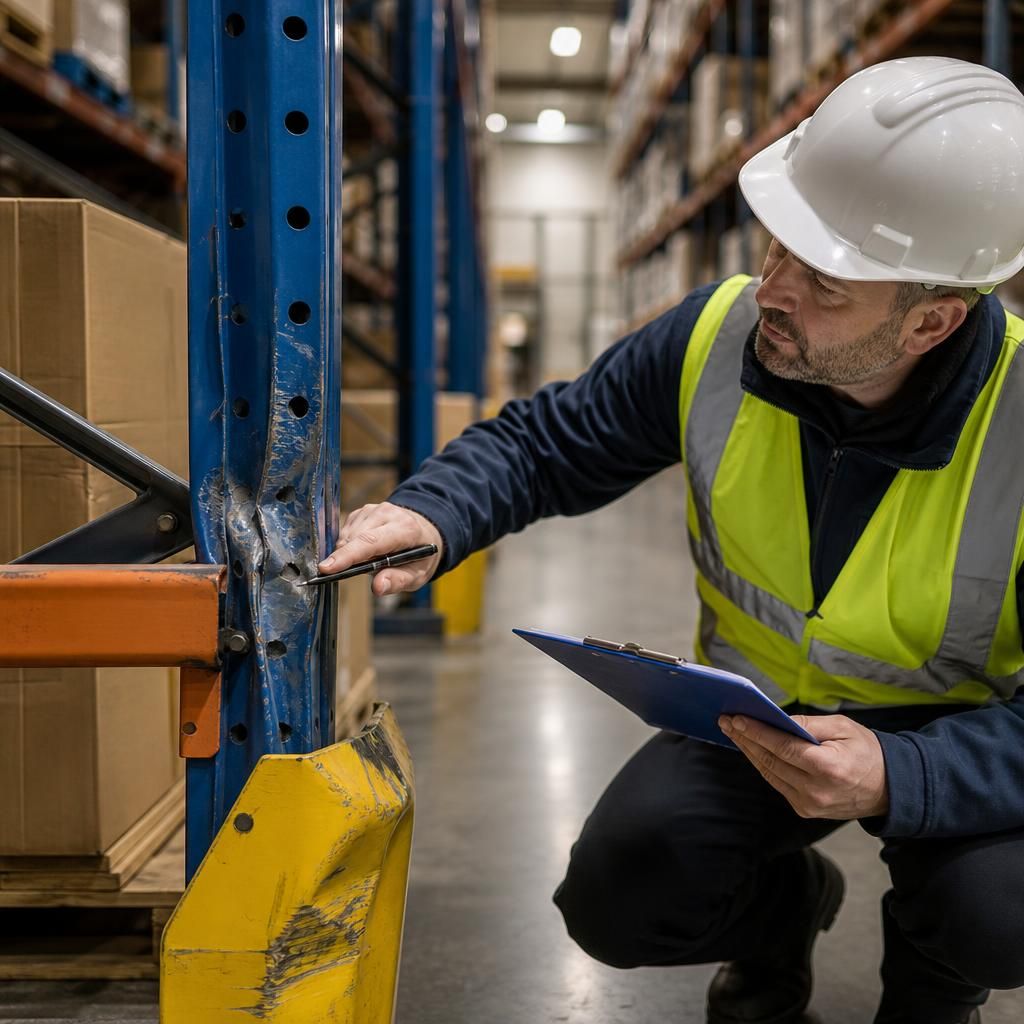
Forklift impacts are a leading cause of damage to warehouse racking systems, particularly around aisle ends, upright frames and beam connections. Even a minor collision can distort steel, loosen a connection or reduce the system’s ability to support its intended load.
Prevent impacts by maintaining clear aisles, separating pedestrians and vehicles where practicable, controlling vehicle speeds and ensuring operators are trained and authorised. Upright guards, end-of-aisle barriers and other suitable protection can reduce the consequences of foreseeable contact, but they do not replace careful driving or routine checks.
Every impact should be reported and assessed, regardless of how minor it appears. Unload or isolate the affected area when necessary, then arrange a competent inspection before normal use resumes. Prompt action prevents progressive damage and helps maintain a safe, compliant warehouse racking system.
Arrange a Warehouse Racking Safety Inspection
Arrange a warehouse racking safety inspection with Able Racking to identify damage, assess risks and confirm whether your system remains safe to use. Contact our experienced team to book an inspection and receive practical recommendations for any required repairs or protection.