
What are the best safety accessories for warehouse racking?
The best safety accessories for warehouse racking include column guards, end-of-aisle guards, frame protectors, pallet safety nets, load notices and anti-collapse measures. Their suitability depends on the warehouse layout, vehicle movements, pallet configuration and findings from a competent inspection or risk assessment.
The best safety accessories for warehouse racking are those selected to control the specific risks identified in the storage layout, traffic plan and inspection findings. In most warehouses, this includes column and frame guards, end-of-aisle protection, pallet supports, back-of-rack protection, safety nets or gates, load notices and secure locking devices. Accessories should be correctly specified, professionally installed and included in routine warehouse racking inspections; a poorly fitted protector can create additional hazards or give a false sense of security.
Safety accessories do not replace sound design, careful loading, operator training or regular inspection. Their purpose is to reduce the likelihood and consequences of impact, falling goods, incorrect loading and unauthorised changes to the warehouse racking system.
Column and frame guards
Column guards protect the lower sections of upright frames from contact with handling equipment. They are particularly useful where forklift trucks, reach trucks or pallet trucks operate close to warehouse racking. Depending on the design, a guard may be fixed to the floor, attached to the upright or positioned around the vulnerable section without transferring impact forces into the frame.
The correct guard must suit the upright profile, available clearance and expected impact risk. It should not obstruct visibility, prevent inspection of the upright or interfere with baseplates and floor fixings. Guards should also be checked after an impact, as a guard that appears undamaged may have transferred force into the warehouse racking frame.
End-of-aisle protection and traffic barriers
The ends of warehouse racking runs are exposed to turning vehicles and reversing movements. End-of-aisle guards, steel barriers and other impact protection can create a stronger physical separation between vehicle routes and storage structures. They are most effective when positioned according to the actual swept path of the equipment rather than simply aligned with the aisle.
Protection should not narrow the working aisle, restrict emergency access or create a trip hazard. Where barriers are used, their condition, fixings and distance from the warehouse racking should be checked regularly. Damaged barriers must not be treated as effective protection until they have been assessed and repaired or replaced.
Pallet supports and load-support accessories
Pallet supports provide additional support beneath pallets stored on beams, especially where pallet quality, pallet type or loading conditions make direct beam storage unsuitable. They can help reduce the risk of pallets slipping through, breaking or becoming unstable, but they must be compatible with the pallet dimensions, beam arrangement and rated load.
Other load-support options may include timber supports, steel support bars or purpose-designed decking. Each solution needs to be specified for the loads being stored. Supports should be properly seated and retained so that they cannot be displaced during loading or unloading. They should not be introduced as an informal modification without checking the effect on the warehouse racking design and safe working load.
Back-of-rack protection
Mesh panels, rear guards and pallet backstops help prevent pallets or loose products from falling into work areas, walkways or adjacent warehouse racking. They are particularly important where people, vehicles or other operations are located behind the storage system.
Back-of-rack protection must be designed for the type of goods, pallet arrangement and potential impact. It should not be used to compensate for excessive overhang, unstable loads or incorrect placement. Clearances are important: a pallet should not be forced against a rear guard, and the guard should not be used as a load-bearing element unless it has been specifically designed for that purpose.
Pallet safety nets, gates and anti-fall measures
Pallet safety nets and similar anti-fall systems can help retain goods where pallets are stored at exposed positions or where loose items could fall from a beam level. Gates may be used at loading positions or other access points to reduce the risk of people or materials falling from an elevated storage area.
These systems require careful consideration of access, loading methods and emergency procedures. Nets and gates should be securely attached, kept free from damage and used in accordance with their design limits. They must not be removed for convenience and left out of service without an alternative control being put in place.
Load notices and identification labels
Load notices are an essential safety accessory because they communicate the safe working load and operating restrictions for the warehouse racking system. Notices should be clearly visible to operators and positioned where they can be read before loading takes place. They should reflect the installed configuration, including beam levels, bay arrangements and any relevant restrictions.
Additional labels can identify aisle locations, maximum pallet positions, damaged equipment or areas temporarily taken out of service. Labels must be kept accurate. If the warehouse racking layout changes, the load notice and associated documentation should be reviewed by a competent person rather than amended informally.
Beam safety locks and retaining devices
Beam safety pins, locking clips and retaining devices help prevent beams from being accidentally lifted or dislodged during normal operation. Every adjustable beam connection should have the correct retaining device fitted and fully engaged.
Missing, bent or incompatible pins should be replaced promptly. A locking device is not a substitute for checking whether the beam connector, upright or frame has been damaged. During inspections, the condition and engagement of these components should be checked across the warehouse racking installation.
Mesh decking and containment panels
Mesh decking and containment panels can provide a stable surface for stored goods and help prevent smaller items from falling through or behind the structure. They are useful where pallet dimensions vary or where individual cartons are stored on levels not intended for direct pallet placement.
The decking must be suitable for the imposed load and correctly supported. It should not be overloaded, cut or altered without approval. Any gaps, loose panels, damaged welds or unsupported edges should be reported and addressed promptly.
Aisle markings and collision-reduction measures
Floor markings, aisle identification and clearly defined vehicle routes help operators understand how the warehouse racking area is intended to be used. In suitable locations, mirrors, warning signs, pedestrian barriers and speed-control measures can improve visibility and reduce the likelihood of contact with the storage system.
These measures work best when supported by a traffic management plan. Markings should remain visible, routes should be kept clear and changes in vehicle movements should trigger a review of the protection in place. Warning signs alone cannot control a risk where the layout encourages vehicles to approach the warehouse racking too closely.
How to choose the right accessories
- Start with the risk assessment: identify vehicle impact points, falling-object risks, pedestrian routes, loading practices and areas where damage has previously occurred.
- Review the warehouse racking design: confirm the upright profile, beam arrangement, clearances, floor condition, load requirements and manufacturer or supplier limitations.
- Match the accessory to the hazard: use column guards for vulnerable uprights, barriers for vehicle separation, pallet supports for load stability and containment systems for falling-object risks.
- Check compatibility: accessories must not obstruct inspections, alter structural connections, reduce required clearances or conceal damage.
- Use competent installation: fixings, spacing and positioning should follow the product design and the assessed requirements of the warehouse.
- Update information: revise load notices, layout drawings and operating instructions when the warehouse racking configuration changes.
Accessories should be inspected as part of the wider warehouse racking safety regime. Look for impact damage, loose fixings, displaced supports, missing locking devices, torn nets, bent barriers, damaged mesh and labels that no longer match the installation. Any significant damage should be reported immediately, the affected area made safe and the warehouse racking assessed by a competent person before it is returned to normal use.
Where an accessory has been installed after an incident, it is important to investigate the underlying cause as well. A damaged guard may indicate poor vehicle separation, an unsuitable aisle arrangement, inadequate operator training or a loading practice that needs to change. Combining physical protection with competent inspections, suitable procedures and prompt repairs provides a more reliable approach than relying on any single accessory.
For an existing installation, the most suitable combination can be confirmed through a professional warehouse racking inspection and site-specific risk assessment. This approach ensures that protection is proportionate to the actual working environment, supports compliance with recognised warehouse safety expectations and helps preserve the safe performance of the storage system.
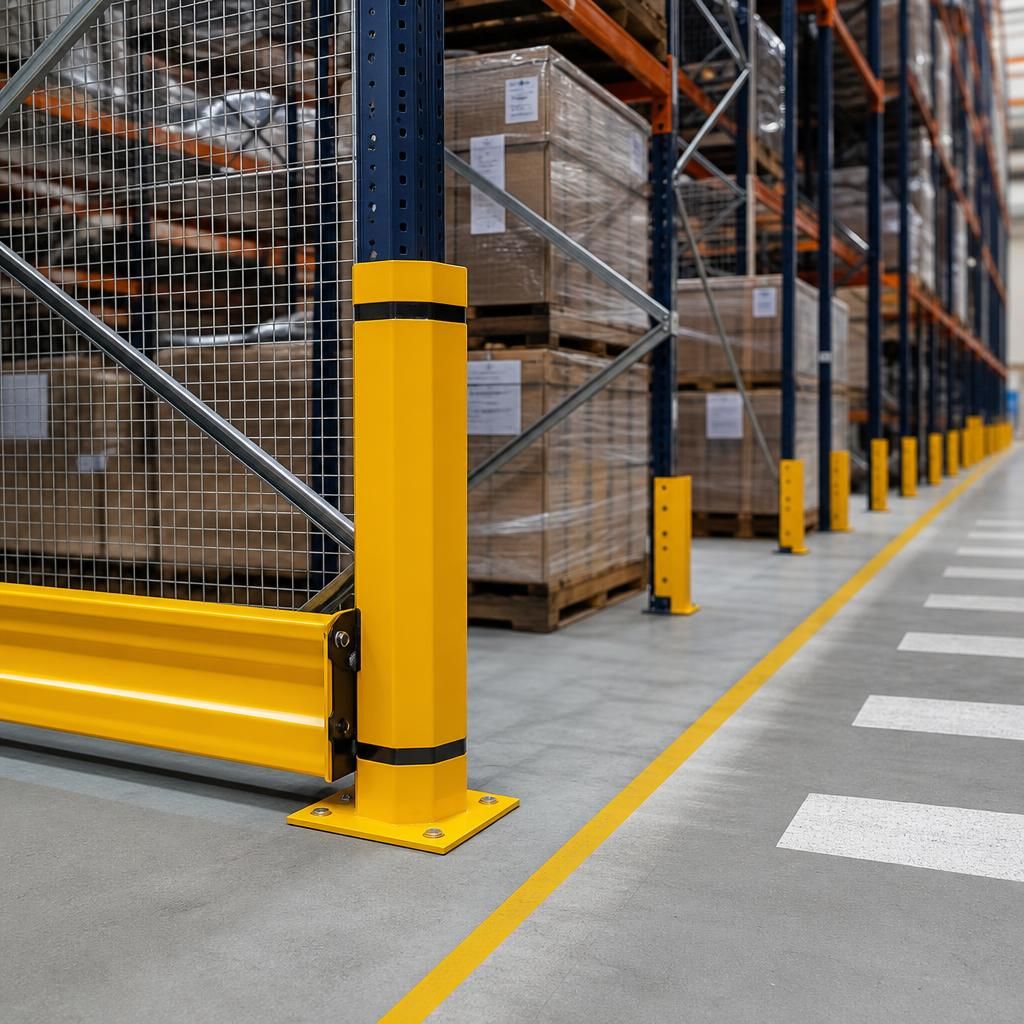
Column guards and end-of-aisle barriers are among the most effective safety accessories for warehouse racking because they reduce the likelihood of vehicle impact reaching vulnerable frames. They must be selected for the upright profile, traffic routes, available clearance and likely impact forces, then installed so they do not obstruct inspections, fixings or emergency access.
Protection should be checked after every known impact and during routine warehouse racking inspections. A guard may look intact while force has transferred into the frame, so damaged or displaced protection should be reported promptly and the affected area assessed by a competent person before normal use resumes.
Arrange a warehouse racking safety assessment
Arrange a warehouse racking safety assessment with Able Racking to identify damage, loading risks and gaps in your protective measures. Our experienced team can recommend practical, site-specific improvements to help keep your warehouse racking safe and compliant.