
How often should warehouse racking be inspected for safety compliance?
Warehouse racking should receive a documented expert inspection at least every 12 months, with more frequent inspections where the risk assessment, operating conditions or previous damage indicates this is necessary. Trained staff should also carry out regular visual checks and report defects promptly so that safety issues can be assessed and repaired without delay.
Warehouse racking should receive a documented inspection by a competent person at least every 12 months. More frequent inspections may be necessary where the risk assessment, operating conditions, traffic levels, loading arrangements or previous damage indicate increased risk. Trained warehouse staff should also carry out routine visual checks and report defects immediately, so that damaged warehouse racking can be assessed and made safe without delay.
UK legislation does not set one universal inspection interval for every warehouse racking installation. However, employers must maintain work equipment in a safe condition, and recognised warehouse safety guidance, including HSE guidance and the relevant European standard for warehouse racking use, supports a planned inspection system. In practice, this means combining routine internal checks with a formal inspection by a suitably experienced and independent competent person at least annually.
The correct frequency should be established through a documented risk assessment. A warehouse with frequent forklift movements, high pallet turnover, narrow aisles, demanding loading conditions or a history of impact damage may need inspections more often than once a year. The same applies where warehouse racking is heavily loaded, exposed to harsh working conditions or used by operatives who regularly change storage arrangements.
Routine checks by trained employees should take place at intervals suited to the risks, often during each shift or working day in busy operations. These checks are not a substitute for a formal warehouse racking inspection. They are intended to identify obvious problems early, including:
- Visible bends, dents, cracks or other damage to uprights, beams, bracing or connections.
- Missing or displaced beam locking devices, bolts, anchors or other components.
- Unstable loads, damaged pallets or pallets that are not positioned correctly.
- Overloaded locations or loads that extend beyond the permitted storage position.
- Changes to the warehouse racking configuration that have not been authorised or recorded.
- Damage to floor fixings, protection equipment, decking or other supporting elements.
A formal inspection should be completed by a competent person with suitable knowledge, training and practical experience of warehouse racking systems. The inspection should assess the installation as a whole rather than focusing only on visible frame damage. It should consider the condition of uprights, beams, bracing, connectors, anchors, protection, decking, load notices, pallets and the surrounding working environment. The inspector should also consider whether the warehouse racking is being used in accordance with its design capacity and the manufacturer’s instructions.
Every inspection should result in a written report. The report should identify the warehouse racking inspected, record defects clearly, show the location and severity of each issue, and recommend corrective action. Photographs, marked-up layout drawings or location references can make it easier for warehouse managers and repair teams to find the affected area. Inspection records should be retained with other warehouse safety documentation and used to demonstrate that reported defects have been dealt with.
Any impact damage should be reported immediately, even if it appears minor. A forklift collision can affect the stability or load-bearing performance of warehouse racking without causing an obvious collapse. The affected area should be assessed by a competent person before it is returned to normal use. Depending on the severity of the defect, the location may need to be unloaded, isolated or clearly marked until suitable repairs have been completed.
Warehouse racking should also be inspected after changes to the installation or its use. This includes alterations to beam levels, replacement components, relocation, changes to pallet sizes or weights, the introduction of different handling equipment, and changes to aisle layouts. An inspection is also appropriate after an unusual event such as a significant impact, fire, flood or other incident that could affect the structure or floor fixings.
Inspection frequency should not be confused with maintenance frequency. An annual inspection does not mean that repairs can be postponed until the next scheduled visit. Defects should be managed according to their risk. Serious damage may require immediate unloading and isolation, while less urgent defects should still be assigned an owner and completion date. Repairs should use suitable compatible components and should not be improvised through unapproved welding, drilling or straightening.
A practical inspection programme should include:
- A risk assessment covering warehouse racking use, traffic, loads, working practices and the condition of the installation.
- Routine visual checks by trained employees, with a clear process for reporting defects.
- A documented competent-person inspection at least every 12 months, or more frequently where required by the risk assessment.
- Immediate assessment following impact damage, structural concerns or significant changes.
- Written records showing findings, actions, repair status and any areas temporarily taken out of service.
- Periodic review of the inspection frequency after incidents, layout changes, operational changes or recurring defects.
The most reliable approach is therefore a layered system rather than a single annual appointment. Regular staff checks help identify problems between formal visits, while a detailed competent-person inspection provides an independent assessment of condition, use and compliance. Maintaining both parts of the programme helps protect operatives, reduce unplanned disruption and keep warehouse racking performing safely throughout its service life.
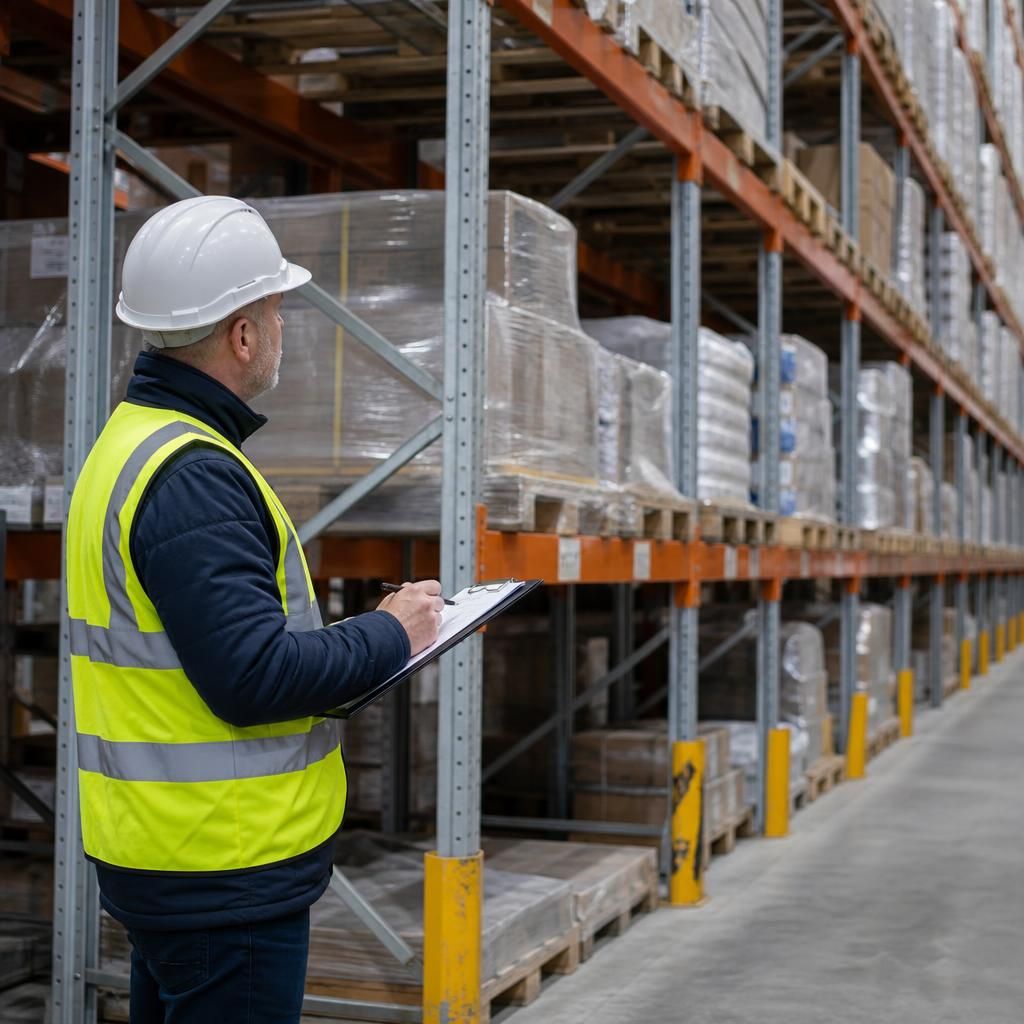
Warehouse racking should be inspected by a competent person at least annually, with the interval shortened where the risk assessment identifies greater exposure to damage or unsafe use. This formal inspection should be supported by routine visual checks from trained warehouse staff, particularly in busy areas with frequent forklift movements or changing loads.
Staff checks help identify visible damage, displaced components, unstable pallets, missing locking devices and unauthorised changes between formal inspections. Any defect or impact should be reported immediately. The affected area may need to be unloaded or isolated until a competent person has assessed it and confirmed whether warehouse racking repairs are required.
Arrange your warehouse racking inspection
Arrange your warehouse racking inspection with Able Racking for a competent assessment of its condition, use and safety compliance. Contact our experienced team to discuss your inspection requirements and any current concerns.