
What are the main benefits of using cantilever warehouse racking for timber storage?
Cantilever warehouse racking provides a stable, accessible way to store long and bulky timber while keeping different stock sizes organised and visible. Its open-front design improves handling efficiency, uses available warehouse space effectively and supports safer loading and retrieval when correctly specified and maintained.
Cantilever warehouse racking is particularly well suited to timber storage because it supports long, bulky and variable-length materials without front posts obstructing access. The open-front design allows timber to be loaded and retrieved from the aisle using suitable handling equipment, while adjustable arms and clearly defined storage levels help keep different stock types organised. When the system is correctly designed, installed and maintained, it can improve space use, handling efficiency, stock visibility and workplace safety.
Key benefits for timber storage include:
- Efficient storage of long materials: Timber lengths can extend beyond the footprint of conventional pallet storage. Cantilever warehouse racking supports these loads along their length, reducing the need to place long products across several separate storage locations.
- Better use of available space: Storage levels can be arranged vertically, making use of warehouse height while preserving practical aisle space. This can reduce reliance on floor stacking and create a more orderly storage layout.
- Clear and direct access: The absence of front uprights makes it easier to position and remove timber from the storage face. This is especially useful where products are handled regularly or where different lengths and sections need to be selected quickly.
- Improved stock visibility: Timber remains visible from the aisle rather than being concealed behind pallets or tightly packed floor stacks. Clear labelling and consistent location allocation can make it easier to identify stock, check quantities and apply stock rotation procedures.
- Greater flexibility: Arms and storage levels can be specified or adjusted to suit different timber dimensions, provided any changes remain within the system designer’s approved configuration. This makes the system more adaptable than fixed storage arrangements when the product range changes.
- Reduced handling difficulty: Organised, accessible storage can reduce unnecessary movement and rehandling. Timber can be placed in a defined location and retrieved with the appropriate forklift, crane or other handling equipment, subject to the site’s risk assessment and operating procedures.
- Less damage caused by poor stacking: Separating timber on designed support arms can help prevent products being stored directly on uneven floors or buried beneath other stock. Correct support spacing is important because insufficient support can lead to deflection, instability or product damage.
- Improved housekeeping: Moving timber off the floor can help keep walkways and working areas clearer. This does not remove the need for routine housekeeping: loose offcuts, packaging and damaged timber must still be removed promptly.
These benefits depend on selecting a system that matches the timber being stored. The design should consider the longest and heaviest items, the cross-section of the material, bundle dimensions, how loads are presented to the arms and whether storage is single-sided or double-sided. It should also account for the capacity of the bases, columns and individual arms, as well as the available building slab and the impact of handling equipment.
Load distribution is especially important. Timber should be placed so that its weight is shared across the intended supports and does not project beyond the arms in a way that creates an unsafe overhang. Bundled products may behave differently from individual lengths, and uneven or shifting loads can affect stability. The safe working load information supplied for the system must be followed, with operating instructions displayed where they can be seen by warehouse staff.
A well-planned layout can also improve material handling efficiency. Storage locations can be assigned according to timber length, type, demand or dispatch sequence, limiting unnecessary travel and helping operators select the correct product. Aisles must remain wide enough for the equipment in use, with adequate clearance for manoeuvring, loading and retrieval. Site traffic routes, pedestrian controls and visibility at aisle ends should be considered as part of the overall arrangement.
Safety remains a central benefit only when the installation is used correctly. Loads should be placed steadily, kept within the specified capacity and prevented from being pushed or dragged against the structure. Operators should receive appropriate instruction on load placement, vehicle operation and the risks associated with unstable or damaged timber. Any impact, bent component, missing arm, loose connection or other defect should be reported and assessed before the affected area is used again.
Regular inspections and planned maintenance help preserve the system’s performance. The storage area should receive routine visual checks, while a competent person should carry out formal warehouse racking inspections at suitable intervals and after significant damage or alteration. Inspection findings should be recorded, and repairs should use compatible components and follow the manufacturer’s or system designer’s requirements. Unauthorised modifications, overloading and makeshift repairs can invalidate the original design assumptions.
Overall, cantilever warehouse racking gives timber suppliers, manufacturers and building-materials operations a structured alternative to floor stacking. Its main advantages are direct access, adaptable storage, better use of vertical space, clearer stock control and safer, more predictable handling. The best results come from combining an appropriate design with accurate load information, competent installation, trained operators and consistent inspection and maintenance.
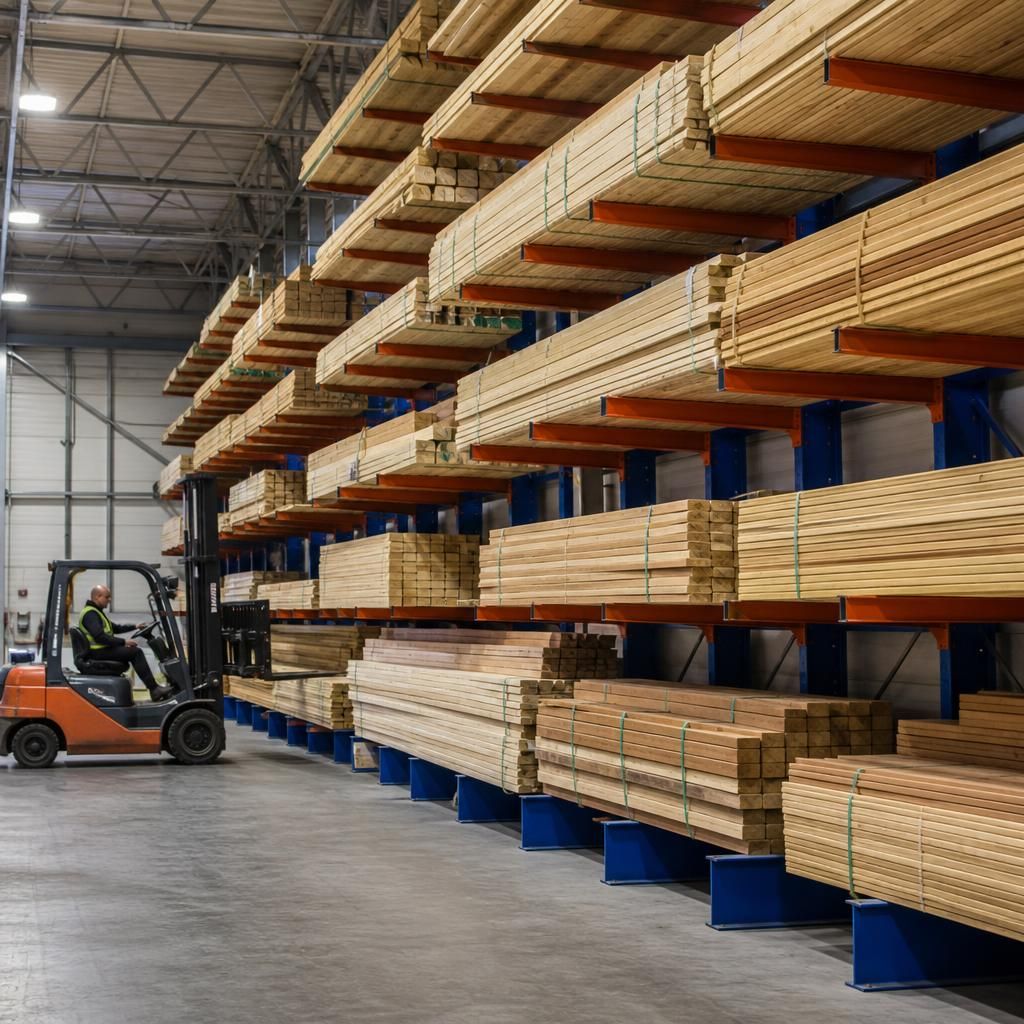
Cantilever warehouse racking improves timber storage by keeping long products visible, separated and accessible from the aisle. The open-front arrangement allows operators to identify the required timber without moving unrelated stock or searching through unstable floor stacks.
Assigning storage locations by timber type, length or demand can make picking more consistent and reduce unnecessary handling. Timber should be positioned evenly across the approved support arms, with clear load information followed at all times. Keeping stock off the floor also helps maintain clearer working areas, although regular housekeeping remains essential to remove offcuts, packaging and damaged materials.
Discuss your timber storage requirements with our experts
Speak to our experts about your timber storage requirements and receive practical advice on selecting, configuring and maintaining a cantilever warehouse racking system suited to your stock and handling methods.