
What are the differences between single-sided and double-sided cantilever warehouse racking?
Single-sided cantilever warehouse racking is accessed and loaded from one side, making it suitable for positioning against a wall or at the edge of a storage area. Double-sided cantilever warehouse racking is accessible from both sides, allowing higher storage density and more efficient use of central warehouse space, provided there is sufficient aisle access.
Single-sided and double-sided cantilever warehouse racking differ mainly in how they are accessed and where they can be installed. Single-sided systems have storage arms on one face of the upright and are normally positioned against a wall or at the edge of a storage area. Double-sided systems have storage arms on both faces of a shared upright structure, allowing materials to be stored and retrieved from two opposing aisles.
The correct option depends on the available floor layout, the handling equipment used, the required storage density and the characteristics of the loads. Both configurations can provide effective storage for long, awkward or variable-length products, but they are not interchangeable in every warehouse.
Single-sided cantilever warehouse racking
Single-sided cantilever warehouse racking is designed for access from one direction. Its rear face can be placed close to a suitable wall or boundary, which makes efficient use of perimeter space that may otherwise be difficult to utilise. It is often appropriate where the warehouse layout has a clear wall line or where goods only need to be presented to one aisle.
- It requires access and handling space on one side only.
- It can be installed along warehouse walls or at the end of a storage run.
- It may simplify traffic planning because all loading and retrieval takes place from the same aisle.
- It can be a practical choice where the available storage area is narrow or where a second access aisle would be unnecessary.
- It avoids using the reverse side of the structure for storage, which can be useful where that side borders a wall, column or protected area.
However, single-sided storage may provide less storage density across a central floor area because each upright serves one access face. The layout also needs sufficient clearance in front of the arms for the forklift, crane or other handling equipment used to place and remove materials.
Double-sided cantilever warehouse racking
Double-sided cantilever warehouse racking stores goods on both faces of the upright structure. It is normally installed in a central position between two access aisles, enabling operators to load from one side and retrieve from the other. This arrangement can increase the amount of usable storage obtained from a central section of the warehouse, provided the aisle layout and handling equipment are suitable.
- It provides access from both sides of the structure.
- It can store more product-facing positions within a given central floor area than a single-sided arrangement.
- It may support more direct separation of incoming and outgoing stock when the layout is planned accordingly.
- It can improve accessibility where materials are regularly selected from either side.
- It may be well suited to larger storage areas with planned parallel aisles and clear vehicle routes.
Double-sided systems require enough space on both sides for safe loading, retrieval and vehicle movement. If one side becomes obstructed or is too narrow for the intended equipment, the potential benefit of the configuration is reduced. The structure must also be positioned so that loads cannot project into vehicle routes or create a hazard for people working in adjacent aisles.
Key differences in layout and space use
The most noticeable difference is the relationship between the structure and the surrounding aisles. A single-sided system is generally a perimeter solution, whereas a double-sided system is generally a central storage solution. This does not mean that every wall-side location must use a single-sided system, or that every central location must use a double-sided system; the final choice should be based on the building, access requirements and load-handling process.
Single-sided systems can make better use of boundary space and may leave more open floor area in front of the storage run. Double-sided systems can reduce duplicated uprights or unused rear-facing space within a central layout, but they need an additional access aisle and careful control of traffic movements. A measured layout should consider aisle width, turning areas, emergency routes, columns, doors, sprinkler clearances and any areas where loads are transferred or inspected.
Load capacity and structural considerations
Neither configuration should be assumed to have a greater load capacity simply because it is single-sided or double-sided. Capacity depends on the design of the uprights, bases, arms, bracing, anchorage, load distribution, product dimensions and the forces imposed during handling. On a double-sided system, loads on both faces must be included in the design assessment. Uneven loading, overhanging products and impact from handling equipment can affect the structure and its safe working limits.
Before installation or alteration, the system should be assessed for the intended product weights, lengths, centres of gravity and loading method. Safe working load information should be clearly displayed and operators should be trained not to exceed the specified limits. Any change to arm positions, components, load types or handling equipment should be reviewed rather than treated as a minor adjustment.
Access, picking and stock control
Single-sided cantilever warehouse racking can provide a straightforward picking sequence where products enter and leave through the same working aisle. This may suit stock that is stored by product type, length or frequency of use and does not need two-sided access.
Double-sided cantilever warehouse racking can support faster movement between parallel aisles when products are accessed from both directions. It may also help separate replenishment and picking activities, although this depends on the warehouse process and the controls used by the operating team. Two-sided access does not automatically improve efficiency: poorly planned aisles, congested routes or unsuitable handling equipment can remove the expected benefit.
Safety and operational requirements
Both configurations require a suitable, level supporting surface, secure anchorage, appropriate protection from vehicle impact and clear identification of safe working loads. The floor must be capable of supporting the imposed loads, and the system must be installed in accordance with the design and manufacturer’s instructions.
Regular inspections should check for bent or damaged uprights, arms and braces, displaced components, loose fixings, impact damage, overloaded levels and changes to the surrounding operating area. A double-sided layout also requires attention to both access faces and the aisle interfaces on each side. Any damage should be reported promptly, the affected area should be controlled where necessary and repairs should be completed using suitable components and competent methods.
Operators should load materials evenly, keep products stable on the arms and avoid pushing loads into uprights or adjacent stock. Forklift drivers and other equipment users need adequate visibility and clearance when approaching either configuration. The storage plan should also maintain required access routes and prevent materials from obstructing doors, fire equipment or escape paths.
Which configuration is usually appropriate?
- Choose single-sided storage where the system will sit against a wall or boundary, only one access aisle is required, or the available layout does not justify storage on both faces.
- Choose double-sided storage where a central run can be accessed safely from two aisles and higher use of the available floor area is a priority.
- Review both options where the warehouse handles long or heavy products, uses specialist handling equipment, has restricted aisle space or is likely to change its stock profile.
The decision should be made from a measured warehouse plan rather than from the appearance of the system alone. Product dimensions, load weights, handling methods, aisle clearances, floor conditions and future operational changes should all be considered. A competent assessment can then establish the appropriate configuration, component specification, protection and inspection requirements.
In practical terms, single-sided cantilever warehouse racking is usually the simpler choice for perimeter storage, while double-sided cantilever warehouse racking is usually more suitable for central, high-density layouts with safe access on both sides. Whichever arrangement is selected, correct design, professional installation, clear load information, operator training and planned inspections are essential to keep the storage system safe and effective.
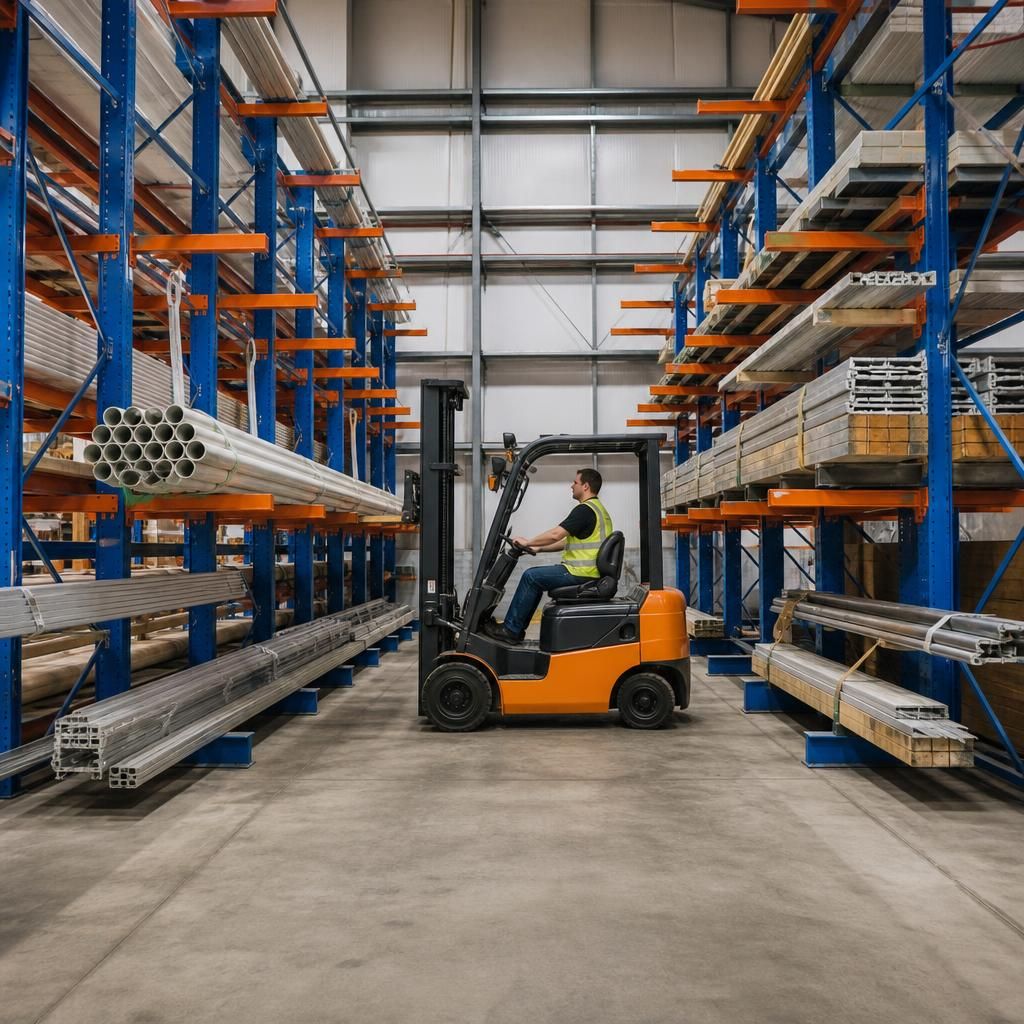
The main difference between single-sided and double-sided cantilever warehouse racking is the direction of access. Single-sided cantilever warehouse racking is loaded and retrieved from one aisle, so it is generally positioned against a wall or at the edge of the storage area. Double-sided cantilever warehouse racking has storage arms on both faces and is normally installed between two aisles.
Double-sided access can make better use of central floor space, but it also requires sufficient clearance on both sides for the intended forklift or other handling equipment. A measured layout should account for aisle widths, turning movements, columns, doors, emergency routes and any areas where loads are inspected or transferred. If one side cannot be accessed safely, a single-sided arrangement may be the more practical option.
Get Expert Advice on Your Cantilever Warehouse Racking Layout
Speak to Able Racking for expert advice on selecting and planning a safe, efficient cantilever warehouse racking layout for your site and handling requirements.