
How does cantilever warehouse racking improve material handling efficiency?
Cantilever warehouse racking improves material handling efficiency by providing clear, direct access to long, bulky or awkward loads without front columns obstructing them. Its open design helps operators load, retrieve and organise materials more quickly while using available warehouse space effectively.
Cantilever warehouse racking improves material handling efficiency by providing unobstructed access to long, bulky and awkwardly shaped loads. Unlike systems with front columns, its arms support stock from the rear, allowing operators to position, retrieve and inspect materials directly from the aisle. This reduces handling difficulties, supports clearer workflows and helps make better use of available warehouse space.
The design is particularly suitable for products such as timber, steel sections, pipes, conduit, sheet materials, plastics, furniture components and other loads that cannot be stored efficiently on conventional pallet systems. By matching the storage structure to the shape of the goods, businesses can reduce unnecessary movement, improve stock visibility and organise materials in a more logical sequence.
Key ways cantilever warehouse racking improves handling efficiency include:
- Direct access to stored materials: Open-front arms allow loads to be placed on or removed from the system without working around upright frames at the front of the storage position.
- Better storage of long loads: Products can be supported along their length rather than being forced into unsuitable pallet locations or left on the floor.
- Fewer handling stages: Materials can often be transferred directly between vehicles, handling equipment and their assigned storage locations, reducing repositioning and double handling.
- Improved use of vertical space: Multiple storage levels allow suitable products to be stored above floor level, while maintaining access to lower levels for frequently required stock.
- Clearer stock identification: An open layout makes it easier to see product type, size, condition and quantity during picking, replenishment and routine checks.
Open access is especially valuable where loads vary in length or are handled individually rather than as standard pallets. Operators can use suitable lifting equipment to approach the load from the aisle and place it on the arms with fewer obstructions. This can make the handling process more predictable, provided that the system has been designed for the intended loads and the equipment is operated within the required clearances.
Cantilever warehouse racking can also improve warehouse layout. Long products stored horizontally on the correct arms require less floor space than stock spread across aisles, corners or temporary holding areas. A planned layout separates storage, vehicle routes, picking areas and working zones, helping to reduce congestion. The result is a more consistent flow of materials through receiving, storage, picking and dispatch.
Efficiency depends on using the system as part of a suitable handling process. Storage locations should be assigned according to product dimensions, weight, demand and handling frequency. Frequently picked items may be positioned where they are quickest and safest to access, while slower-moving or heavier stock can be located in appropriate areas based on the equipment being used. Consistent labelling and location records further reduce the time spent searching for materials.
The system can support both manual and mechanical handling, but the operating method must be considered during design. Forklift trucks, side loaders, cranes and other equipment need sufficient aisle width, approach clearance and lifting capacity. Loads should be stable, evenly distributed and placed within the permitted arm positions. Poorly matched equipment or restricted access can remove the efficiency advantages of the system and increase the risk of impact damage.
Good organisation also supports inventory control. Because stock remains visible and accessible, staff can identify misplaced materials more easily and carry out checks without moving several other loads first. Separating products by type, length, grade or customer order can reduce picking errors and make replenishment more straightforward. The open arrangement may also help teams identify damaged goods or unsafe loading conditions before they cause a wider operational problem.
Safety is an essential part of material handling efficiency. A system that is overloaded, damaged or incorrectly loaded cannot provide reliable performance. Safe operation requires clearly defined load capacities, suitable arm configuration, protection against foreseeable vehicle impact and effective housekeeping around the aisles. Staff should understand the correct loading sequence, the limits of the equipment and the action to take if damage or instability is identified.
Regular inspections help maintain both safety and productivity. Uprights, arms, bases, bracing, anchors and protective components should be checked for impact damage, distortion, loose fixings, corrosion and other defects. Any issue should be assessed promptly, with affected areas unloaded or isolated where necessary. Preventative maintenance reduces the likelihood of sudden disruption and helps keep storage positions available for use.
Cantilever warehouse racking is not automatically the most efficient option for every product. Standardised palletised goods, small items and loads requiring individual compartment storage may be better suited to another storage arrangement. The correct choice depends on load dimensions, weight, turnover, handling equipment, available floor area and the required access pattern. A detailed assessment ensures that capacity, aisle layout and protection measures are considered together rather than treating storage density as the only objective.
When correctly specified, installed and managed, cantilever warehouse racking creates a direct link between storage design and handling performance. Its open structure makes long-load storage more accessible, supports a clearer warehouse layout and helps operators move materials with fewer unnecessary stages. Combining an appropriate design with accurate load information, trained operators and regular safety inspections is the most reliable way to achieve lasting efficiency.
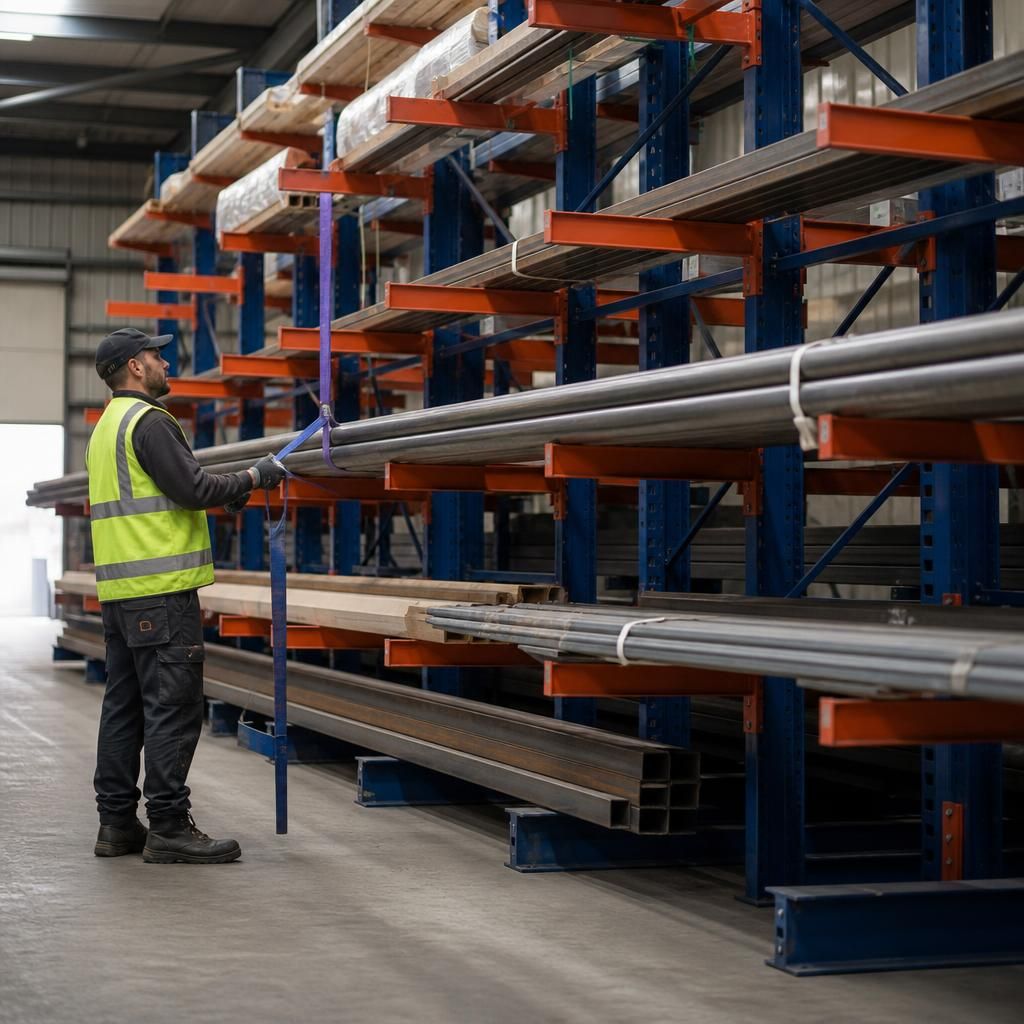
Cantilever warehouse racking improves handling efficiency by giving operators direct access to long, bulky and awkward loads. Because the arms are open at the front, materials can be placed, retrieved and checked from the aisle without working around front columns or moving other stock first.
This can reduce unnecessary repositioning and make the movement of goods more consistent between receiving, storage and dispatch. To achieve this benefit, loads should be assigned to suitable locations based on their dimensions, weight and handling frequency, with enough aisle space for the equipment in use.
Efficiency also depends on safe operation. Loads must remain within the system’s rated capacity, sit securely on the arms and be handled with suitable lifting equipment. Clear labelling, good housekeeping and regular warehouse racking inspections help maintain accessible storage positions while identifying damage or unsafe loading conditions promptly.
Improve Your Cantilever Warehouse Racking Efficiency
Ask Able Racking to review your cantilever warehouse racking layout, load requirements and handling processes to identify practical efficiency improvements. Contact our experienced team to arrange an assessment or discuss your next warehouse racking project.