
How does cantilever warehouse racking enhance accessibility and inventory management?
Cantilever warehouse racking improves accessibility by keeping long, bulky and irregularly shaped items visible and reachable from open-front storage bays, without obstructive front uprights. Clearly arranged levels, labelled locations and consistent stock rotation make it easier to identify, retrieve and monitor inventory while making better use of available warehouse space.
Cantilever warehouse racking enhances accessibility and inventory management by storing long, bulky and irregularly shaped goods in open-front bays with clear access from the aisle. Unlike systems with front uprights obstructing the load face, its arms support materials along their length, making stock easier to see, identify, handle and return to the correct location.
Improved access to stored materials
The open-front design is particularly useful for timber, steel sections, pipes, tubes, sheet materials, mouldings, furniture components and other goods that are difficult to store on standard pallet positions. Loads can be placed directly on the arms and retrieved without moving several other items first, provided the system has been correctly designed for the products and handling equipment in use.
- Materials remain visible from the aisle, reducing time spent searching for the correct item.
- Long products can be stored horizontally without being forced into unsuitable locations.
- Goods can be accessed from the front without working around obstructive front columns.
- Different product lengths, profiles and pack sizes can be allocated to suitable levels or bays.
- Forklift operators and other authorised personnel have a clearer view of the load position during placement and retrieval.
Accessibility still depends on the overall warehouse layout. Aisle widths must allow the selected handling equipment to approach, turn and operate safely. The arms, columns, braces and load stops must also be positioned so that they support the goods without creating unnecessary obstructions. Where hand-picking is involved, frequently used items should be stored at practical working heights to reduce excessive reaching, lifting and manual handling.
Clearer stock identification
Open storage makes it easier to check what is held in each bay without unloading the system. This supports accurate stock identification and helps warehouse teams distinguish between similar products, grades, dimensions or batches. Bay references, level identifiers and durable product labels should be visible from the operating aisle and matched to the organisation’s stock records.
A consistent location structure is important. For example, products can be arranged by type, length, customer order, material grade or frequency of use, depending on the operation. The chosen arrangement should be applied consistently across the warehouse so that employees can locate goods without relying solely on individual knowledge.
Labels should correspond with the warehouse management system, stock sheets or other inventory records. When stock is moved, the location record should be updated promptly. This prevents items being physically available but recorded against the wrong bay, which can lead to unnecessary searching, duplicate purchasing or delayed order fulfilment.
More effective stock rotation
Cantilever warehouse racking can support stock rotation when the layout and operating procedure are planned around the required movement sequence. Goods with an earlier receipt date, shorter shelf life or priority for dispatch can be assigned accessible locations. Although long materials may not always follow a conventional first-in, first-out process, clear labelling and planned placement can still help teams use older or priority stock before newer deliveries.
Stock rotation is easier when loads are not mixed carelessly within the same location. Where products vary by specification, batch or condition, separate and clearly identified positions should be used. This reduces the risk of selecting the wrong material and makes cycle counting or periodic stock checks more straightforward.
Better use of warehouse space
The system uses vertical storage space while keeping long loads accessible from the aisle. Levels can be set to suit the dimensions of the products rather than relying on fixed pallet locations. This can reduce unused space above stored goods and create a more orderly arrangement, provided there is sufficient clearance for safe handling and inspection.
Space efficiency must not be assessed solely by fitting in more products. The design needs to balance storage density with safe access, load visibility, handling routes, fire protection requirements, lighting, pedestrian movement and future changes in stock profile. Overcrowding bays or placing materials outside the supported load area can make access more difficult and increase the likelihood of damage.
Support for safer handling
Organised storage helps operators understand where each load should be placed and how it should be retrieved. This can reduce unnecessary movement, improvised stacking and attempts to handle products from unsuitable positions. Load stops, arm spacing and protective measures should be selected according to the stored goods and the way they are handled.
Operators should follow site procedures for loading, unloading and reporting damage. They should not climb on the structure, use arms as access steps or remove components to make room for a load. Any impact, bent component, displaced load, missing safety feature or other defect should be reported and assessed promptly. Regular inspections by a competent person remain essential, even where the arrangement appears orderly.
Practical steps for improving accessibility and inventory control
- Review the dimensions, weights, packaging and handling method for every product group.
- Assign products to bays and levels that provide suitable support and convenient access.
- Keep fast-moving or frequently selected goods in locations that minimise travel and manual handling.
- Use clear, durable labels that can be read from the normal operating aisle.
- Maintain a consistent location coding system across the warehouse.
- Keep aisles, access routes and the areas around the structure free from stored materials and obstructions.
- Record every stock movement accurately and investigate discrepancies rather than moving unrecorded items.
- Review the arrangement when product dimensions, stock quantities, handling equipment or work processes change.
For the best result, accessibility and inventory management should be considered during the design, installation and ongoing review of the cantilever warehouse racking system. A competent assessment can confirm that bay dimensions, arm levels, load capacities, aisle arrangements and protection measures are appropriate for the intended use. Combining a suitable layout with disciplined labelling, stock control and inspection procedures allows the system to remain accessible, organised and safe throughout its working life.
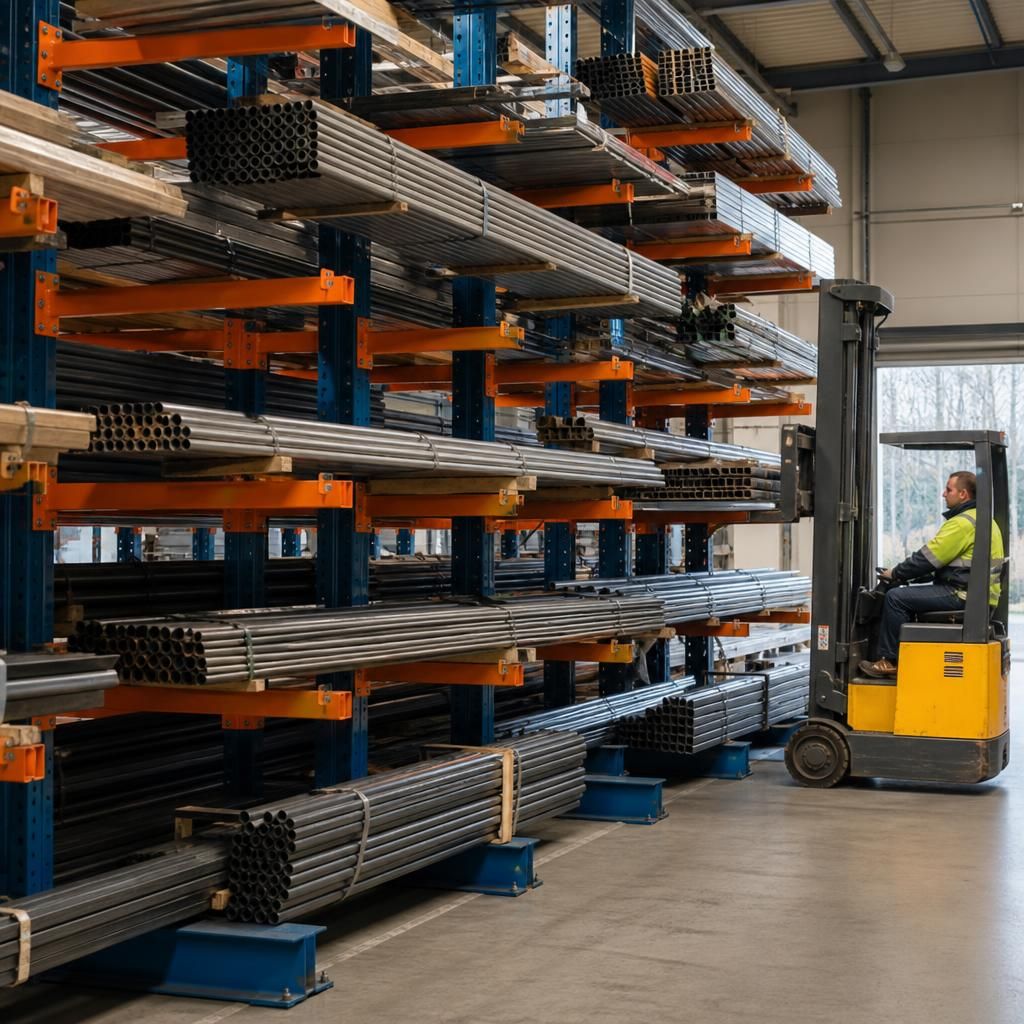
Clear location labelling is one of the simplest ways to improve inventory control on cantilever warehouse racking. Bay references, level identifiers and product descriptions should be visible from the operating aisle and match the warehouse management system or stock records.
Use a consistent structure based on product type, dimensions, material grade or dispatch priority. Keep similar items in clearly separated locations, record every movement promptly and investigate discrepancies rather than placing unrecorded stock in an available bay. This helps warehouse teams identify materials quickly, supports stock rotation and reduces incorrect selections without unnecessary handling.
Optimise Your Cantilever Warehouse Racking for Easier Access and Better Inventory Control
Speak to Able Racking to review your cantilever warehouse racking layout, access requirements and inventory control processes. Our experienced team can recommend practical improvements or arrange an inspection to help keep your storage system safe, organised and efficient.