
What safety measures should be implemented during the installation of cantilever warehouse racking?
During cantilever warehouse racking installation, safety measures should include a prepared and level work area, a competent installation team, suitable lifting equipment, controlled exclusion zones, and strict adherence to the manufacturer’s instructions and approved design. Each component must be securely fixed, correctly aligned and inspected before the system is loaded or put into service.
The essential safety measures during cantilever warehouse racking installation are proper design and site preparation, a competent installation team, suitable lifting equipment, controlled working areas, secure anchoring and a formal inspection before the system is used. Every upright, base, arm, brace and connection must be installed to the approved design and the manufacturer’s instructions. The completed warehouse racking should not be loaded until it has been checked and formally handed over.
Confirm the design and site conditions
Installation should begin with a review of the approved layout, load requirements and intended storage method. The design must reflect the type, length, weight and distribution of the materials to be stored, as well as the required arm spacing, clearances and access arrangements. Cantilever warehouse racking is particularly sensitive to uneven loading and unbalanced forces, so the design should account for the maximum loads on each arm and level rather than relying on estimates made on site.
The installation area should be checked before work starts. The floor must be suitable for the imposed loads, sufficiently level and capable of accepting the specified anchors. Installers should identify cracks, weak areas, obstructions, changes in floor level, vehicle routes, overhead services, fire protection equipment and emergency access points. Any discrepancy between the site and the approved design should be resolved before assembly begins.
Use a competent installation team
Cantilever warehouse racking should be installed by people who understand the system, the manufacturer’s instructions, safe lifting practices and the risks associated with working in an active warehouse. The team should be appropriately trained and supervised, with clear responsibility for coordinating the work, checking components and stopping the installation if unsafe conditions develop.
A pre-start briefing should cover the installation sequence, individual responsibilities, delivery arrangements, lifting operations, exclusion zones, emergency procedures and the controls needed around other warehouse activities. The method statement and risk assessment should be specific to the site and the warehouse racking system, rather than relying on a generic document.
Inspect components before assembly
All uprights, bases, arms, braces, connectors, bolts, anchors, end stops and protective items should be checked before they are installed. Components should match the approved specification and should be free from damage, distortion, excessive corrosion or unauthorised modification. Damaged parts should be quarantined and referred to a competent person or the manufacturer; they should not be straightened, welded or used as a temporary substitute without formal approval.
Components should be stored securely on stable ground so that they cannot roll, collapse or obstruct access routes. Long or heavy members require suitable supports and controlled handling. Careful storage also prevents damage before installation and reduces the risk of trip hazards in the work area.
Control lifting and handling operations
Suitable lifting equipment should be selected for the weight, dimensions and shape of the components. Equipment must be appropriate for the ground conditions and working space, inspected as required and operated by trained personnel. The lift should be planned so that the load remains stable and does not pass over people, occupied workstations or unprotected traffic routes.
Loads should be secured using suitable lifting accessories, with attention paid to their centre of gravity and the risk of long members swinging or rotating. Hands and feet should be kept clear of crush points, and installers should never stand beneath a suspended component. Where possible, components should be guided using controlled methods rather than by placing hands near connections or between members.
Establish an exclusion zone
The installation area should be separated from pedestrians, warehouse vehicles and unrelated work. Barriers, signs and a designated banksman can help prevent people entering the lifting and assembly zone. Traffic routes should be diverted or controlled where necessary, and communication between the lifting operator, banksman and installation team should be agreed before work starts.
The exclusion zone should remain in place while components are being lifted, positioned, bolted or temporarily supported. It should also cover areas where an unsecured upright or arm could fall. Good housekeeping is important throughout the work: packaging, fixings, tools and unused components should be removed from access routes and emergency exits.
Assemble the structure in the correct sequence
Uprights and bases should be positioned accurately and supported during assembly. Bracing, ties and connections should be installed in the sequence specified by the design or manufacturer so the structure becomes stable as work progresses. Installers should not leave partially assembled bays unsupported or rely on loose bolts, temporary props or lifting equipment to provide stability beyond the intended stage of the installation.
Bolted connections should be fitted with the correct fixings and tightened in accordance with the manufacturer’s requirements. Unauthorised drilling, cutting, welding or alteration can affect the strength and stability of the system and should not be carried out. Arms must be fully engaged and secured, with retaining devices correctly fitted. End stops or other load-retention measures should be installed wherever they are part of the design or necessary to prevent stored materials moving off the arms.
Anchor the warehouse racking correctly
Base plates should sit fully and evenly on the prepared floor, with anchors installed to the specified type, position, embedment and tightening requirements. Drilling should be controlled to avoid damaging embedded services or weakening the floor. Dust and debris should be removed from drilled holes where required by the fixing system, and anchors should be checked after installation.
Where the floor is uneven or packing is required, the solution must be approved as part of the installation method. Improvised packing, insufficient anchoring or unapproved changes to the base arrangement can transfer loads incorrectly and reduce the stability of the warehouse racking.
Maintain safe access and working-at-height controls
Where installers need to work above ground level, they should use suitable access equipment and follow the site’s working-at-height controls. Ladders should not be used as a substitute for an appropriate platform where extended assembly, forceful work or two-handed handling is required. Tools and components should be managed to prevent dropped objects, and areas below elevated work should remain clear.
Personal protective equipment should support, rather than replace, other controls. Typical requirements may include safety footwear, head protection, eye protection, gloves suited to the task and high-visibility clothing where vehicle movements are present. The precise selection should follow the site risk assessment and the work being undertaken.
Inspect and measure before handover
A competent person should inspect the completed warehouse racking before it is loaded. The inspection should confirm that the layout matches the approved design, uprights and arms are correctly aligned, braces and connections are secure, anchors are correctly installed and all retaining devices are present. The surrounding area should also be checked for adequate clearances, safe access, vehicle conflicts and obstructions to fire or emergency arrangements.
Any defects or deviations should be recorded and corrected before use. If the installation has been altered from the approved design, it should be reviewed by a suitably qualified person before acceptance. The handover information should include the intended load limits, operating restrictions, inspection arrangements, relevant drawings or instructions and details of any outstanding actions.
Prevent premature loading
Materials should not be placed on the arms while installation is incomplete or while anchors, connections or braces are awaiting inspection. Once the warehouse racking is approved for use, load notices should be displayed clearly and operators should be briefed on the permitted loads, positioning requirements and restrictions on impact or unauthorised alterations.
Safe installation is the foundation for continued warehouse racking performance. Planned inspections, prompt reporting of damage and controlled loading help confirm that the system remains stable after it enters service. Able Racking can support customers with installation checks, safety inspections and practical guidance tailored to the warehouse environment.
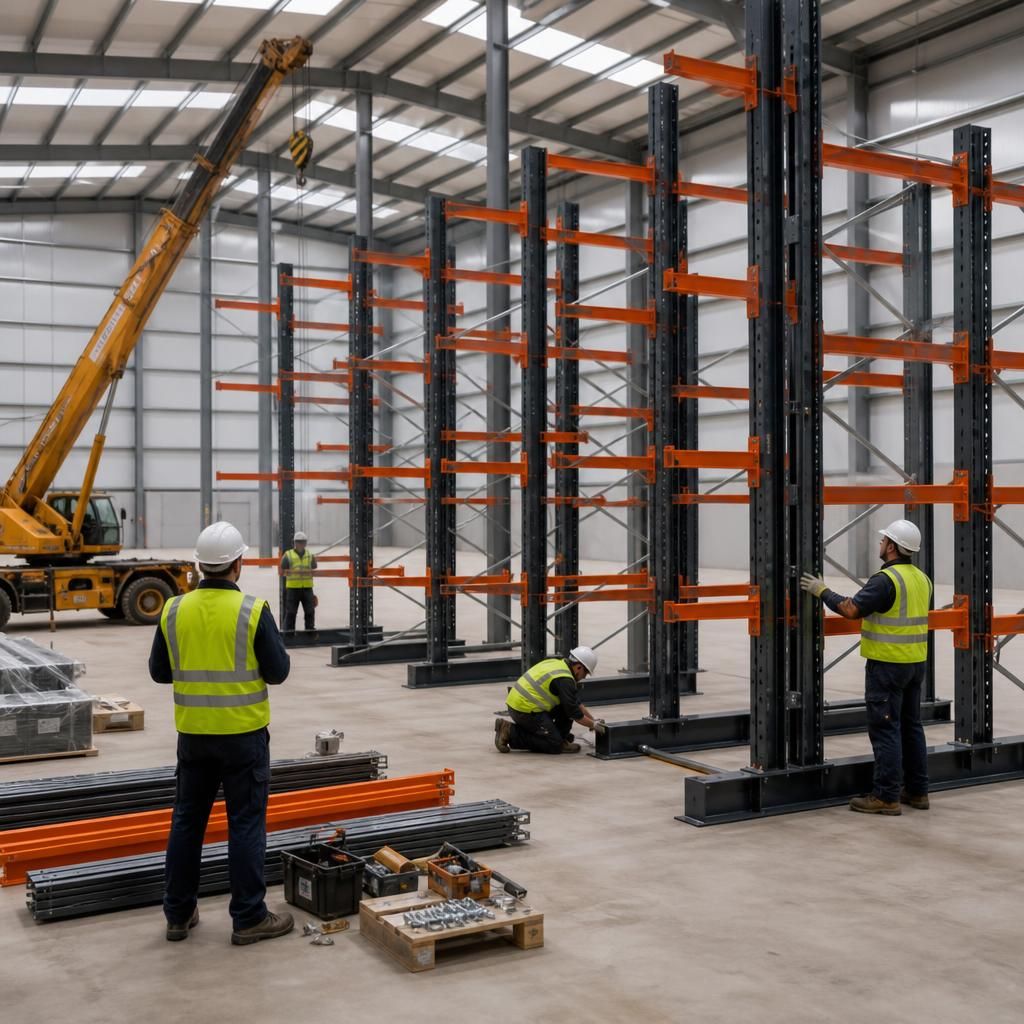
A controlled exclusion zone is essential during cantilever warehouse racking installation. Barriers and clear signage should keep pedestrians, warehouse vehicles and unrelated work away from lifting and assembly areas. A designated banksman should coordinate movements and maintain clear communication with the installation team, particularly when long or heavy components are being positioned.
The exclusion zone must remain in place while uprights, arms and braces are being lifted, secured or temporarily supported. Good housekeeping is also important: tools, fixings and packaging should be removed from access routes, emergency exits and areas below elevated work to reduce trip hazards and the risk of falling objects.
Arrange expert cantilever warehouse racking installation support
Arrange expert cantilever warehouse racking installation support from Able Racking, with competent installation, site checks and formal handover included. Contact our team to discuss your requirements and plan a safe, compliant installation.