
What factors should be considered when choosing materials for cantilever warehouse racking systems?
When choosing materials for cantilever warehouse racking systems, consider the loads, arm spans, storage environment, required durability, corrosion resistance, fire considerations, maintenance needs and total lifecycle cost. Structural steel is commonly selected for its strength and rigidity, but the specification should be based on a competent design assessment covering the stored goods, operating conditions and applicable safety requirements.
The most suitable materials for cantilever warehouse racking systems are determined by the loads, dimensions and operating environment rather than by material cost alone. Structural steel is the usual choice for the columns, bases and arms because it provides the strength, stiffness and predictable performance required for long or heavy goods. The specification should also consider corrosion protection, impact resistance, decking, fire precautions, maintenance requirements and whole-life cost.
A competent designer should assess the proposed system before materials are selected. This assessment should reflect the type and weight of the stored goods, load distribution, arm length, column height, aisle arrangements, handling equipment, building conditions and the required safety factors. Changing from one material or finish to another can affect capacity, connection performance and the assumptions used in the design, so substitutions should not be made without technical approval.
Structural steel for the main framework
Structural steel is commonly used for the upright columns, base assemblies, arms, bracing and connecting components. Its principal advantages are high load-bearing capacity, rigidity and consistent engineered performance. These properties are important where goods are long, dense or unevenly distributed, as excessive deflection can affect stability, handling and safe storage.
The grade, section shape and thickness of the steel should be selected according to the design loads and the way forces pass through the system. Uprights must resist vertical loading as well as bending and movement caused by stored goods, loading activity and accidental contact. Arms need sufficient strength and stiffness to support the goods along their length without unacceptable deflection. Bracing and base connections are equally important because a strong arm or column cannot compensate for an inadequately restrained structure.
Material selection should therefore be based on the complete engineered system, not on the apparent strength of an individual component. The design documentation should identify the intended loads, configuration, limitations and any conditions that could reduce capacity.
Painted, galvanised or otherwise protected steel
The working environment has a direct influence on the required finish. Painted or powder-coated steel is often appropriate for clean, dry internal warehouse areas. A suitable coating can provide protection against general wear and corrosion, while also making damage easier to identify during inspections.
Galvanised steel or another corrosion-resistant specification may be more appropriate where the system is exposed to moisture, condensation, wash-down processes, high humidity, corrosive substances or outdoor conditions. The protection must be suitable for the actual exposure, not simply selected because it is described as durable. Joints, cut edges, drilled areas and damaged coatings can become vulnerable points and should be considered during design, installation and maintenance.
Where corrosion is already present, the condition should be assessed before repainting or covering the affected area. Surface treatment may improve appearance but will not restore steel that has lost significant section or structural capacity. Corroded components may require repair or replacement following a competent inspection.
Materials for arms and load support
Cantilever arms are subjected to bending forces and may experience concentrated loads when goods are placed or removed. The arm material and profile should be matched to the load, span, support arrangement and method of handling. End stops or lips may be incorporated to help prevent goods from sliding off, but they must not be treated as a substitute for correct loading or secure storage.
Where stored goods could roll, shift or rest unevenly, the design may require additional supports, restraint features or a different arm arrangement. The contact surface should also be considered. Smooth steel may be suitable for some products, whereas goods that are easily damaged or liable to move may require protective coverings, timber supports or other approved load-spreading measures.
Decking and load-spreading materials
Decking is selected according to the size, shape and condition of the goods. Steel decking can provide a robust, durable surface and may be suitable for demanding industrial use. Timber supports can be useful where a softer contact surface is needed or where stored products require separation from steel components, but the timber must be sound, appropriately sized and capable of supporting the intended load.
Any decking or packing material must sit securely on the arms and must not create an unstable overhang. It should not obstruct inspection points, interfere with bracing or alter the designed load path. Damaged, split, wet, contaminated or distorted timber should be removed, particularly where its condition could affect the stability of stored goods.
Materials that absorb moisture or degrade in the working environment may be unsuitable for certain warehouses. Where hygiene, contamination control or cleaning procedures apply, the chosen surface should be compatible with those requirements and easy to inspect.
Load characteristics and material strength
The material specification must reflect what is actually being stored. Long loads such as timber, steel sections, pipes, sheet materials and fabricated components can behave differently from compact palletised goods. Their weight may be concentrated at a few contact points, and their length can increase the risk of overhang, rolling or uneven loading.
Consider the following characteristics before finalising the material and component specification:
- the maximum weight of each load and the combined load on each level;
- the length, width, diameter and rigidity of the stored goods;
- whether loads are uniform, bundled, loose, flexible or liable to roll;
- where the load will contact the arms, decking or supports;
- the frequency and method of loading and unloading;
- the clearance required for handling equipment; and
- the consequences of a dropped, displaced or damaged load.
A material that performs well under a uniformly distributed load may be unsuitable where the same total weight is applied at isolated points. The design should account for the most demanding credible loading condition and clearly state any restrictions for operators.
Resistance to impact and operational damage
Material selection should account for the way the system will be used, including contact from forklift trucks, side loaders, cranes and other handling equipment. Steel provides a durable framework, but no material is immune to damage from collision, overloading or poor operating practices.
Where impact is foreseeable, the design may incorporate protection for vulnerable columns, bases and end areas. Protection must be positioned so that it does not obstruct access, reduce storage capacity or introduce new trip and handling hazards. It should also be inspectable and replaceable.
After installation, impact damage should be reported promptly. Bent steel, cracked welds, displaced connections, damaged coatings and distorted arms can indicate that the system no longer performs as designed. Painting over damage or straightening components without an approved repair method can conceal a serious defect.
Connections, welds and component compatibility
The strength of the system depends on more than the material used for its visible parts. Bolts, welds, base plates, anchors, pins and other connections must be compatible with the loads, steel sections and installation method. Differences in thickness, grade, hole positions or connection details can affect the transfer of forces through the frame.
Components should be supplied as part of a coordinated design or approved by the responsible technical professional. Mixing components from different systems, using unapproved replacement parts or altering holes and connections on site can invalidate the original design assumptions. Repairs should use materials and methods that restore the intended structural performance.
Fire and environmental considerations
Steel does not provide unlimited performance in a fire. Its strength and stiffness can reduce as temperatures rise, so fire strategy, building requirements, stored materials and insurance conditions should be reviewed where relevant. Coatings, protection systems and access arrangements must be compatible with the site’s fire precautions.
The storage environment may also expose components to chemicals, salt, fertilisers, cleaning agents or other contaminants. These can accelerate corrosion or damage protective finishes. The selected material and coating should be assessed against the specific substances present, with suitable cleaning and inspection arrangements included in the maintenance plan.
Whole-life cost rather than purchase price
The lowest initial material cost may not produce the lowest overall cost. A more durable coating or stronger protective detail may reduce corrosion, replacement work and operational disruption over the service life of the warehouse racking system. Conversely, specifying a more expensive material without a relevant environmental or structural need may provide little practical benefit.
Whole-life assessment should include manufacture, transport, installation, inspections, cleaning, repairs, replacement components, downtime and eventual disposal. Availability of compatible replacement parts is also important. A system that can be repaired promptly using documented, approved components is easier to keep safe and operational.
Practical selection process
- Define the goods, maximum loads, dimensions and loading patterns.
- Assess the building, operating environment, handling equipment and likely impact risks.
- Obtain a design that specifies the required steel sections, connections, finishes, decking and protection.
- Check that materials and coatings are suitable for moisture, chemicals, temperature and cleaning conditions.
- Confirm installation requirements, inspection access, load notices and maintenance arrangements.
- Review any proposed change or replacement component with the responsible designer before use.
Material choice is only one part of safe performance. Correct installation, load control, visible capacity information, operator training and regular inspections are necessary to confirm that the completed warehouse racking system remains suitable for service. If the operating conditions or stored goods change, the original material and capacity assessment should be reviewed rather than assuming the existing specification remains adequate.
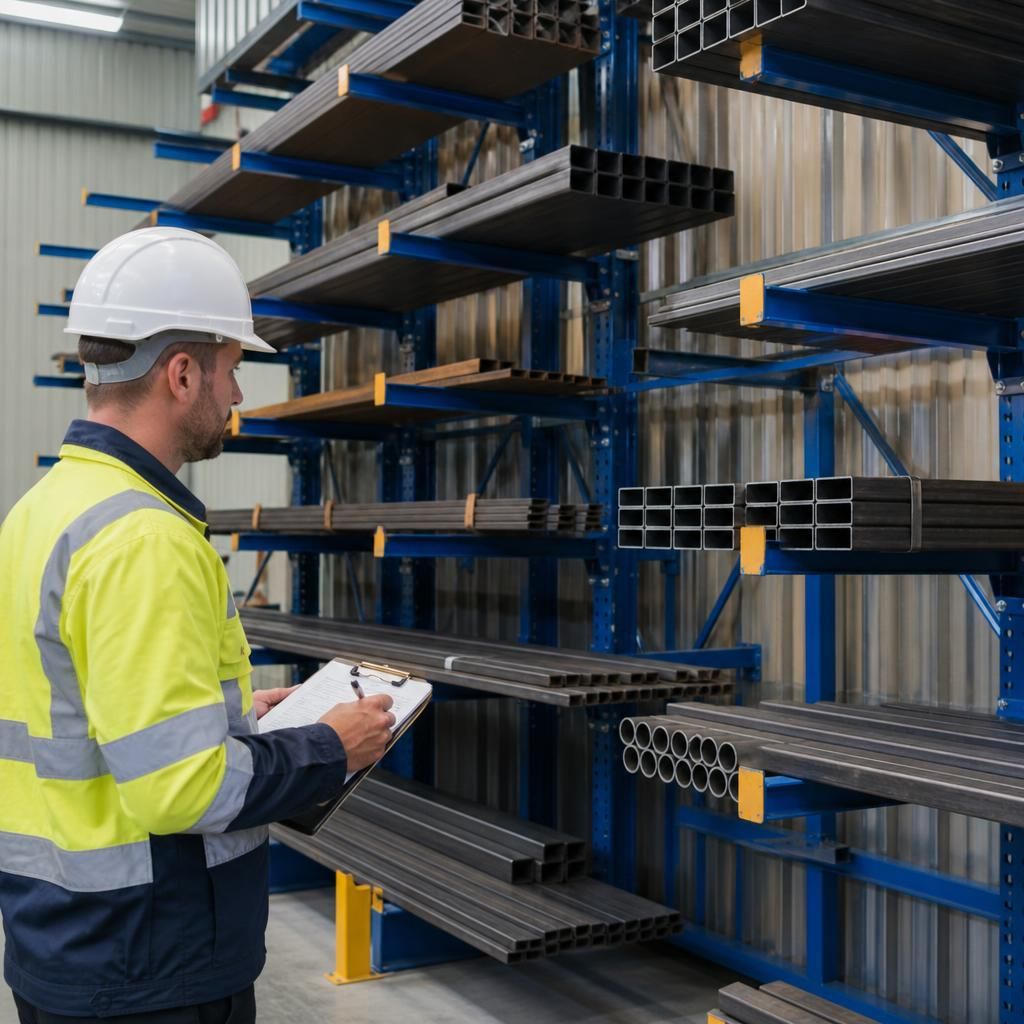
The finish applied to structural steel should match the warehouse environment, because moisture, condensation, wash-down procedures and chemical exposure can accelerate corrosion. Painted or powder-coated steel is generally suitable for clean, dry internal areas, while galvanised or specially protected steel may be more appropriate where components face persistent humidity, outdoor exposure or corrosive substances.
Selection should also account for vulnerable areas such as joints, drilled holes, cut edges and damaged coatings. These points require regular inspection because surface treatment cannot restore steel that has already lost significant section. If corrosion or impact damage is found, the affected component should be assessed by a competent person before it is repainted, repaired or returned to service.
Discuss your cantilever warehouse racking material requirements
Discuss your cantilever warehouse racking material requirements with Able Racking to confirm that the steel, finishes, decking and protective components suit your loads and operating environment.