
What are the most common causes of cantilever warehouse racking damage?
The most common causes of cantilever warehouse racking damage are forklift impact, overloading, incorrect loading, poor installation, corrosion and unauthorised alterations. Regular inspections, safe loading practices and prompt repairs help identify damage early and maintain a stable, compliant storage system.
Cantilever warehouse racking damage is most commonly caused by forklift impact, overloading, incorrect loading, poor installation, corrosion, unauthorised alterations and inadequate maintenance. These issues can weaken uprights, arms, bracing, connections and base plates, reducing the system’s stability and increasing the risk of a partial or complete collapse. Regular inspections, controlled loading and prompt repairs are essential for keeping the installation safe and compliant.
Forklift and vehicle impact
Forklift impact is one of the most frequent causes of damage in warehouse storage areas. A vehicle may strike an upright, base plate, arm or bracing member while approaching, loading or reversing from a bay. Even an apparently minor collision can bend a component, loosen a connection or damage floor fixings. Repeated low-level impacts can also cause cumulative damage that is not immediately obvious.
Impact protection, clearly defined vehicle routes and suitable operator training can reduce this risk. Any impact should be reported and assessed promptly rather than being treated as cosmetic damage. Damaged components may need to be unloaded, isolated and repaired or replaced by a competent person.
Overloading and exceeding the design capacity
Every cantilever warehouse racking system is designed for specific loads, arm capacities, bay configurations and storage conditions. Placing materials that exceed these limits can cause excessive deflection, permanent distortion or failure of an arm, upright or connection. The total load is not the only consideration: the weight, length, shape and distribution of the stored material all affect how forces are transferred through the structure.
Safe working load information should be displayed clearly and kept consistent with the approved design. Loads should not be added on the assumption that unused space represents unused capacity. Changes to the stored product, arm arrangement or bay layout should be reviewed before implementation.
Incorrect loading and uneven load distribution
Incorrect loading can damage a system even when the total weight is within its rated capacity. Long or heavy materials should be positioned so that the load is properly supported and does not create excessive leverage at the front of an arm. Concentrating weight at one end, allowing materials to overhang excessively or placing loads unevenly across a bay can increase local stresses and cause instability.
Loads should be placed carefully, kept stable and arranged in accordance with the system design. Materials should not be dragged across arms or dropped onto them, as this can damage protective finishes and deform structural members. Loose items should also be secured where their shape or position could allow them to roll or fall.
Poor installation or incorrect assembly
Installation defects can create weaknesses from the outset. Examples include incorrectly fitted arms, missing or unsuitable bolts, inadequate bracing, poorly aligned uprights, incorrect torque on connections and base plates that are not securely fixed to an appropriate floor. An installation may appear complete while still failing to meet the design requirements if components have been substituted or assembled incorrectly.
Installation should follow the approved design, manufacturer’s instructions and relevant safety requirements. The completed system should be checked by a competent person before it is put into use, particularly where the installation has been altered, extended or moved.
Unauthorised alterations and modifications
Removing bracing, changing arm positions, adding components from another system or altering the spacing between levels can affect the original load calculations. Welding, drilling or cutting structural members can also reduce their strength and invalidate the design assumptions. These changes are sometimes made to accommodate different materials but may introduce serious risks if they have not been assessed.
No alteration should be made without technical approval and a review of the system’s capacity and stability. Updated load notices and inspection records should be provided when an approved change affects the configuration or safe working limits.
Corrosion and environmental exposure
Moisture, condensation, chemicals and outdoor exposure can cause corrosion on uprights, arms, bracing, fixings and base plates. Corrosion reduces the effective thickness of metal and may weaken connections or conceal deterioration beneath coatings. Areas close to leaking roofs, wash-down facilities, loading doors and damp floors may require particular attention.
Corroded components should be assessed rather than simply painted over. The source of moisture or chemical exposure should be addressed, and affected parts should be repaired or replaced where their structural performance has been compromised.
Wear, fatigue and accidental damage during handling
Regular movement of long, heavy or awkward materials can cause wear to arms and contact points. Dropping loads, dragging them along the structure or using unsuitable handling equipment may bend components and damage end stops or restraints. Repeated loading and unloading can also loosen fixings or expose weaknesses that were not visible during routine use.
Handling procedures should match the design and the stored materials. Operators should be instructed to place loads under control and to report damaged components, missing restraints, loose connections or unusual movement immediately.
Inadequate inspections and delayed repairs
Damage becomes more difficult and costly to control when it is not identified early. A system may continue to be used with a bent upright, damaged arm or loose fixing until the defect worsens. Visual checks by warehouse personnel should be supported by formal inspections carried out at suitable intervals by a technically competent inspector. Inspections should cover structural members, connections, floor fixings, load notices, protection and the surrounding working area.
Findings should be recorded, prioritised and followed through to completion. Where damage presents an immediate risk, the affected bay should be unloaded and taken out of service until a competent person confirms that it is safe to use. Repairs should use suitable components and should not rely on improvised straightening, drilling or welding.
How to reduce the risk of damage
- Display accurate safe working load information and make sure operators understand it.
- Use suitable impact protection in areas where vehicles operate close to the structure.
- Keep vehicle routes, loading areas and access points clear and properly managed.
- Train operators to approach, load and remove materials without striking or dragging them across the system.
- Prevent unauthorised changes to the layout, components or load arrangement.
- Carry out routine visual checks and arrange formal inspections by a competent person.
- Record defects and complete repairs promptly, isolating unsafe bays where necessary.
- Review the design whenever the stored materials, operating methods or configuration changes.
The condition of cantilever warehouse racking should be judged by its structural components, loading conditions and operating environment rather than by appearance alone. A documented inspection and maintenance process helps identify the underlying cause of damage, distinguish repairable defects from components requiring replacement and maintain the system’s intended capacity. If impact or significant damage has occurred, stop using the affected area and arrange a competent assessment before work continues.
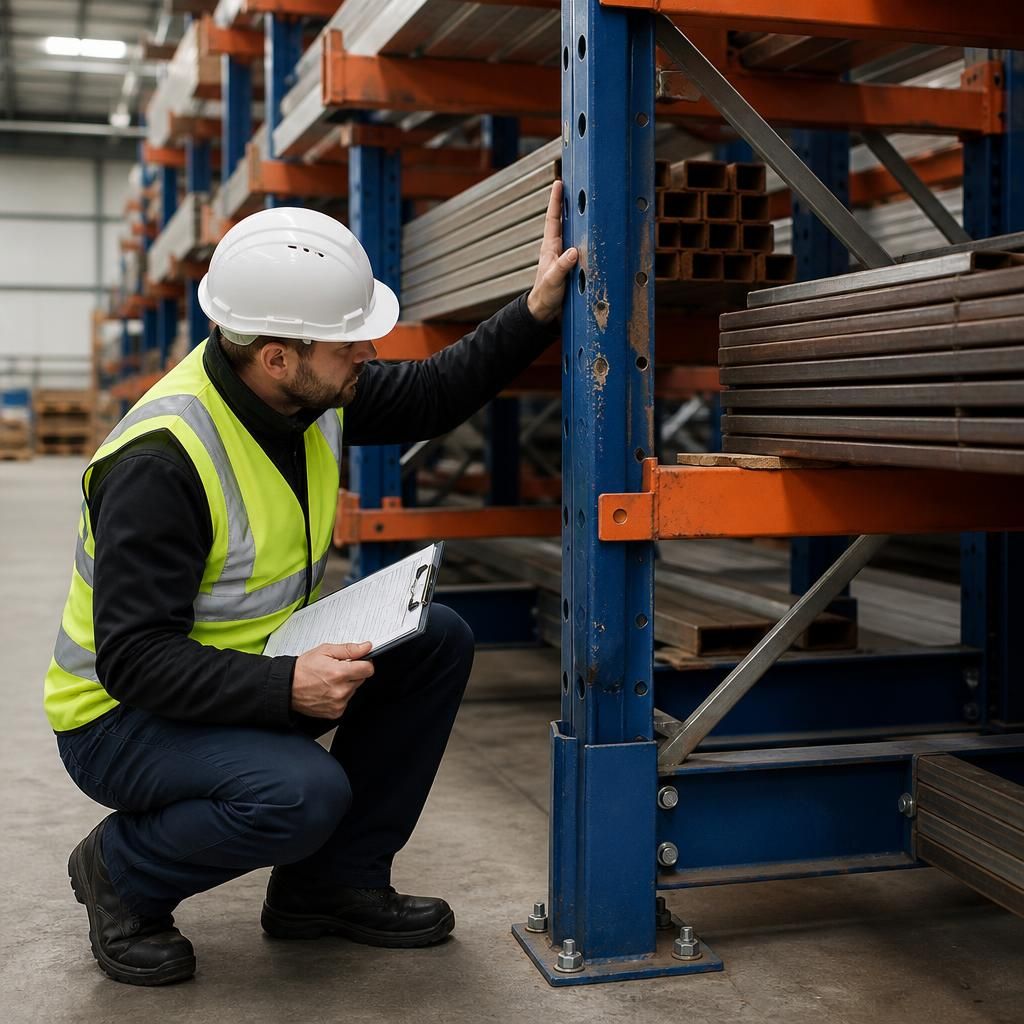
Forklift and vehicle impact is a common cause of cantilever warehouse racking damage because a collision can bend an upright, arm or bracing member, loosen floor fixings or distort a connection. Damage may not be obvious immediately, so even a minor impact should be reported and assessed rather than treated as cosmetic.
The affected bay should be unloaded and isolated where there is visible distortion, instability or uncertainty about its condition. A competent inspection can determine whether components require repair or replacement and confirm that the system remains suitable for use. Clear vehicle routes, suitable impact protection and operator training help reduce the likelihood of repeat damage.
Arrange a professional cantilever warehouse racking inspection
Arrange a professional cantilever warehouse racking inspection with Able Racking to identify damage, assess structural safety and confirm whether repairs or replacement are required.