
What are the key benefits of compliance in cantilever warehouse racking systems?
Compliance in cantilever warehouse racking systems helps keep people and stored materials safe by ensuring the system is correctly designed, installed, loaded, inspected and maintained. It also reduces damage and disruption, supports legal and insurance requirements, and helps the warehouse operate more efficiently with greater confidence in the system’s stability.
Compliance in cantilever warehouse racking systems helps protect people, stock and equipment by ensuring the system is properly designed, installed, loaded, inspected and maintained. It reduces the likelihood of collapse, falling materials and avoidable damage, while supporting legal duties, insurer requirements, efficient warehouse operations and informed decisions about repairs or replacement.
Improved protection for people and stored materials
Cantilever warehouse racking is designed to store long, bulky or awkwardly shaped loads. These loads can create significant forces on the upright columns, arms, bracing and base connections if they are placed incorrectly or exceed the system’s design capacity. Compliance helps confirm that the system is suitable for the intended materials and that its rated capacity is understood and followed.
A compliant system should have suitable protection against foreseeable risks, including:
- Loads falling from the arms or becoming unstable
- Forklift or vehicle impact to columns, bracing and end frames
- Overloading or uneven loading of individual arms
- Incorrectly positioned or poorly supported materials
- Progressive damage caused by an unreported defect
- Unauthorised alterations that affect structural stability
These controls reduce the risk of injury to warehouse operatives, drivers, contractors and visitors. They also help prevent damage to stored goods and nearby equipment.
Greater structural stability
Compliance provides assurance that the cantilever warehouse racking system is being used in accordance with its original design. This includes observing the specified load limits, arm spacing, bay configuration, ground conditions, anchorage arrangements and clearance requirements.
Where the system has been altered, extended or exposed to different loading conditions, a competent assessment can identify whether the existing design remains suitable. This is important because adding arms, changing the upright arrangement or storing heavier materials can affect the forces transferred through the complete structure. A system that appears visually sound may still require technical review if its configuration or use has changed.
Reduced risk of damage and disruption
Regular compliance checks identify damage before it develops into a more serious structural issue. Impacted uprights, bent arms, displaced bracing, loose fixings and damaged base connections should be assessed promptly rather than left in service without a decision.
Early action may involve unloading an affected area, installing a temporary control, arranging a repair or replacing a component. This is generally more manageable than responding to a collapse, an injury or extensive stock damage. It also helps reduce unplanned downtime and the disruption associated with closing storage areas at short notice.
Damage reporting is an important part of this process. Operatives should know how to report an impact or defect, and responsible personnel should understand how to isolate unsafe areas until the issue has been assessed.
Support for UK health and safety duties
Employers have duties to protect employees and others who may be affected by warehouse activities. Maintaining safe work equipment and storage systems forms part of a wider risk management process. For cantilever warehouse racking, this includes selecting suitable equipment, providing appropriate information and training, controlling vehicle movements, managing loads and arranging inspections by a competent person.
Industry guidance, including the principles set out in HSE warehousing guidance and the relevant European storage equipment standards, can help inform a suitable inspection and maintenance regime. Compliance is not achieved by holding a document alone. The system must be safe in its actual working environment, and identified defects must be acted upon within an appropriate timescale.
Clearer inspection and maintenance decisions
A compliant approach creates a documented process for routine user checks, formal inspections and corrective action. Routine checks by trained warehouse personnel can identify obvious defects, while a more detailed inspection by a competent inspector provides an independent assessment of the system’s condition.
Useful records may include:
- The location and identification of each cantilever warehouse racking system
- Inspection findings and photographs where appropriate
- Details of damage, risk classification and recommended action
- Repair, replacement or isolation records
- Evidence of completed remedial work
- Load information and relevant design or installation documentation
- Training records for people who use or inspect the system
Accurate records make it easier to identify recurring damage, monitor unresolved defects and demonstrate that appropriate action has been taken. They also help maintenance teams distinguish between acceptable wear, repairable damage and conditions requiring immediate isolation.
More efficient warehouse operations
Safety and efficiency are closely linked. Correctly labelled load capacities, consistent loading practices and well-maintained components make it easier for operatives to store and retrieve materials correctly. This can reduce handling errors, unnecessary repositioning and delays caused by inaccessible or unstable loads.
A compliant system also supports safer vehicle movements. Suitable aisle clearances, controlled operating procedures and protection for vulnerable structural components can reduce the likelihood of contact damage. Where the storage layout is changed, reviewing the traffic routes and loading activities helps ensure that the system remains suitable for the way the warehouse now operates.
Better control of legal, insurance and business risk
Inspection and maintenance records can provide useful evidence that foreseeable risks have been assessed and managed. They may also support discussions with insurers, auditors, landlords, customers or enforcing authorities where evidence of equipment safety is required.
Compliance does not remove liability or guarantee that an incident cannot occur. It does, however, demonstrate a controlled approach based on suitable design, competent installation, user training, planned inspections and timely corrective action. This is particularly important where warehouse operations involve contractors, visiting drivers or multiple shifts of personnel.
Longer service life for the system
Preventative maintenance helps preserve the condition of uprights, arms, bracing, fixings and protective components. Identifying corrosion, impact damage, loose connections or deterioration early can prevent avoidable stress on surrounding parts.
Extending the useful service life of cantilever warehouse racking depends on continued suitability, not simply keeping old components in place. If damage is beyond economical or technically appropriate repair, replacement should be considered. Reusing components, mixing parts or making unapproved modifications can compromise the original design and should not be undertaken without competent technical approval.
Improved workforce awareness
Compliance is more effective when the people using the system understand its limitations. Training should cover load capacities, safe placement and removal of materials, impact reporting, exclusion procedures and the importance of not climbing on the structure or making unauthorised changes.
Clear signs and instructions should match the actual system configuration. If the load arrangement, arm levels or stored materials change, the information provided to operatives should be reviewed. Practical training and clear reporting routes help turn inspection findings into preventative action.
Greater confidence in day-to-day use
The main practical benefit of compliance is a controlled and traceable approach to warehouse safety. When the design information is available, loads are managed correctly, inspections are completed and defects are dealt with promptly, responsible personnel can make decisions based on evidence rather than assumptions.
For a cantilever warehouse racking system, compliance should therefore be treated as an ongoing process rather than a one-off check. Regular user monitoring, formal inspections, planned maintenance, suitable training and competent advice work together to keep the system safe, stable and fit for its intended purpose.
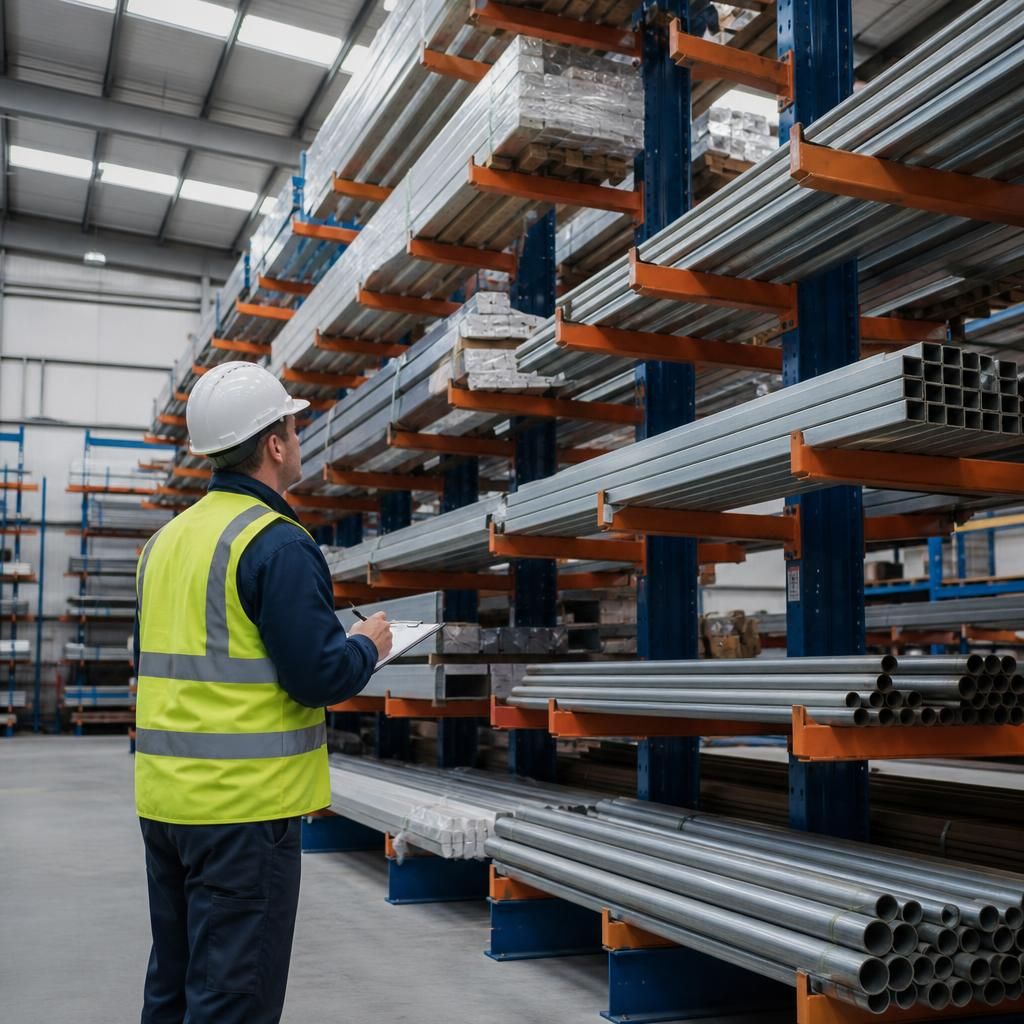
Compliance in cantilever warehouse racking means keeping the system suitable for its intended loads and ensuring that design information, inspections, maintenance and user procedures remain up to date. This gives warehouse teams a reliable basis for identifying defects and taking corrective action before they affect structural stability or daily operations.
One important benefit is better control of damage. A documented inspection process should record the location of each issue, its condition, the action required and confirmation that the work has been completed. This helps responsible personnel to:
- isolate unsafe areas promptly;
- arrange competent repairs or component replacement;
- identify repeated impact or loading problems; and
- demonstrate that reported defects have been managed appropriately.
Records should support, rather than replace, practical safety controls. Damaged uprights, arms, bracing or fixings must be assessed promptly, with affected loads removed or the area restricted where necessary. This traceable approach reduces avoidable disruption and helps keep the cantilever warehouse racking system safe, stable and suitable for continued use.
Arrange a cantilever warehouse racking compliance inspection
Arrange a cantilever warehouse racking compliance inspection with Able Racking to assess the system’s condition, identify risks and confirm any required corrective action.