
What factors influence the choice between single-sided and double-sided cantilever racking?
The choice between single-sided and double-sided cantilever racking is mainly influenced by available space, load requirements, access arrangements and whether the system can be positioned against a wall or in an open warehouse area. Single-sided units suit perimeter storage, while double-sided units provide access from both faces and can offer greater storage capacity within a central aisle.
The choice between single-sided and double-sided cantilever racking is primarily determined by the available floor layout, how materials need to be accessed, the required storage capacity and whether the system can be safely positioned against a wall or in an open area. Single-sided cantilever racking is generally suited to perimeter storage, while double-sided cantilever racking is normally used where access is required from both sides of a central run.
Both configurations can store long, bulky or irregularly shaped materials more effectively than conventional pallet storage. The correct option should be selected as part of the overall warehouse design rather than based on the frame arrangement alone. Load characteristics, handling equipment, structural conditions and safe operating clearances all need to be assessed before installation.
Available space and warehouse layout
Floor space is often the first consideration. Single-sided units can be placed against a suitable wall or at the edge of a storage area, using space that may otherwise be difficult to utilise. They provide access from the aisle-facing side while keeping the storage footprint close to the perimeter.
Double-sided units require access aisles on both faces, but they can provide storage on either side of the central frame. This can make them more efficient in a warehouse with sufficient open floor space, particularly where several runs can be arranged in a planned layout. The layout must still allow safe movement around the ends of the runs and provide enough clearance for loading and retrieval operations.
A site survey should consider columns, doors, loading bays, walkways, emergency exits, fixed plant and other obstructions. The available area should be measured in three dimensions, including the clear height beneath lighting, sprinklers, roof structures and services. A configuration that appears suitable on a plan may not be practical if it restricts access or creates unsafe interference with other warehouse activities.
Required access and handling methods
Single-sided cantilever racking is appropriate when operators and handling equipment approach stored materials from one direction. This can simplify traffic management where the storage is located along a wall or at the edge of a working area.
Double-sided cantilever racking is more suitable when materials need to be loaded or collected from both sides. It can reduce unnecessary travel between storage locations and may support a more flexible picking arrangement. However, two-sided access also requires careful control of aisle use. Operators must be able to manoeuvre safely without striking the frames, arms or stored loads.
The handling equipment used on site is an important factor. Forklifts, side loaders, cranes and manual handling methods have different turning, reach and clearance requirements. The position of the operator, the direction of approach and the dimensions of the materials must be considered when determining aisle widths and arm heights. Manufacturer guidance and the handling equipment supplier’s recommendations should be reviewed together.
Type, size and weight of the loads
The stored materials influence both the configuration and the specification of the cantilever racking. Long steel sections, timber, pipes, boards, profiles and other extended products may require different arm lengths, spacing and load distribution arrangements.
Single-sided units can be suitable where the load profile is consistent and all materials are presented from one face. Double-sided units may provide greater flexibility where materials vary in length or are grouped according to different production, picking or dispatch requirements. The decision should not be based only on the total weight of the stock. The weight per arm, per level and per upright, together with the position of the load, is also relevant.
Loads should remain within the stated capacity of the system and be positioned so that they cannot slide, roll or project into an access route. If materials have a tendency to roll, suitable restraints or end stops may be required. Any changes to the stored products, arm positions or loading method should be checked against the original design and load notices.
Wall conditions and building structure
A single-sided configuration may be installed near a wall, but the wall should not automatically be treated as a structural support or a substitute for suitable racking protection. The system normally needs to remain stable through its own base design, anchorage and approved installation method.
The condition and construction of the floor are particularly important for either configuration. The slab must be capable of supporting the imposed loads, while the fixings must be suitable for the floor type and installation environment. Uneven floors, damaged concrete, joints or hidden services can affect where the units can be positioned and anchored.
Double-sided units are often installed in open areas, so the stability of the complete run, the relationship between adjacent runs and protection from vehicle impact need to be considered. A competent survey and installation assessment should confirm that the proposed arrangement is appropriate for the building and operating conditions.
Storage density and future requirements
Double-sided cantilever racking can make better use of a central storage zone because both faces of the run are available. This may be valuable where perimeter space is limited or where the warehouse requires a higher density of long-load storage without extending the storage area unnecessarily.
Single-sided units can be easier to phase around an existing operation. They may be added along suitable boundaries without creating a new central traffic route, which can be useful where the warehouse is divided into distinct working areas. The choice should also account for likely changes in stock range, load weights and handling equipment. A system designed only for current materials may become unsuitable if future loads are longer, heavier or handled differently.
Where expansion is likely, the proposed layout should allow for additional runs, safe aisle arrangements and any changes to access routes. It is generally more efficient to plan this before installation than to reposition loaded units later.
Safety, protection and compliance
Safety requirements apply to both single-sided and double-sided cantilever racking. The system should be designed, installed and used in accordance with the relevant manufacturer’s instructions and applicable workplace safety guidance. Load notices should be visible, accurate and kept up to date.
Double-sided arrangements may need additional consideration because both faces are exposed to vehicle movements and loading activity. End-of-aisle protection, upright guards and other impact protection may be appropriate, depending on the site risk assessment. Single-sided units positioned beside walls, walkways or workstations also require protection where they could be struck or create a hazard for people nearby.
Regular inspections should check for bent arms, damaged uprights, loose components, missing restraints, displaced loads, degraded fixings and signs of impact. Any damage that could affect stability or capacity should be reported promptly, with the affected area unloaded and controlled until a competent person has assessed it. The selected configuration does not remove the need for planned maintenance, operator training and routine visual checks.
Cost and operational practicality
The purchase cost is only one part of the comparison. Installation complexity, floor preparation, protection, handling equipment, aisle space and the effect on travel distances can all influence the overall value of each option. A double-sided system may provide more usable storage in an open area, but it may also require more planning for traffic flow and protection. A single-sided system may be simpler where suitable perimeter space already exists, but it can provide less storage capacity within the same central floor area.
The best choice is therefore the configuration that supports safe daily operations while making effective use of the available building. A competent assessment should review the proposed loads, dimensions, access equipment, floor condition, wall locations, traffic routes and future requirements before a final specification is agreed.
In practical terms, choose single-sided cantilever racking when storage can be located along a suitable boundary and materials only need to be accessed from one face. Choose double-sided cantilever racking when the warehouse has sufficient open space, requires access from both sides and would benefit from a central, higher-capacity storage arrangement. Whichever option is selected, the design, installation and inspection process should be completed by experienced operatives and supported by clear load information and staff training.
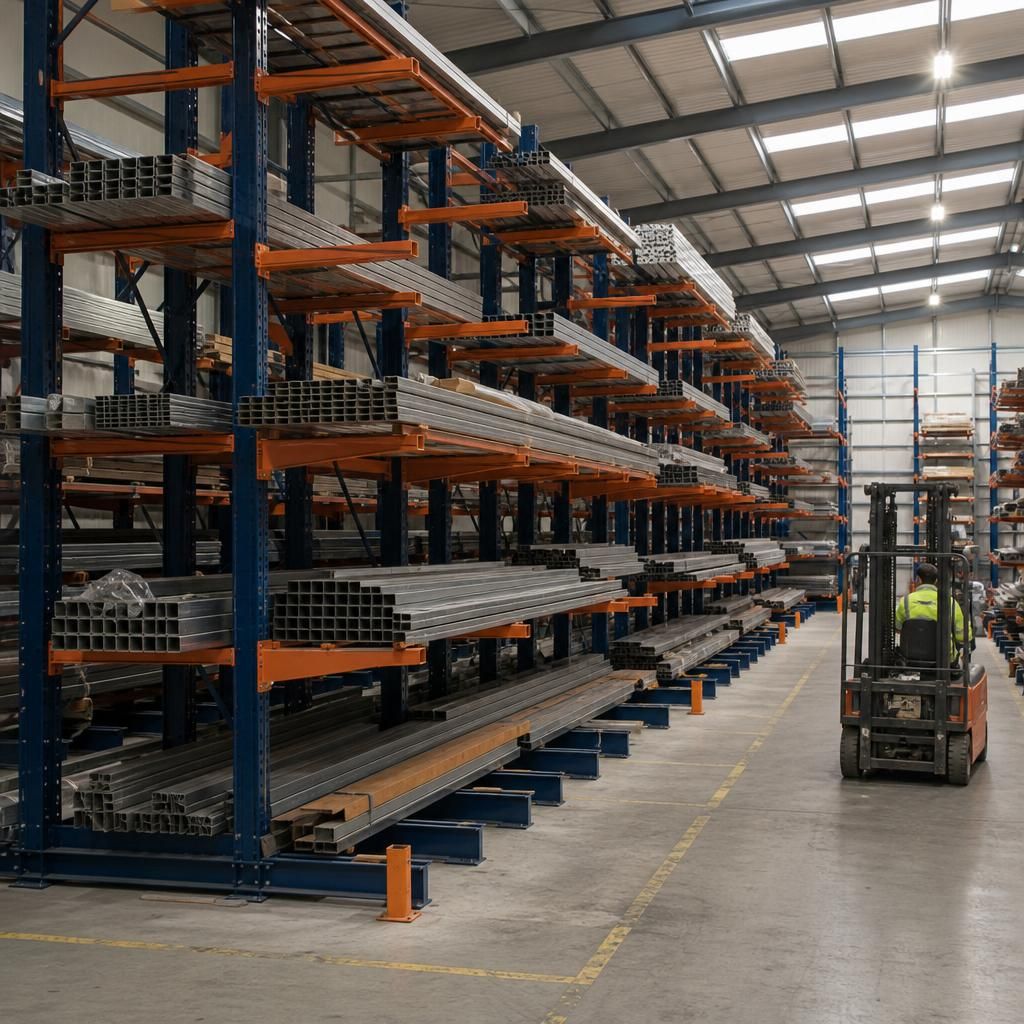
The choice between single-sided and double-sided cantilever racking depends largely on how the available warehouse space will be accessed. Single-sided units suit storage positioned against a suitable boundary, where materials are loaded and retrieved from one aisle. Double-sided units are better suited to open areas where both faces can be accessed safely, providing storage on either side of the central frame.
Before selecting a configuration, assess aisle widths, handling equipment, load dimensions, traffic routes, walls, doors and emergency access. The layout must provide enough clearance for safe manoeuvring and prevent stored materials from obstructing walkways or neighbouring operations. A competent site assessment will confirm whether the proposed arrangement is practical, stable and suitable for the intended loads.
Discuss your cantilever racking requirements with our experts
Discuss your cantilever racking requirements with our experts to assess your warehouse layout, load characteristics and access needs. We can help you determine whether a single-sided or double-sided configuration is suitable for safe, efficient storage.