
What are the main differences between single-sided and double-sided cantilever racking?
Single-sided cantilever racking provides storage on one side of its uprights, while double-sided cantilever racking stores materials on both sides. The main differences are access, floor-space efficiency, capacity and positioning: single-sided systems suit perimeter locations, whereas double-sided systems are generally better for central warehouse aisles and higher-density storage.
Single-sided and double-sided cantilever racking differ mainly in where they store loads and how they use available floor space. Single-sided cantilever racking has arms extending from one face of the upright, so it stores materials on one side only. Double-sided cantilever racking has arms on both faces, allowing loads to be stored and accessed from opposite sides. As a result, single-sided systems generally suit walls, boundaries and perimeter locations, while double-sided systems are usually positioned in central warehouse aisles where access from both sides is possible.
Single-sided cantilever racking
A single-sided system is designed to stand against, or close to, a suitable wall or boundary. Its uprights and arms face into the storage area, leaving the rear side unavailable for loading. This arrangement can make effective use of otherwise unused perimeter space without placing storage in the middle of an aisle.
- Loads are placed and retrieved from one side only.
- The system is suitable for installation against a wall or along the edge of a warehouse.
- It can help preserve open circulation space where storage access is required from only one direction.
- Its total storage capacity is limited by the available length of the structure and the number and capacity of the arms on one face.
- It may be the more practical choice where the warehouse layout cannot provide safe access to both sides.
Single-sided cantilever racking is often appropriate for timber, sheet materials, pipes and other long loads stored along a perimeter. However, the wall behind the system should not be treated as structural support unless it has been specifically assessed and designed for that purpose. The upright frames and bases must be selected to support the imposed loads independently and safely.
Double-sided cantilever racking
A double-sided system has storage arms projecting from both faces of the upright frames. It is normally installed in a free-standing row, with an aisle or other suitable access route on each side. This allows the same upright structure to serve two storage faces and can provide a higher storage density within a defined floor area.
- Loads can be loaded and unloaded from both sides.
- The system is suited to central warehouse runs rather than locations directly against a wall.
- It can reduce the amount of floor space needed for a given storage requirement when both faces are used efficiently.
- It supports more direct access to different load positions, provided the aisle arrangement allows suitable handling equipment movement.
- Its design must account for the combined loading on both sides, not simply the capacity of one face.
Double-sided cantilever racking can be particularly useful where materials need to be grouped by size, type or frequency of use and accessed from more than one route. It is not automatically the better option, however. The additional storage face only provides a benefit if there is enough room for safe aisles, suitable handling equipment and controlled loading and unloading on both sides.
Key differences in space and layout
The most visible difference is the way each system occupies the warehouse. Single-sided cantilever racking uses the perimeter and leaves the area behind the uprights unavailable for storage access. Double-sided cantilever racking uses a central position and requires access aisles on both sides, but it can store materials on both faces of the same row.
When comparing layouts, assess the complete footprint rather than looking only at the width of the uprights. Include the required aisle widths, vehicle turning areas, loading clearances, pedestrian routes, emergency access and any space needed to handle long or awkward materials. A double-sided system may offer greater storage density, but a poorly planned aisle can restrict access and reduce its practical capacity. A single-sided system may provide less storage per row while making the overall traffic flow simpler.
Access and handling differences
Single-sided cantilever racking provides one-direction access. This can make stock control straightforward where all loading and retrieval take place from the same aisle. It may also reduce the risk of unplanned traffic passing through the rear of a storage row.
Double-sided cantilever racking provides two-direction access, which can improve flexibility and make better use of handling routes. It also introduces additional traffic-management considerations. Forklift trucks, cranes or other handling equipment must have adequate clearance on both sides, and operators must be able to place loads without striking adjacent arms, uprights or stored materials. The operating procedure should make clear which equipment is permitted, how loads are approached and how pedestrians are kept separate from vehicle movements.
Capacity and structural design
Neither system has a standard capacity that can be assumed from its appearance. The safe working load depends on the design of the uprights, bases, arms, bracing, arm spacing, load dimensions, load distribution, floor conditions and the way materials are placed on the system.
For a single-sided system, the design primarily considers the loads applied to one face. For a double-sided system, the structure must be assessed for the intended loading arrangement on both faces, including situations where one side is more heavily loaded than the other. The supplier or structural designer should provide clearly stated load information for each relevant component and configuration.
Loads should be stable, within the specified dimensions and supported across the appropriate number of arms. Concentrated loads, uneven bundles and materials that project beyond the arms can create forces that differ substantially from the assumed design loading. Do not increase the load simply because unused space remains on an arm.
Safety and inspection considerations
Both types require competent installation, clear load notices and regular checks. Inspectors should consider the condition of the bases, uprights, arms, bracing, fixings, protective features, floor and stored loads. Damage from handling equipment, missing components, displaced arms and overloaded positions should be reported and addressed promptly.
Double-sided systems require particular attention to both faces, including the rear face that may be overlooked during routine checks. Single-sided systems still need adequate rear clearance, stable positioning and protection against impact from vehicles operating in the adjacent aisle. Any proposed change to the layout, arm levels, load type or handling equipment should be reviewed before it is introduced.
Which system should you choose?
Choose single-sided cantilever racking when storage is best located along a wall or boundary, access is needed from one direction, or the warehouse layout cannot accommodate a safe aisle on both sides. Choose double-sided cantilever racking when central rows are possible, materials need to be accessed from opposite sides and the available floor area benefits from storage on both faces.
The correct choice should be based on the complete operating arrangement rather than storage capacity alone. Review the material dimensions and weights, handling equipment, aisle requirements, stock rotation, available floor area, building constraints and future storage needs. A properly designed layout should then be checked against the manufacturer’s specifications and inspected after installation to confirm that it is suitable for the intended use.
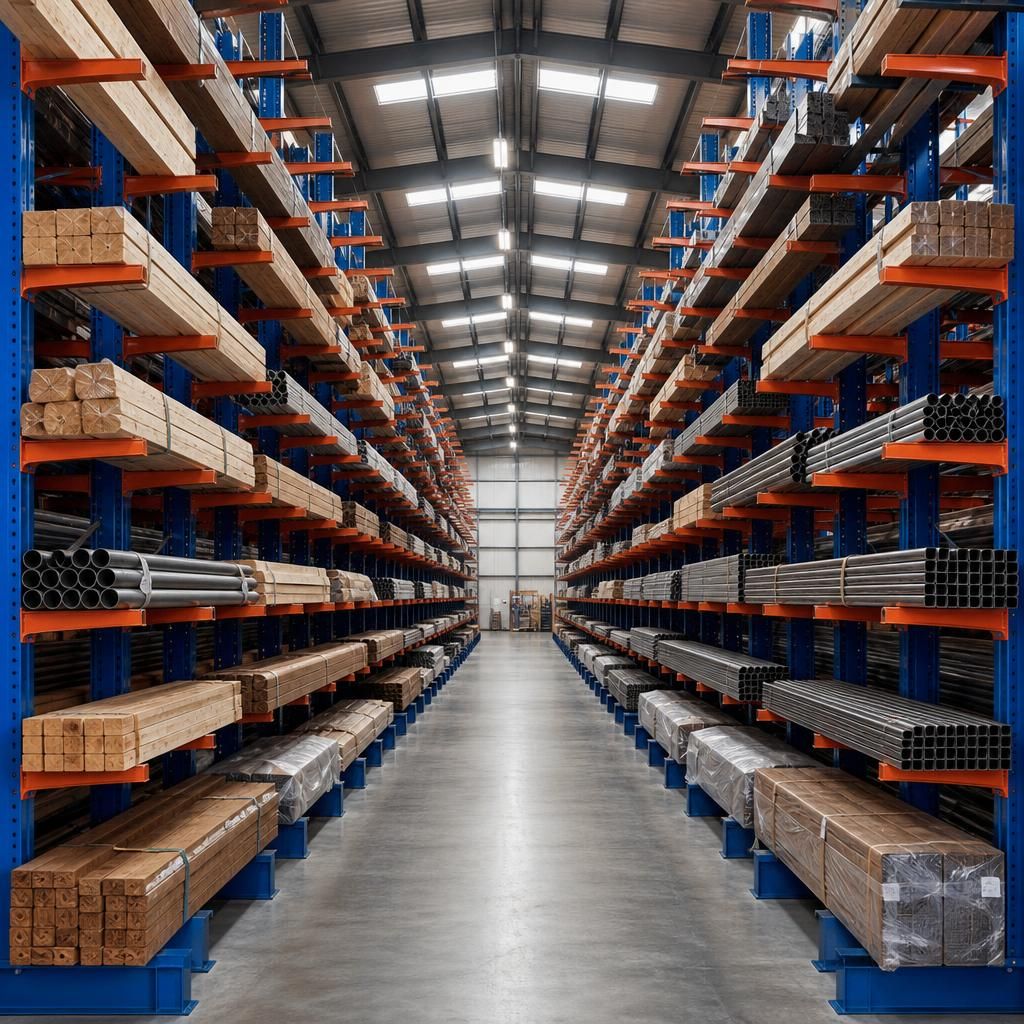
The main practical difference between single-sided and double-sided cantilever racking is how each system uses warehouse space. Single-sided cantilever racking is normally positioned against a wall or boundary, with loads accessed from one aisle. Double-sided cantilever racking is installed as a free-standing row, allowing materials to be stored and retrieved from both faces.
When comparing the options, assess the complete layout rather than the storage row alone. Double-sided cantilever racking can provide greater storage density, but it requires safe access aisles, suitable handling-equipment clearance and effective traffic management on both sides. Single-sided cantilever racking may provide less storage per row, but can be more suitable where perimeter space is available or access is required from one direction only.
Discuss your cantilever racking requirements with our experts
Discuss your cantilever racking requirements with our experts to compare single-sided and double-sided options against your available space, handling equipment and storage needs.