
What are cantilever shelves, and how do they benefit warehouse storage?
Cantilever shelves are warehouse racking storage levels supported by horizontal arms fixed to upright columns, rather than by front posts. They provide clear, accessible storage for long, bulky or irregularly shaped items, improving product visibility, handling access and the efficient use of available warehouse space.
Cantilever shelves are warehouse racking storage levels formed by horizontal arms fixed to upright columns, rather than supported by front posts. This open-front design provides clear access to long, bulky or irregularly shaped goods, such as timber, steel sections, pipes, sheet materials, mouldings, furniture components and other items that do not fit efficiently into conventional pallet storage.
A cantilever system normally consists of a stable base, vertical columns, horizontal arms and bracing. The arms can be positioned at different heights to create adjustable storage levels. Depending on the goods and the layout, shelves or decking may be added to the arms to support smaller items or products that need a continuous surface. End stops, retaining pins and other accessories can also be specified where they are appropriate for the stored materials.
The main benefit is unobstructed loading and retrieval. Because there are no front uprights at each storage level, operators can place materials directly onto the arms using suitable manual handling equipment or warehouse vehicles. This reduces interference when handling long loads and makes it easier to see the full length of stored products before removal.
- Improved access: Open-front storage makes goods easier to load, identify and retrieve, particularly where items vary in length or are handled regularly.
- Better use of vertical space: Adjustable arm positions allow the available height to be arranged around the dimensions of the stock, subject to the system’s design and safe working limits.
- Greater flexibility: Storage levels can often be adapted as product ranges, stock profiles or handling methods change.
- Reduced product obstruction: Long materials are less likely to overhang into adjacent storage locations when the system is correctly designed for their dimensions.
- Clearer stock visibility: The open structure makes it easier to identify stored materials and maintain an orderly warehouse.
- Efficient floor planning: Cantilever warehouse racking can provide dedicated storage for awkward loads that might otherwise occupy floor space or be placed unsafely against walls.
Cantilever shelves are particularly useful where goods are long, heavy, flexible, easily damaged or difficult to stack. Their suitability depends on the load dimensions, weight, length, stiffness, handling equipment and required access. For example, bundles of timber may require different arm spacing and load distribution from individual lengths of pipe or sheet material. The design should account for both the heaviest expected load and the way that load is placed onto or removed from the arms.
Single-sided units are generally positioned against a wall or at the edge of a storage area, while double-sided units allow access from both sides and can be used within a warehouse aisle. The correct arrangement depends on available space, traffic routes, access requirements and the need to separate different product types. A competent designer should also consider aisle widths, vehicle clearances, floor condition, column protection and the risk of loads extending beyond the storage footprint.
Load capacity must never be judged by appearance alone. Each component and complete bay has defined safe working limits, and the permissible load can change according to arm position, spacing, column height, bay configuration and how evenly the goods are distributed. Capacity information should be displayed clearly, and operators should be trained not to exceed the stated limits or use damaged components.
Safe use also depends on disciplined loading practices. Materials should be placed centrally and evenly across the supporting arms, with any specified retaining devices fitted correctly. Loads should not be dragged across arms, thrown into position or allowed to project into walkways without suitable controls. Warehouse traffic routes should be kept clear, and vehicles should be operated with enough clearance to avoid striking columns, bases or stored materials.
Regular inspection is essential because impact damage, bent arms, distorted columns, loose connections, missing retaining devices and changes to the warehouse layout can affect the integrity of the system. Operators should report visible defects immediately and, where necessary, isolate the affected area until it has been assessed. A planned warehouse racking inspection by a competent person provides a more detailed check of structural condition, load notices, protection, housekeeping and safe use. Repairs should be completed using suitable parts and approved methods rather than improvised alterations.
When selecting cantilever shelves, consider the following points:
- the length, weight, shape and stability of each stored product;
- the required number and height of storage levels;
- whether access is needed from one side or both sides;
- the handling equipment and operating clearances;
- the floor’s ability to support the imposed loads;
- protection against vehicle impact and unauthorised changes;
- future changes in stock profiles or storage requirements; and
- inspection, maintenance and operator training arrangements.
In summary, cantilever shelves provide a practical form of warehouse racking for long and awkward materials because the supporting arms leave the front of each storage level open. They improve access, visibility and flexibility while making better use of available height. The benefits depend on accurate design, clearly defined load limits, suitable handling procedures and ongoing inspection. A site-specific assessment is the appropriate way to confirm the required configuration and ensure the finished installation is safe, compliant and suited to the warehouse operation.
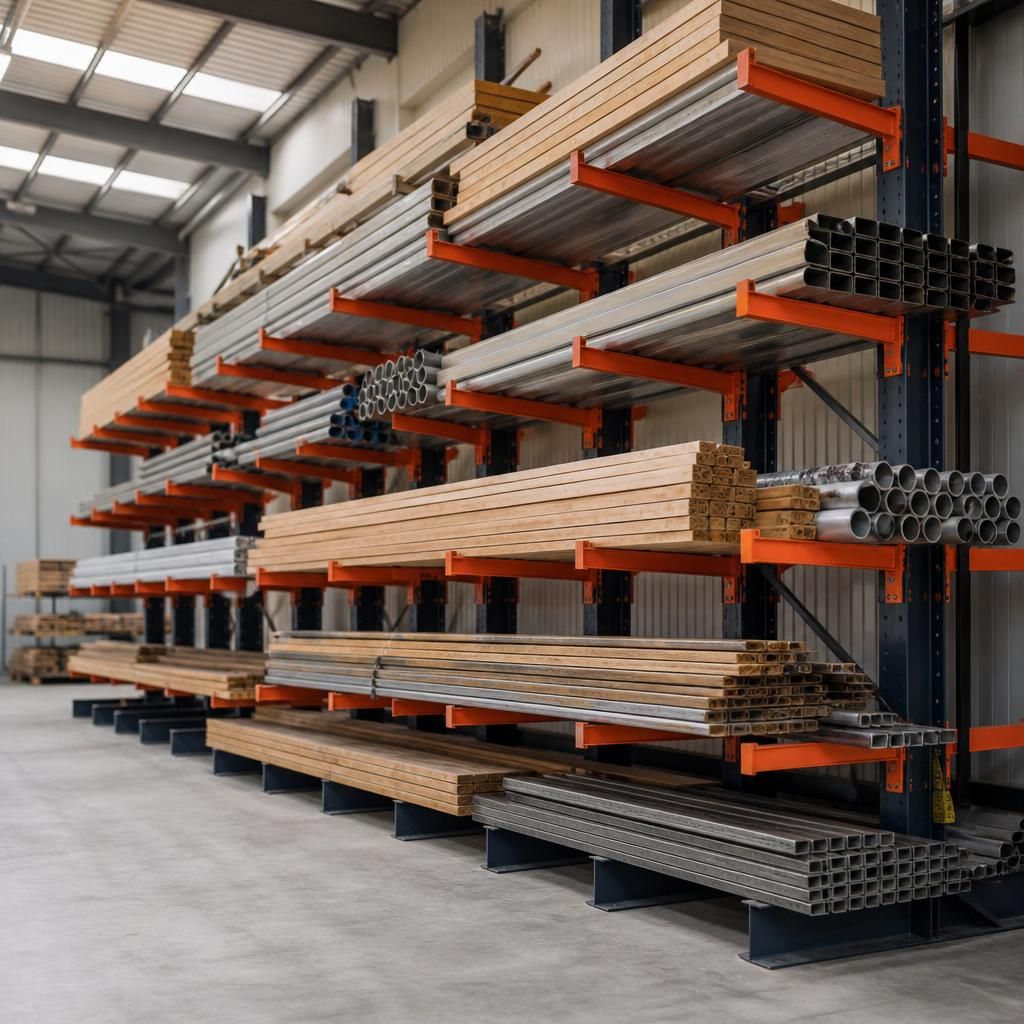
Cantilever shelves are open-front warehouse racking levels supported by horizontal arms fixed to upright columns. This design is particularly suitable for long or awkward materials because front posts do not obstruct loading, retrieval or visual checks of the stored goods.
The arm positions can be adjusted to suit the dimensions of the stock, helping operators separate different product types and use available height more effectively. Shelves or decking may be added where smaller items need continuous support, but the system must still be designed for the intended load and handling method.
- Check the weight, length and stability of each product before setting arm spacing.
- Distribute loads evenly and keep materials within the designed storage footprint.
- Maintain clear vehicle and pedestrian routes around the storage system.
- Arrange regular inspections to identify impact damage, distorted components or missing retaining devices.
Discuss your cantilever shelf requirements
Discuss your cantilever shelf requirements with Able Racking to confirm the suitable warehouse racking configuration, load capacity and access arrangements for your materials. Our experienced team can assess your storage needs and advise on a safe, practical solution.