
What role do lifts and conveyors play in mezzanine loading solutions?
Lifts and conveyors support mezzanine loading solutions by moving pallets, goods and materials safely and efficiently between floor levels, reducing manual handling and improving the flow of stock through the warehouse. When correctly specified and integrated with guarding, access controls and operational procedures, they can increase productivity while supporting safer loading and unloading.
Lifts and conveyors form the main material-handling link between warehouse floor levels in mezzanine loading solutions. A lift transfers pallets, cages, cartons or other loads vertically, while a conveyor provides a controlled route for moving goods horizontally or between defined transfer points. Used together, they reduce manual handling, improve the movement of stock and help loading operations run more consistently.
The most suitable arrangement depends on the load, the available space, the required throughput and the way people access the mezzanine. A properly designed system should be treated as part of the wider access and loading solution, rather than as separate equipment added after construction.
The role of lift systems
Goods lifts and vertical material lifts are used where products need to move between the ground floor and the mezzanine deck. They are particularly useful for pallets, stillages, roll cages, containers and bulky items that cannot be carried safely on stairs. Depending on the design, a lift may serve a single loading point or several levels.
A lift can support operations by:
- Moving heavy or awkward loads without relying on manual carrying.
- Separating vertical goods movement from pedestrian routes.
- Reducing the time spent transferring stock between levels.
- Providing a consistent loading point for incoming and outgoing goods.
- Supporting better use of upper-level storage, production or picking areas.
Goods lifts are intended for materials, not unrestricted passenger travel. Where a system is required to carry people, it must be specifically designed, selected and safeguarded for that purpose. The lift type, platform dimensions, safe working load, travel distance and loading method must all match the intended use.
The role of conveyor systems
Conveyors move goods along a defined route once they have been placed on the conveyor. Roller conveyors are often suitable for stable pallets, totes and cartons, while belt conveyors can be better for smaller, irregular or less rigid items. Powered conveyors can maintain a controlled flow over longer distances, whereas gravity sections may be appropriate where the route and load allow them.
In a mezzanine loading application, conveyors can:
- Link a lift to a picking, packing, production or dispatch area.
- Move goods between transfer points with less repeated handling.
- Maintain a more predictable flow of materials during busy periods.
- Reduce the need for forklifts or pallet trucks to travel across pedestrian areas.
- Support a defined process for loading and unloading goods at each level.
Conveyors do not remove the need for suitable loading procedures. Operators still need to place goods correctly, control the flow, prevent overloading and deal safely with damaged or incorrectly positioned items. Stops, sensors, side guides and accumulation zones can help prevent collisions and product movement, but these features must be selected for the goods being handled.
How lifts and conveyors work together
A common arrangement uses a lift to move a load vertically and a conveyor to carry it to the next process area. For example, a pallet may be loaded onto a lift at ground level, transferred to the mezzanine deck, and then moved along a conveyor towards a packing or storage station. In the reverse direction, the same arrangement can transfer completed goods back to dispatch.
Integration is important because a poorly aligned transfer point can create delays, impact damage and unsafe manual intervention. The lift platform and conveyor should be positioned so that the load can be transferred without excessive pushing, pulling or reaching. Where a pallet truck or other handling equipment is used, there must be enough room for the operator to approach, position and remove the load safely.
Controls should also define the sequence of operation. A typical system may prevent the lift from travelling while its gates are open, prevent a conveyor from running when the receiving area is obstructed, and stop movement when an emergency device is activated. These interlocks need to be understood by operators and checked as part of planned maintenance.
Safety features and guarding
Vertical openings at mezzanine edges present a significant fall risk when a lift is not positioned at the loading level. Gates, barriers and interlocked access arrangements should prevent people from approaching an open edge or entering the lift area when the platform is absent. The precise arrangement depends on the lift design, loading method and site layout.
Conveyors also require guarding around moving parts, including drive mechanisms, nip points, chains, rollers and transfer areas. Emergency-stop devices should be accessible from the relevant working positions, and operators should be able to identify how to isolate the equipment before clearing a blockage or carrying out cleaning and maintenance.
Other important controls include:
- A clearly identified safe working load for the lift, platform and conveyor.
- Suitable edge protection wherever goods or people could fall from the mezzanine.
- Protection against loads rolling, sliding or falling from the conveyor.
- Safe separation between pedestrians, vehicles and moving equipment.
- Clear operating instructions and warning signage at loading points.
- Suitable lighting and adequate space for loading, unloading and inspection.
- Training that reflects the actual equipment and procedures used on site.
Choosing the right arrangement
Selection should begin with the goods being moved and the process they must support. Consider the maximum load, load dimensions, centre of gravity, base condition, packaging, frequency of movement and whether the goods are fragile, loose or liable to shift. A system designed for uniform pallets may not be appropriate for mixed cartons or wheeled cages.
The layout should then be assessed. Important factors include the floor and deck levels, available headroom, lift footprint, conveyor route, fire exits, pedestrian walkways, vehicle movements and access for maintenance. The equipment should not obstruct escape routes or create a new conflict between loading activity and routine work.
Capacity is not limited to the lift’s safe working load. The whole process must be considered, including the floor loading, conveyor capacity, transfer points, pallets or containers used, and the capability of the handling equipment. The chosen arrangement should also allow for foreseeable changes in product type or workflow without encouraging operators to exceed its design limits.
Compliance, inspection and maintenance
Lift and conveyor installations should be assessed against the requirements that apply to the equipment and its use. This may include the Provision and Use of Work Equipment Regulations, the Lifting Operations and Lifting Equipment Regulations where applicable, and work-at-height requirements for exposed edges and access points. A competent person should confirm which examinations, inspections and maintenance activities are required for the specific installation.
Routine checks should look for unusual noise, damaged guards, worn rollers, defective sensors, hydraulic or electrical faults, damaged gates, poor alignment and signs that loads are catching at transfer points. Safety devices should not be bypassed to maintain production. Any defect affecting safe operation should be reported, controlled and repaired by a suitably competent person.
Maintenance access should be considered from the outset. Engineers need safe access to motors, controls, rollers and lift components, while operators need a clear procedure for isolation and restart. Records of inspections, examinations, repairs and training provide useful evidence that the system is being actively managed.
Practical benefits for warehouse operations
When correctly specified, lifts and conveyors can make mezzanine loading more efficient by creating a repeatable route for goods and reducing unnecessary handling. They can also help organisations use vertical space without requiring every load to be moved by hand or carried through shared pedestrian areas.
The greatest benefits are achieved when the equipment, structure, guarding and procedures are planned as one system. A site assessment can identify loading risks, unsuitable transfer points and access issues before installation or modification work begins. It can also help determine whether a lift, conveyor, or combined solution is appropriate for the loads and workflow involved.
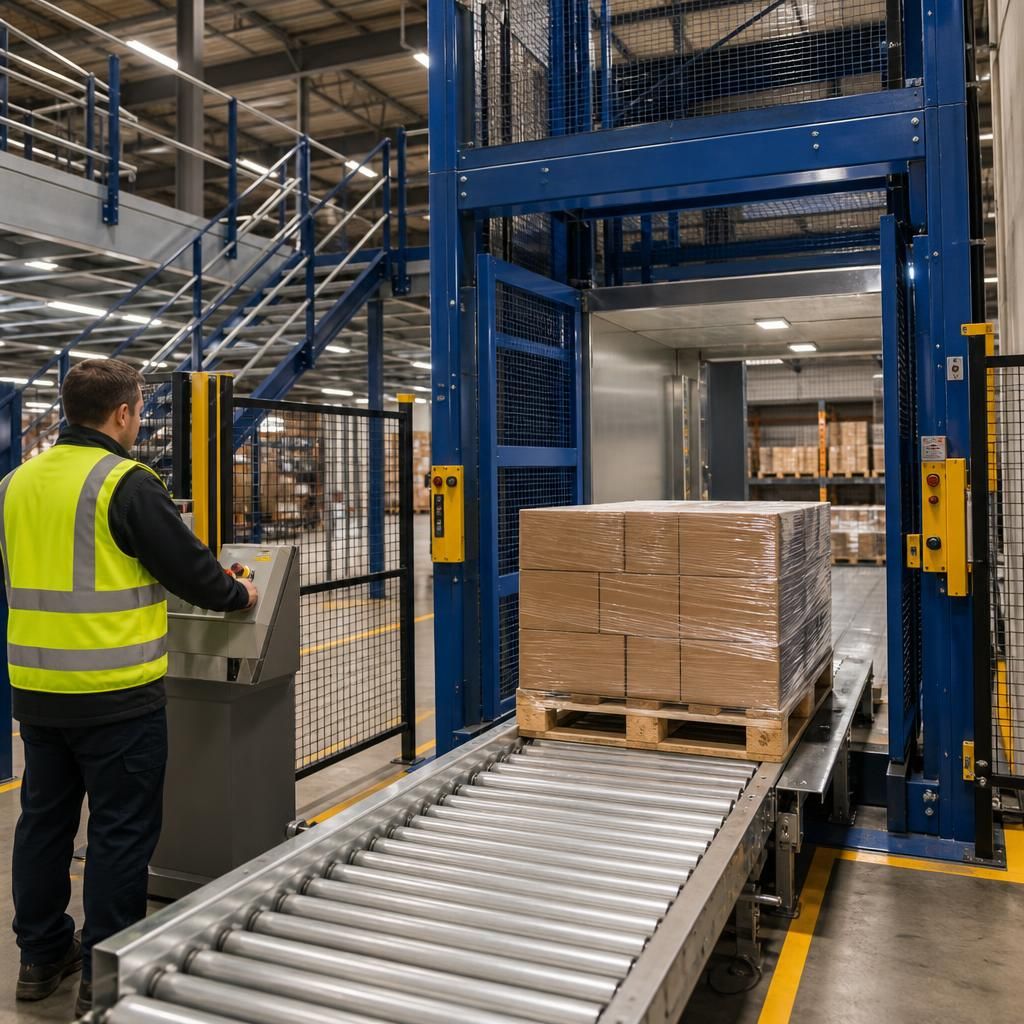
Integrating the lift, conveyor and loading point as one controlled system is essential for safe, reliable mezzanine goods movement. The equipment should be aligned so pallets, cages or cartons can transfer without excessive pushing, pulling, reaching or manual repositioning.
At each transfer point, check that the load is stable, the conveyor can accept its dimensions and weight, and there is sufficient space for the operator and handling equipment. Interlocked gates, emergency stops, sensors and physical guarding should prevent movement when the receiving area is obstructed or when access protection is not secure.
This arrangement also needs clear operating procedures. Operators should know how to load and unload safely, isolate the equipment before clearing a blockage and report damaged guards, misalignment or unusual movement. Planned inspections and maintenance help keep the lift, conveyor, controls and access protection working together as intended.
Discuss your mezzanine loading requirements
Discuss your mezzanine loading requirements with our experienced team to identify a safe, practical lift or conveyor solution for your operation.