
What considerations should be made for choosing the right conveyor system for mezzanine loading?
Choose a conveyor system for mezzanine loading by assessing the goods being moved, required load capacity and throughput, available space, transfer points, and how the conveyor will integrate with existing warehouse operations. Safety features, access for maintenance, future capacity, installation requirements and compliance with relevant standards should also be confirmed before selecting the most suitable configuration.
The right conveyor system for mezzanine loading is determined by the goods being transferred, the required capacity and flow, the available space, the height and direction of travel, and the way the equipment will interact with people and existing warehouse operations. A suitable design must move goods reliably while protecting operators, preserving access to the platform and allowing safe inspection, cleaning and maintenance.
Start by defining the operating requirement in practical terms. Consider:
- the type, weight, dimensions and stability of the goods;
- whether products are boxed, palletised, loose, fragile, irregular or prone to slipping;
- the required flow rate and whether goods must move continuously, intermittently or in batches;
- the direction of travel, including any changes between horizontal and inclined movement;
- the loading and unloading points, including the position of doors, gates, workstations and storage areas; and
- whether the conveyor must handle a single product type or a changing range of loads.
These details influence the choice between belt, roller, chain or other conveyor arrangements. Belt conveyors can provide a continuous conveying surface and are often suitable for smaller or less stable items. Roller systems may be appropriate for products with a firm, flat base, particularly where accumulation or manual transfer is required. Heavier or more demanding loads may require a more robust powered arrangement. The conveyor should be selected for the actual operating conditions rather than simply its maximum stated capacity.
Load capacity should include the weight of the goods, the spacing between items and the way loads are introduced onto the conveyor. A system that is adequate for an evenly distributed flow may not be suitable if heavy items are placed together or if loads are dropped onto the line. Account for starting loads, stopping loads, inclines and any accumulation zones. The design should also prevent items from overhanging, colliding or becoming unstable at transfer points.
Product dimensions are equally important. The conveyor width, roller pitch, belt type, side guides and transfer arrangement must suit the smallest and largest items expected in normal use. Check that packages will remain centred and that their shape will not create snagging points. If goods can vary significantly, adjustable guides or a more flexible conveyor configuration may be preferable to a system designed around one fixed package size.
The available layout and the height difference between levels will determine the physical configuration. Measure the route carefully, including headroom, clearances around the platform, access routes, fire exits, lighting, columns, doors and other equipment. Inclined conveyors need particular attention to grip, product stability and safe loading. Where the route changes direction, the transfer should be designed to avoid gaps or trapping points and to maintain control of the goods.
Loading and discharge points require detailed planning. Operators should not need to reach across moving equipment, step into the conveyor path or work beneath suspended loads. Provide a clear operating position at each manual interface, with suitable working space and a controlled method of introducing or removing goods. If goods are transferred through an opening in the platform, the opening must be protected when it is not in use, with access gates, guarding or another engineered solution appropriate to the arrangement.
Safety should be considered as part of the conveyor design rather than added after installation. A suitable risk assessment should identify hazards including nip points, moving belts or rollers, entanglement, falling goods, unexpected start-up, unauthorised access and interaction with vehicles or pedestrians. Depending on the design, safeguards may include:
- fixed guarding around accessible moving parts;
- emergency-stop devices positioned so they can be reached from normal operating and access areas;
- interlocked gates or access doors where entry to a hazardous area is possible;
- side guides, end stops and retaining features to prevent goods leaving the conveyor;
- physical separation between pedestrian routes and moving equipment;
- warning signs, audible or visual indicators where appropriate; and
- controls that prevent automatic restart after an emergency stop or power interruption.
Controls should be straightforward for operators to understand. Confirm whether the conveyor needs local controls, remote operation, automatic sequencing or integration with existing handling equipment. The control logic should define what happens when a downstream section is full, a sensor is obstructed, a gate is opened or an emergency stop is activated. Sensors and interlocks must be positioned and configured so that they support safe operation without creating avoidable stoppages.
Structural and building considerations must be checked before the system is specified. The supporting structure must be suitable for the conveyor, its goods, guarding, transfer equipment and any dynamic forces created during operation. Fixings, penetrations and supports should be agreed with the relevant structural and project specialists. Maintain required clearances from platform edges and ensure that the installation does not compromise edge protection, fire protection, lighting, ventilation or access for emergency response.
Maintenance access is an important selection criterion. Operators and engineers need a safe way to reach belts, rollers, motors, sensors and control panels without climbing on the conveyor or working in an unprotected position. Allow space for cleaning, adjustment, component replacement and fault finding. Isolating devices should be clearly identified, and the safe isolation procedure should be established before the system is put into service.
Consider the working environment as well as the goods. Dust, moisture, temperature, washdown requirements and the risk of product contamination can affect the choice of belt, bearings, motors, guarding and electrical equipment. In areas where noise is a concern, compare the operating characteristics of different conveyor types and specify controls or enclosures where necessary.
Compliance and documentation should be confirmed at the design stage. The completed installation should be supported by suitable risk assessments, operating instructions, maintenance information and records of commissioning. In the UK, work equipment must be suitable, maintained and used safely in accordance with applicable health and safety duties, including the requirements associated with the Provision and Use of Work Equipment Regulations. Where the overall solution includes separate lifting equipment, that equipment may require its own examination and compliance arrangements.
Installation planning can affect both cost and operational disruption. Agree how equipment will be delivered, lifted into position, assembled, tested and handed over. Check whether temporary closures, isolation of other equipment or out-of-hours work will be required. Before use, verify guarding, emergency stops, sensors, load movement, transfer points and stopping distances under realistic conditions. Operators should receive instruction covering normal operation, blocked conveyors, emergency stops, safe loading and reporting of defects.
Future requirements should also influence the specification. If product sizes, volumes or work areas may change, allow for adjustable guides, spare control capacity, accessible service areas and a layout that can be extended without creating new hazards. However, flexibility should not result in unused openings, unnecessary manual handling or a system that is more complex to operate and maintain than the task requires.
A practical selection process is to document the goods and workflow first, survey the proposed route, identify all personnel and vehicle interfaces, obtain a design that includes safeguarding and maintenance access, and then review the complete arrangement before ordering equipment. Able Racking can assess the loading operation, installation environment and safety requirements with the wider access solution in mind, helping ensure the chosen conveyor is suitable for present use and can be maintained safely throughout its working life.
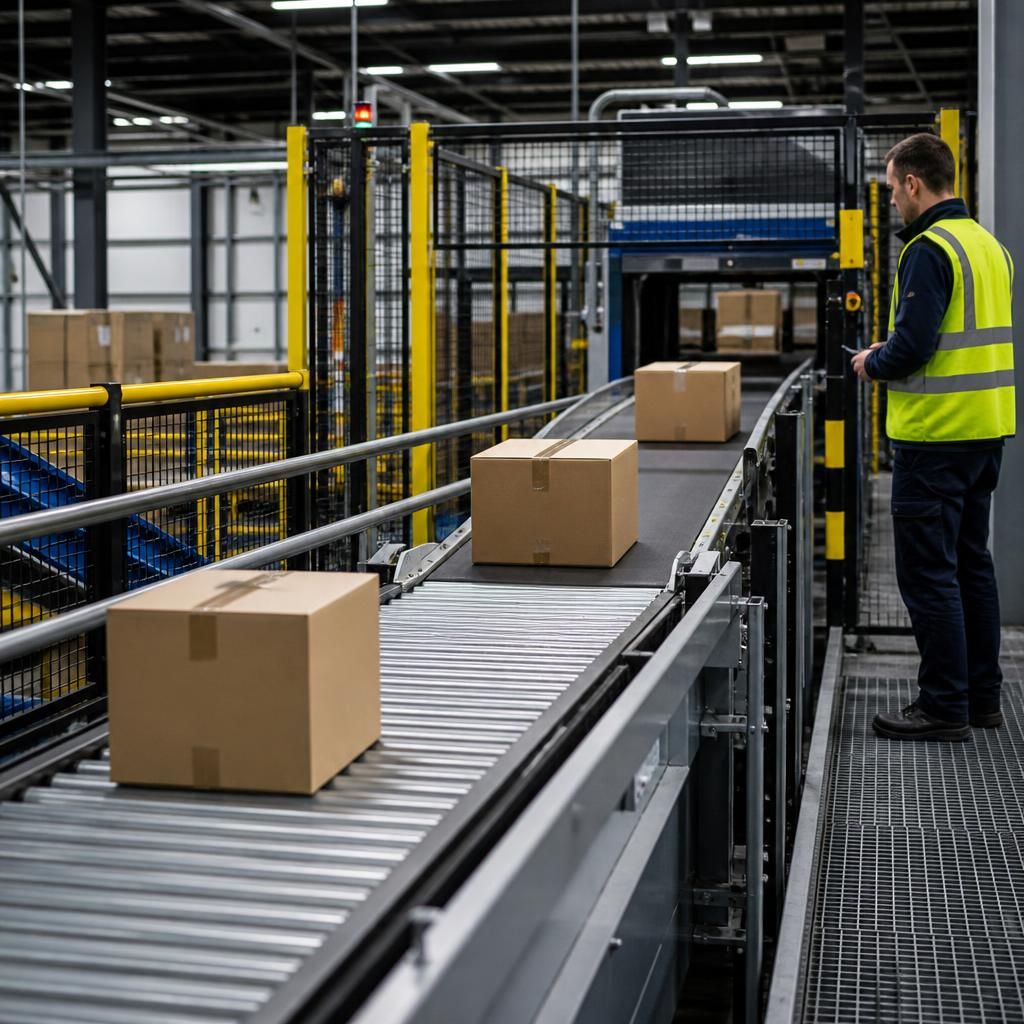
Safety at the transfer point is a key consideration when choosing a conveyor system for mezzanine loading. Where goods pass through a platform opening, the design must prevent people from reaching moving components or falling through the opening when the conveyor is not operating.
The arrangement should include suitable guarding, side protection and an engineered gate or interlocked access solution, depending on the layout and operating method. Emergency-stop controls must be accessible from normal working positions, while sensors and controls should prevent unexpected movement when access protection is open or a downstream section is blocked. Safe clearance around loading and discharge points is also essential, so operators do not need to reach across the conveyor or stand beneath moving goods.
Maintenance access should be planned at the same stage. Belts, rollers, motors and sensors need to be reachable for inspection and cleaning without climbing on the equipment or entering an unprotected area. Reviewing these points before installation helps ensure the conveyor supports efficient material movement without compromising access to the mezzanine platform or the safety of operators.
Discuss Your Mezzanine Conveyor Requirements
Discuss your mezzanine conveyor requirements with our experienced team to review the goods, layout, safety controls and installation requirements. We can help you assess a suitable conveyor configuration for safe, reliable loading operations.