
What are the different types of mechansims available for mezzanine loading and access systems?
Mezzanine loading and access systems use mechanisms such as goods lifts, vertical reciprocating conveyors, pallet gates, loading gates and fixed or powered conveyors. The appropriate option depends on the load type, travel distance, throughput, available space and required safety controls.
The main mechanisms used for mezzanine loading and access systems are goods lifts, vertical reciprocating conveyors, pallet gates, up-and-over gates, loading gates and fixed or powered conveyors. The correct choice depends on the load, lifting height, movement frequency, available floor space, operator involvement and the level of separation required between people and materials.
Each mechanism performs a different function. Lifting equipment moves goods between levels, gates provide a safe loading point at an exposed edge, and conveyors transfer products horizontally or between connected work areas. In many installations, two or more mechanisms are combined to create a complete and controlled materials-handling process.
Goods lifts
A goods lift, sometimes called a goods-only lift, transports pallets, cages, containers or other materials between the ground floor and the mezzanine. It is generally selected where loads are heavy, bulky or unsuitable for manual handling, or where goods need to travel vertically on a regular basis.
Goods lifts can be configured with single or multiple entry points, depending on the building layout. They may include powered doors, interlocked landing gates, controls at each level and guarding around the lift shaft. A goods lift must be designed for its intended load and operating conditions. It should not be used to carry people unless it has been specifically designed, approved and safeguarded for passenger use.
Important selection factors include the maximum load, platform dimensions, travel distance, loading method, available headroom and the required operating speed. The arrangement should also prevent a lift door or landing gate from opening when the platform is not correctly positioned.
Vertical reciprocating conveyors
A vertical reciprocating conveyor, or VRC, moves goods vertically on a platform or carriage. It is often suitable where materials need to be transferred between fixed levels but a conventional lift installation would not be appropriate for the required process.
VRCs can be used for pallets, cartons, totes and other unit loads. They may serve one or more levels and can be integrated with conveyor lines at the entry and exit points. Their design should include suitable guarding, landing protection, interlocked access points and controls that prevent movement when an unsafe condition is detected.
VRCs are intended for goods movement rather than general personnel access. Clear operating procedures are needed so that operators do not enter the travel area or use the equipment as a passenger lift.
Pallet gates
A pallet gate protects an open edge while allowing pallets to be loaded safely on to a mezzanine. It normally uses a barrier arrangement that presents a closed guard at the exposed edge when the loading position is not in use. The barrier is then moved or configured to allow the load through while maintaining protection on the other side.
Common designs include lift-out, swing, pivoting and counterbalanced pallet gates. A counterbalanced or mechanically assisted design can reduce manual effort, but it still needs to be correctly operated and maintained. The gate must be suitable for the pallet dimensions, loading equipment and expected frequency of use.
The key principle is that the exposed edge should remain protected during loading and unloading. The operating area, gate movement and load path must be assessed together to prevent trapping points, falling goods and unintended access.
Up-and-over pallet gates
An up-and-over pallet gate uses a barrier that rises above the loading area, allowing a pallet to pass beneath or into the protected zone without leaving the mezzanine edge unguarded. This can be useful where space in front of the platform is limited or where a side-opening gate would interfere with vehicle movement.
The gate should be balanced and operated in a controlled manner. Its dimensions must allow the intended loads to pass through without contact, while the surrounding guardrails and access points must remain effective. The design should also consider overhead obstructions, ceiling clearance and the position of lifting equipment.
Loading gates and material gates
Loading gates are available in several configurations, including hinged, sliding, bi-fold and removable designs. They are used to control access to a loading point and may be selected where the load type, available space or handling method does not suit a pallet gate.
A loading gate should not be treated as a simple barrier. Its position, locking method and relationship with adjacent guardrails are essential to safe operation. Gates should be designed so that they cannot be left unintentionally open when the loading point is unattended. Where a gate is removable, there should be a clear procedure for storage and refitting.
Fixed conveyors
Fixed conveyors provide a continuous route for cartons, totes, trays or other compatible loads between the floor and the mezzanine. They are useful where goods follow a predictable route and the operation requires a steady flow rather than occasional pallet movement.
Depending on the application, a conveyor may be gravity-fed, belt-driven, roller-based or chain-driven. A conveyor can be installed horizontally, at an incline or as part of a larger transfer arrangement. The choice depends on the load base, dimensions, weight, surface condition and required throughput.
Conveyor systems should include guarding around moving parts, accessible emergency stops and suitable controls at loading and discharge points. Transfer points need particular attention because they can create trapping, falling-object or collision hazards if the loads are not properly contained.
Powered conveyors
Powered conveyors use motors and control systems to move goods automatically or semi-automatically. They can be connected to sensors, accumulation zones, scanners and other handling equipment to regulate the movement of products between levels.
Powered systems are appropriate where the movement pattern is repetitive, the handling volume is consistent or manual transfer would create unnecessary lifting and carrying. They require a clearly defined control strategy, including start-up and shutdown procedures, isolation arrangements and access for cleaning or maintenance.
Where a conveyor crosses an access route, suitable guarding or controlled crossing arrangements are needed. Operators should be able to identify whether the system is running, stopped or isolated, and emergency controls should be accessible from relevant working positions.
Manual handling and access arrangements
Some mezzanine operations use a combination of stairs, hand-loaded transfer points and protected gates for lightweight or infrequently moved goods. This can be practical when powered equipment would be disproportionate to the task, provided the load is manageable and the process does not expose employees to avoidable risks.
Manual loading areas should have sufficient working space, good lighting, stable flooring and edge protection. The process should also consider lifting posture, load visibility, carrying distances and the risk of goods being dropped over the edge.
How to choose the appropriate mechanism
The most suitable mechanism is normally identified by assessing the complete movement process rather than selecting equipment in isolation. Consider:
- Load characteristics: assess weight, dimensions, shape, stability, packaging and whether the load is palletised.
- Vertical travel: confirm the level difference, available headroom, shaft or platform space and the required loading positions.
- Movement frequency: occasional transfers may suit a gate and manual process, while regular movement may justify a lift, VRC or conveyor.
- Throughput: establish how quickly goods need to be transferred and whether loads need to accumulate between movements.
- Available space: check the footprint, landing area, overhead clearance, aisle widths and access for installation and maintenance.
- Operator interaction: identify where people load, unload, control or approach the equipment, then provide suitable guarding and interlocks.
- Future requirements: allow for changes in product dimensions, load weights, operating patterns and planned expansion where reasonably foreseeable.
Safety and compliance considerations
Every system should be supported by a suitable risk assessment, safe operating procedure and planned inspection and maintenance regime. The assessment should cover falls from height, falling goods, trapping and crushing points, unauthorised access, manual handling, vehicle interaction and unexpected movement.
Depending on the equipment, relevant UK requirements may include the Provision and Use of Work Equipment Regulations and the Lifting Operations and Lifting Equipment Regulations. The exact legal duties depend on the design and use of the installation, so the equipment specification should be reviewed by a competent person before purchase or modification.
Protection should be continuous at exposed edges, except where a properly designed loading operation requires controlled access. Interlocked gates, barriers, landing doors, emergency stops, isolation points and warning signs should be selected according to the risks presented by the system. Safe working loads must be displayed where appropriate and must not be exceeded.
Before the system is put into service, it should be commissioned, checked and handed over with operating instructions. Users should receive practical training covering normal operation, load limits, reporting faults, emergency procedures and safe interaction with gates or conveyors. Regular inspections can identify wear, damage, alignment problems and failures in guarding before they affect the operation.
For an existing installation, changes to the load, layout or operating process should trigger a review. A mechanism that was suitable for occasional carton movement may not remain suitable after palletised goods, powered handling equipment or increased traffic are introduced.
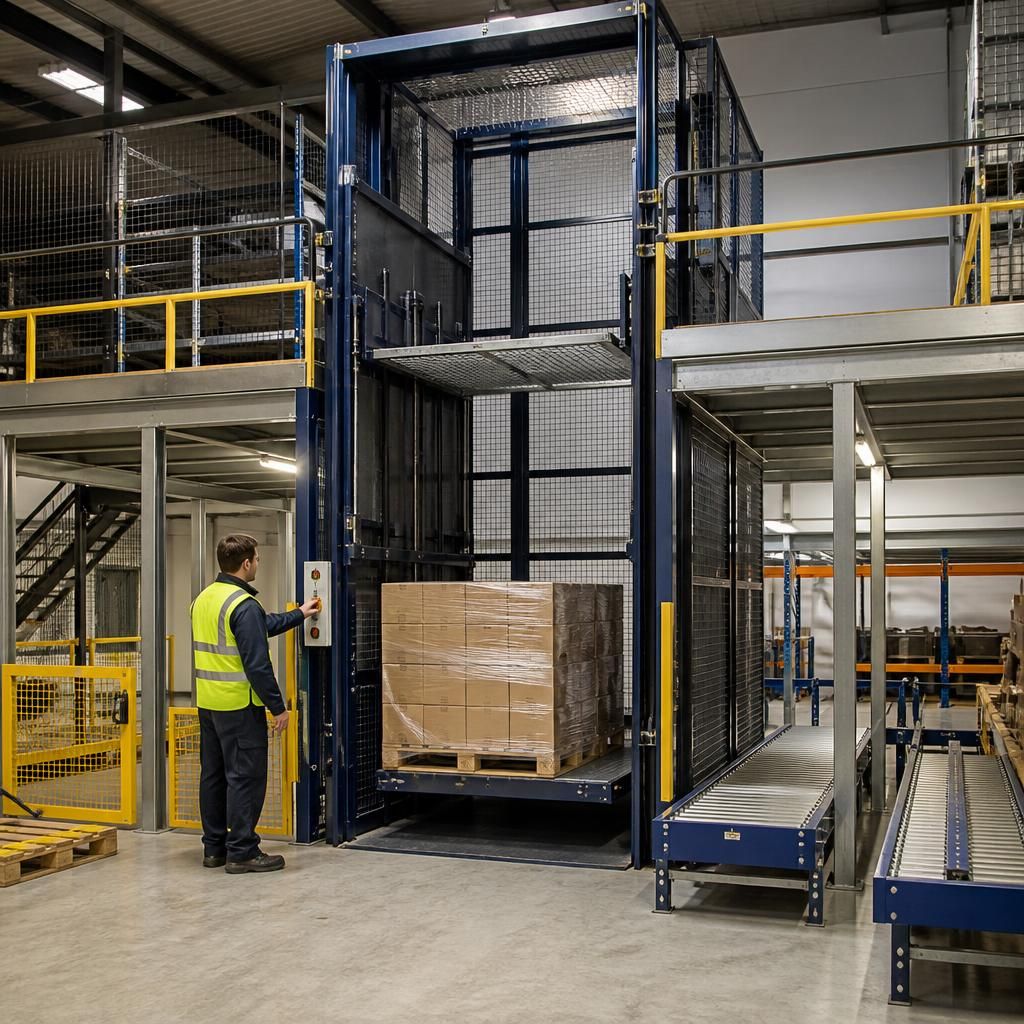
The correct mechanism for a mezzanine loading and access system depends on how goods move, not simply on the height between levels. Goods lifts and vertical reciprocating conveyors suit regular vertical transfers, while pallet gates and loading gates protect exposed loading edges. Fixed or powered conveyors are appropriate where cartons, totes or other compatible loads need a controlled, repeatable route.
Selection should consider load weight and dimensions, transfer frequency, available space, throughput and operator involvement. The mechanism must also be integrated with suitable guarding, interlocked gates, emergency stops and safe operating procedures. Assessing the complete loading process helps prevent falling goods, trapping points and unnecessary manual handling.
Discuss your mezzanine loading and access requirements
Discuss your mezzanine loading and access requirements with Able Racking to review the load types, transfer frequency, available space and safety controls involved. Our experienced team can help identify a suitable mechanism and advise on inspection, installation and ongoing maintenance.