
What maintenance is required for Up & Over Pallet Gate Systems?
Up & Over Pallet Gate Systems require routine visual checks, scheduled maintenance and prompt repair of any damage, wear or operating faults. Maintenance should cover the gate frame, hinges, counterbalance or lifting mechanism, safety stops, fixings and protective components, with inspections recorded and completed by a competent person.
Up & Over Pallet Gate Systems require routine visual checks, planned preventive maintenance and prompt repair of any damage, wear or operating fault. Maintenance should cover the gate frame, hinges, counterbalance or lifting mechanism, safety stops, fixings and protective components. Checks and repairs should be completed by a competent person and recorded so that defects can be tracked and addressed before they affect safe operation.
Routine visual checks
Operators should check the system before use and report anything abnormal. The inspection should confirm that:
- the gate moves smoothly through its full operating range without sticking, excessive force or unusual noise;
- the gate remains stable when open and closed;
- the frame, mesh, panels and edge protection show no distortion, cracks, corrosion or impact damage;
- hinges, pivots, rollers and other moving parts are secure and free from obstructions;
- counterbalance components, lifting arms or springs show no visible damage or loss of tension;
- safety stops, locking points and retaining features operate correctly;
- bolts, welds, anchors and other fixings remain secure;
- the gate closes fully and provides a continuous barrier at the loading edge; and
- there are no unauthorised alterations, stored items or other obstructions affecting operation.
A gate that is unusually difficult to move, drops unexpectedly, fails to stay in position or does not close correctly should be taken out of service until it has been assessed. Operators should not attempt to overcome a fault by tying the gate open, removing a stop or adding an improvised weight.
Planned maintenance
Routine servicing should be based on the manufacturer’s instructions, the frequency of use, the working environment and the findings from previous inspections. Heavily used systems, gates exposed to dust or moisture, and installations in areas where impact is possible may need more frequent attention.
A competent maintenance engineer will typically:
- inspect the complete frame and gate assembly for damage, deformation and corrosion;
- examine hinges, pivots, rollers, bearings and lifting components for wear;
- check the counterbalance or spring-assisted mechanism for correct operation and secure attachment;
- test safety stops, latches, locking arrangements and travel limits;
- check structural fixings and tighten or replace components where required;
- lubricate approved moving parts using the correct lubricant and method;
- check that protective guards and covers remain in place;
- confirm that the gate does not foul adjacent structures, goods or access routes; and
- identify any changes to the surrounding floor, edge protection or supporting structure that could affect the gate.
Lubrication should only be carried out where permitted by the manufacturer. Applying lubricant to the wrong component can attract dust, affect braking or locking parts, and conceal a developing defect. Damaged springs, counterbalance parts and structural components should be replaced with suitable approved parts rather than repaired through makeshift alterations.
Impact and damage checks
Loading areas are vulnerable to impact from handling equipment and materials. After an impact, the gate should be inspected even if the damage is not immediately obvious. Look for bent posts, displaced fixings, cracked welds, distorted panels, damaged floor connections and changes in the gate’s balance or movement. The surrounding structure and edge protection should also be checked, as damage to the support can affect the gate’s performance.
Any system that has been struck, overloaded or modified should remain out of use until a competent person has confirmed that it is safe. Straightening, welding, drilling or changing the counterbalance without an appropriate technical assessment may weaken the assembly or alter its designed operation.
Inspection records and compliance
Maintenance records should identify the system inspected, the date, the person carrying out the work, defects found, actions taken and any parts replaced. Photographs can be useful for recording impact damage or changes over time. Outstanding defects should be assigned to a responsible person with a clear completion date, and any restrictions on use should be communicated to the relevant team.
Maintenance forms part of the employer’s wider duty to provide and maintain safe work equipment. The inspection and servicing regime should reflect the manufacturer’s information, the site risk assessment and applicable workplace safety requirements. Where the gate incorporates a powered or mechanically lifting element, additional assessment may be needed to establish whether specific equipment inspection or examination requirements apply.
When professional attention is required
Arrange a professional assessment where a gate has suffered an impact, shows structural damage, moves unpredictably, loses balance, fails to retain a load safely or continues to develop the same fault. Professional support is also appropriate after relocation, alteration or changes to the supporting structure. A competent specialist can assess the complete installation, distinguish normal wear from a structural defect and specify suitable repairs without compromising the original safety function.
Effective maintenance is preventative rather than reactive. Combining operator checks, scheduled servicing, documented inspections and prompt control of defects helps keep Up & Over Pallet Gate Systems reliable and protects people working around the loading edge.
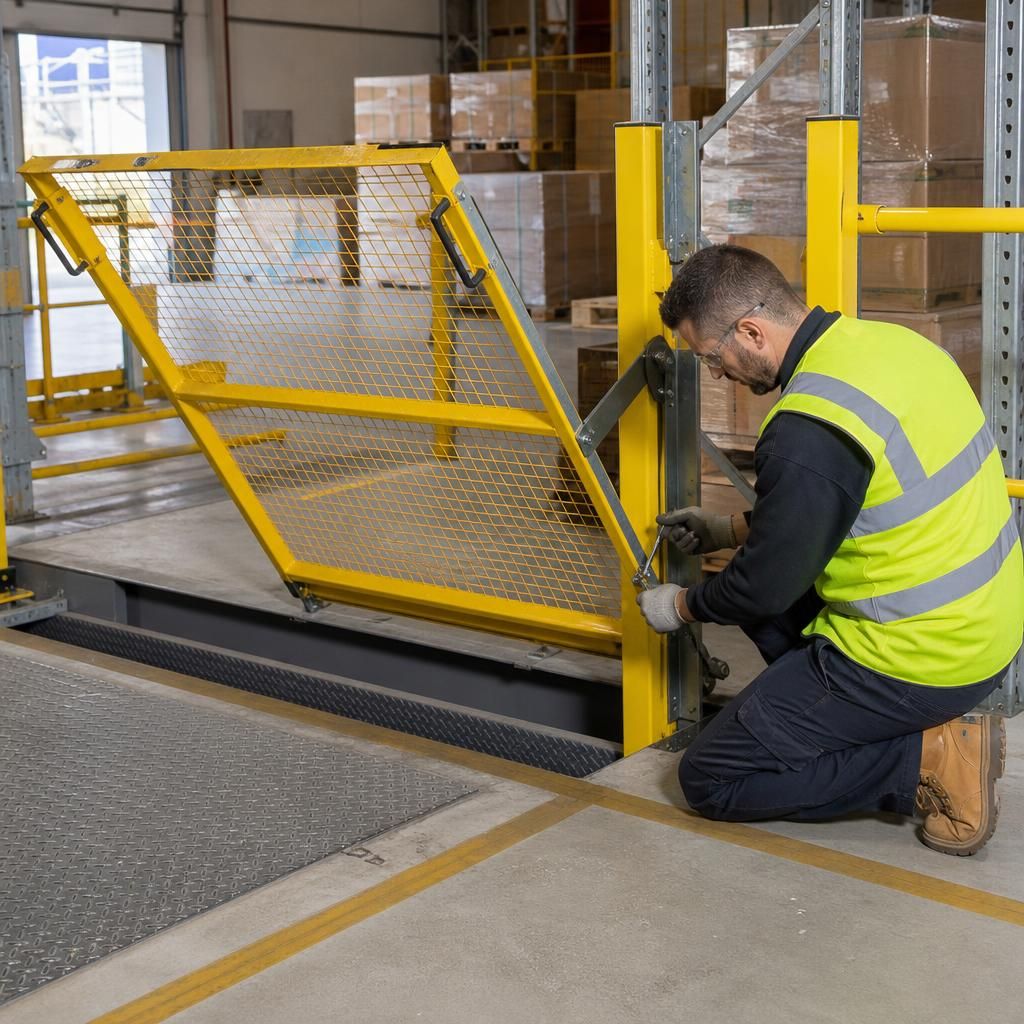
Up & Over Pallet Gate Systems need regular checks of their moving parts, safety stops and structural fixings to remain reliable at a mezzanine loading edge. Operators should check the gate before use, while planned servicing should be completed by a competent person in line with the manufacturer’s instructions and site risk assessment.
Particular attention should be given to:
- smooth movement without sticking, excessive force or unusual noise;
- hinges, pivots, rollers, springs and counterbalance components;
- secure bolts, welds, anchors, latches and safety stops;
- distortion, corrosion or impact damage to the frame, panels and edge protection; and
- the gate closing fully without fouling nearby structures or stored materials.
Any gate that drops unexpectedly, becomes difficult to operate or fails to provide a continuous barrier should be taken out of service until it has been assessed. Do not straighten, weld, drill or modify damaged components without professional approval, as this can affect the gate’s balance and safety function.
Arrange Professional Maintenance for Your Up & Over Pallet Gate System
Arrange professional maintenance for your Up & Over Pallet Gate System to identify wear, damage and operating faults before they affect safe use. Contact Able Racking to schedule a competent assessment or repair.