
What factors should be considered when choosing an Up & Over Pallet Gate System?
When choosing an Up & Over Pallet Gate System, consider the required load capacity, opening size, available space, operating method, compatibility with the existing mezzanine floor and relevant safety requirements. The system should also be assessed for ease of installation, inspection, maintenance and suitability for the way pallets are handled on site.
The right Up & Over Pallet Gate System should be selected according to the loads being handled, the pallet opening required, the available space, the existing mezzanine structure and the way the gate will be operated. Safety, compatibility, installation requirements, inspection access and long-term maintenance should all be assessed before a specification is agreed.
Load capacity and pallet dimensions
Confirm the maximum pallet weight, pallet dimensions and load distribution before choosing a system. The gate must be capable of safely handling the intended load without excessive deflection or instability. Consider whether pallets are consistently uniform or whether the opening must accommodate different pallet types, overhanging goods or awkward loads. The safe working load should be clearly defined and must not be exceeded during normal operation.
The usable opening should provide sufficient clearance for the pallet and handling equipment without creating unnecessary gaps at the platform edge. Allowance may be needed for load variation, pallet condition and the accuracy of the lifting equipment being used.
Opening size and available space
Measure the width, height and depth available at the loading position. An Up & Over Pallet Gate System needs adequate clearance to move through its operating arc without striking nearby structures, stored goods, lighting, conveyors or lifting equipment. The position of columns, handrails, stairs, doorways and other access points can affect the suitable design.
The gate should provide a practical loading opening while retaining effective protection at the exposed edge when the pallet is not being transferred. A site survey is important where space is restricted or where the gate will be installed close to existing structures.
Compatibility with the mezzanine structure
Check how the system will connect to the existing mezzanine, including the available fixing points, edge protection, deck construction and supporting steelwork. The supporting structure must be capable of accepting the loads imposed by the gate and its use. This may require confirmation of structural information or an assessment by a suitably competent person.
Do not assume that a standard design will suit every installation. Beam positions, deck levels, floor finishes and local obstructions can affect the required brackets, posts, fixings and gate dimensions. Any alterations to the structure or edge protection should be agreed before installation.
Operating method and frequency of use
Consider how often the gate will be used, who will operate it and whether pallets are transferred manually or with mechanical handling equipment. The operating method should allow the gate to be opened and closed in a controlled manner without exposing people to avoidable risks.
For frequent handling activity, ease of operation and consistent positioning are particularly important. The system should not require operators to reach into unsafe areas, stand beneath a raised gate or use improvised methods to move it. Where powered equipment or unusual operating conditions are proposed, the associated controls should be included in the risk assessment.
Safety features and risk controls
The selected gate should prevent access to the open edge when the pallet opening is not in use and should remain stable throughout its operating cycle. Depending on the design, relevant features may include interlocking arrangements, positive locking, counterbalanced movement, guarded operating points and protection against unintended opening.
Assess foreseeable risks such as falling pallets or goods, trapping points, unauthorised access, incorrect loading, impact from handling equipment and operation while someone is in an unsafe position. The gate is one part of the overall safeguarding arrangement; it should work with the mezzanine edge protection, access routes, site procedures and operator training.
Compliance and documentation
Selection should take account of the applicable health and safety requirements, the findings of the site risk assessment and the manufacturer’s design information. Depending on the equipment and how it is used, duties under the Provision and Use of Work Equipment Regulations and the Work at Height Regulations may be relevant. The installation should be supplied with suitable instructions, safe working load information and records that support future inspection and maintenance.
Compliance is not established by choosing a particular gate type alone. The complete installation must be suitable for its purpose, correctly installed, properly used and maintained in accordance with the relevant requirements and site controls.
Installation requirements
Confirm how the gate will be delivered, assembled and fixed, and whether installation can be completed without disrupting warehouse operations. The installer should understand the existing structure, identify any access or lifting restrictions and establish a safe method of work. Temporary exclusion zones may be required while components are being positioned and secured.
After installation, check the fixings, alignment, movement, locking arrangements and clearances. Operators should be shown how to use the system correctly, including the safe loading position and the actions to take if the gate does not operate as intended.
Inspection and maintenance
Choose a system that can be inspected easily and maintained with reasonable access to hinges, bearings, fixings, locks and other moving parts. The inspection schedule should reflect the frequency of use, operating environment and findings from the site risk assessment. More frequent checks may be appropriate where the gate is exposed to repeated impact, dust, corrosion or demanding handling conditions.
Look for signs of damage, distortion, loose fixings, worn components, restricted movement or failure to lock securely. Any defect that could affect safe operation should be reported and the gate should be taken out of service where necessary until a competent person has assessed it.
Environmental and operational conditions
Warehouse conditions can influence the material finish and component selection. Consider exposure to moisture, temperature changes, corrosive substances, dust, wash-down processes and potential impact from vehicles or lifting equipment. The finish and construction should be suitable for the environment rather than selected on appearance alone.
It is also worth considering future changes to pallet sizes, workflows, handling equipment or the mezzanine layout. A system with appropriate adjustment or modification options may provide greater flexibility, but any changes must be reviewed to ensure that the safe working load and protective function remain suitable.
Practical selection process
- Record the maximum load, pallet dimensions and handling equipment to be used.
- Measure the opening, operating clearance and surrounding structures.
- Confirm the mezzanine construction, fixing locations and structural capacity.
- Assess operating frequency, user requirements and foreseeable risks.
- Specify suitable safety features, guarding and locking arrangements.
- Confirm installation, training, inspection and maintenance requirements.
- Review the completed installation and retain the supporting documentation.
A competent site assessment should be completed before the final specification is approved. This ensures that the Up & Over Pallet Gate System is matched to the actual loading process, the mezzanine structure and the conditions in which it will be used, rather than selected solely from standard dimensions or load information.
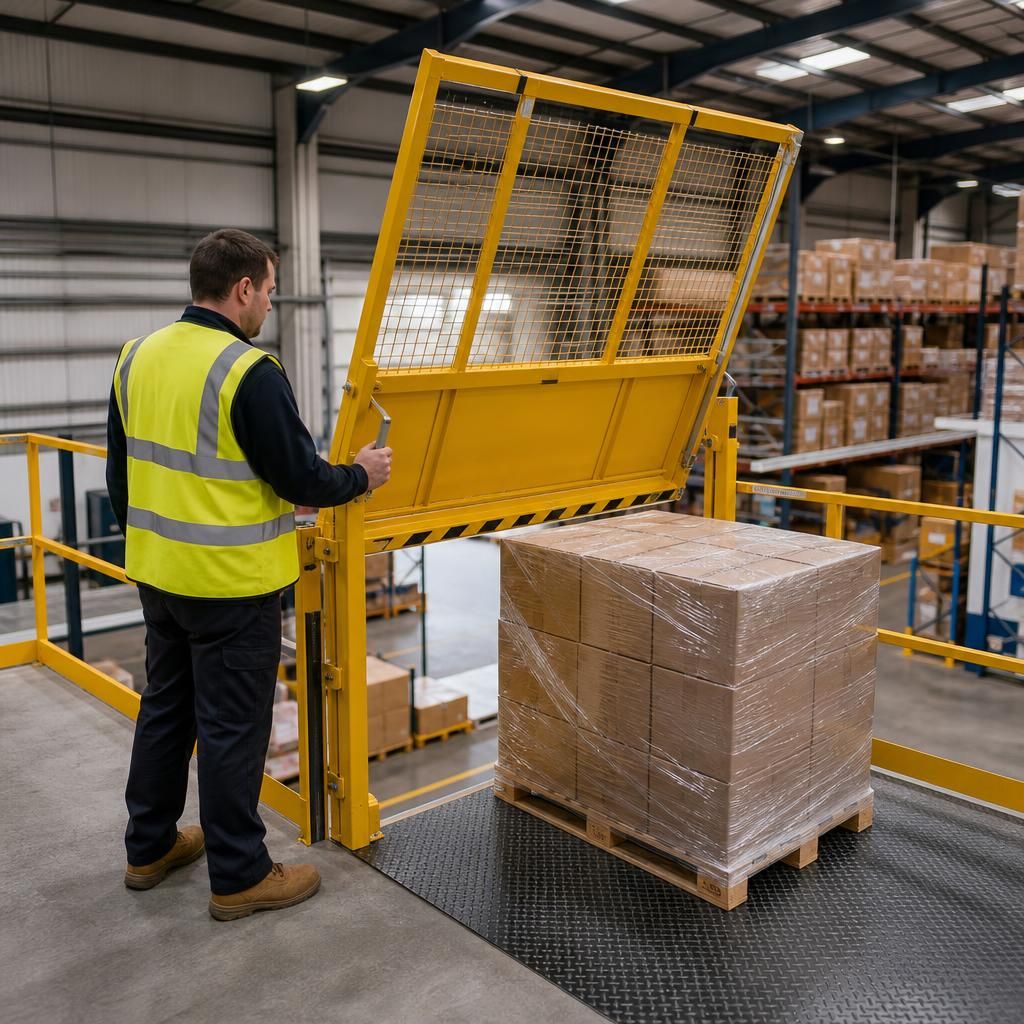
An Up & Over Pallet Gate System must be compatible with the existing mezzanine structure, including its edge protection, supporting steelwork, deck construction and available fixing points. Before selection, confirm that the structure can safely accept the loads imposed by the gate and pallet handling activity.
A site assessment should also check the opening dimensions, operating clearance and nearby obstructions such as columns, handrails, stairs, lighting and conveyors. These details determine the appropriate gate size, brackets, fixings and operating arrangement. Confirming them before installation helps prevent alignment problems, restricted movement and alterations that could compromise the protective function of the system.
Discuss your Up & Over Pallet Gate System requirements
Discuss your Up & Over Pallet Gate System requirements with our experienced team to confirm the correct specification for your mezzanine layout, loading process and safety controls.