
What are the main safety features integral to Up & Over Pallet Gate Systems for mezzanine floors?
Up & Over Pallet Gate Systems for mezzanine floors typically combine a counterbalanced lifting gate, interlocked operation and robust edge protection to prevent people falling while pallets are transferred. Guardrails, toe boards, secure landing arrangements and clearly defined operating procedures provide additional protection for workers and help maintain safe access during loading and unloading.
Up & Over Pallet Gate Systems for mezzanine floors use a counterbalanced lifting gate, interlocked operation and fixed edge protection to prevent people or pallets entering an unprotected floor edge during loading. When correctly designed, installed and used, the system allows pallets to be transferred between floor levels while maintaining a physical barrier on the exposed side of the mezzanine.
The main safety features are as follows:
- Counterbalanced lifting action: The gate is designed to move in a controlled vertical arc or lifting movement, allowing the operator to open the loading side without manually handling a heavy barrier. A correctly balanced system reduces the risk of sudden movement, excessive force and uncontrolled descent.
- Interlocked operation: The gate and the access side should operate so that the pallet opening cannot be left unprotected when the loading side is open. Depending on the design, the interlock may be mechanical or linked to the access arrangement. Its purpose is to prevent a person from walking into the transfer opening while a pallet is being moved.
- Permanent edge protection: Guardrails or other fixed barriers are retained around the remaining exposed edges of the mezzanine. The protection should be continuous, secure and suitable for the workplace, with no unnecessary gaps through which a person, pallet or loose item could pass.
- Toe boards or kickboards: A toe board at the floor edge helps prevent pallets, packaging and other materials from being pushed or rolling off the mezzanine. It also reduces the likelihood of smaller objects falling into the area below.
- Secure pallet landing area: The floor surface at the transfer point should provide a stable, level location for the pallet and handling equipment. The opening, gate dimensions and approach route must be suitable for the loads being handled, with enough clearance to avoid contact with the structure.
- Positive stops and controlled movement: Mechanical stops limit the gate’s travel and help prevent over-opening or impact with adjacent structures. The movement should remain predictable throughout operation, with components selected to withstand the intended working conditions.
- Suitable load capacity: The gate must be specified for the pallet dimensions, goods, handling method and forces likely to be applied during loading. The safe working load and operating limitations should be clearly established and not exceeded.
- Protected counterbalance components: Springs, weights, pivots and other moving parts should be guarded or arranged to minimise trapping, crushing and impact hazards. Operators should not need to reach into moving mechanisms during normal use.
- Visible operating controls: Handles, release points and operating positions should be easy to identify from a safe standing position. Clear instructions help users understand when the gate can be moved and how the load must be positioned before transfer.
- Appropriate visibility: The design should allow the operator to see the pallet, the landing area and nearby personnel as far as practicable. Where the view is restricted, agreed communication methods or additional controls may be required.
- Secure fixings and structural compatibility: The gate must be attached to a suitable part of the mezzanine structure using fixings appropriate to the loads and the existing construction. The supporting structure should be checked before installation rather than relying on appearance alone.
- Durable construction: Materials and finishes should suit the working environment, including exposure to impacts, dust, temperature changes or corrosive substances. Damaged, bent or excessively worn components can affect the gate’s alignment and protective function.
These features work together rather than providing separate protection in isolation. For example, a counterbalanced gate may make pallet transfer easier, but it does not replace guardrails, toe boards, a suitable landing area or a safe operating procedure. The system should also prevent normal use from creating a route for a person to step or fall through the opening.
Safe operation depends on the system being matched to the way the mezzanine is used. Before installation or alteration, the responsible person should consider pallet sizes and weights, the type of handling equipment, traffic routes, the position of the opening, the height of the floor edge and the potential for falling objects. A site-specific risk assessment should identify any need for additional barriers, signage, traffic controls or supervision.
Inspection is equally important. Operators should check the gate before use for unusual movement, damaged guards, loose fixings, worn pivots, failed interlocks, obstruction of the landing area and deterioration of toe boards. The gate should be taken out of service if it does not close or interlock correctly, moves unpredictably or shows structural damage. Repairs and adjustments should be completed by a competent person, followed by a functional check before the system is returned to service.
Periodic examination should verify the condition, alignment, fixings, counterbalance and protective arrangements, with findings recorded and defects prioritised. Training should cover pallet positioning, gate operation, prohibited practices, communication with people below and the procedure for reporting faults. Workers should never climb on the gate, bypass an interlock, leave the opening unprotected or use the gate as a general access point.
In practical terms, the most important safety test is whether the system maintains a barrier whenever a person could be exposed to the open floor edge, while still allowing the intended pallet transfer to take place. A competent assessment can confirm that the chosen Up & Over Pallet Gate System, its supporting structure and its operating controls provide suitable protection for the specific mezzanine layout and working conditions.
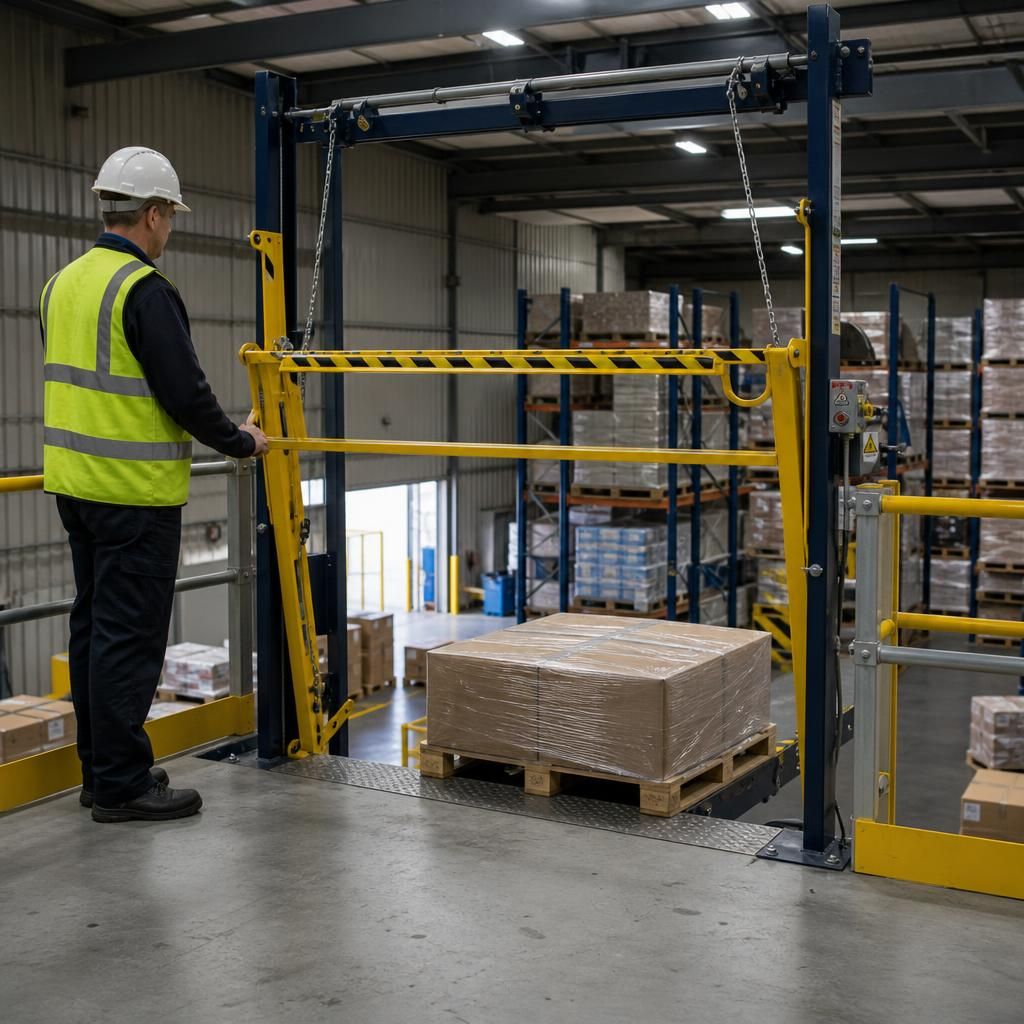
The most important safety feature of an Up & Over Pallet Gate System is its interlocked barrier arrangement, which helps keep the exposed edge of a mezzanine floor protected during pallet transfer. The gate allows goods to be moved through the opening while preventing a person from stepping or falling into an unprotected area.
Fixed guardrails and toe boards should remain in place around the rest of the opening, while the gate’s counterbalanced movement, positive stops and secure fixings support controlled operation. The system must be matched to the pallet loads, handling equipment and floor layout, then checked regularly for damaged components, loose fixings or a failed interlock. If the gate does not close or operate correctly, it should be taken out of service until inspected and repaired by a competent person.
Arrange an expert mezzanine floor safety assessment
Arrange an expert mezzanine floor safety assessment to check that your Up & Over Pallet Gate System, edge protection and operating controls provide suitable protection for your specific layout and working conditions.