
How do Up & Over Pallet Gate Systems integrate with existing mezzanine floor structures?
Up & Over Pallet Gate Systems integrate with existing mezzanine floor structures by being securely positioned at pallet loading points and fixed to suitable structural elements. Their counterbalanced design allows pallets to be transferred safely while maintaining edge protection when the gate is not open, subject to a site assessment and confirmation that the structure can support the installation.
Up & Over Pallet Gate Systems integrate with existing mezzanine floor structures by being installed at designated pallet transfer points and securely connected to suitable structural elements. Their counterbalanced operation allows pallets to be moved between floor levels while maintaining a barrier at the exposed edge whenever the loading opening is not in use. The installation must be based on a site assessment confirming that the mezzanine structure, guarding arrangement and gate fixing points are suitable.
Integration is not limited to attaching a gate to the nearest upright or edge beam. The gate, its supports and the surrounding floor structure must work together as a safe loading arrangement. Existing conditions, including the floor construction, edge protection, access routes, pallet dimensions, handling equipment and operating procedures, all influence the appropriate design and installation method.
Assessment of the existing structure
The process begins with an inspection of the proposed installation location. This identifies the structural members available for fixing and checks whether they can accommodate the gate and the forces generated during normal use. The assessment should also consider the condition of the floor, beams, columns, handrails, toe boards and any existing protection around the loading point.
Where drawings or design information are available, these should be reviewed alongside the site findings. If the original structural information is unavailable or the proposed fixing arrangement is unclear, further engineering advice may be required. A gate should not be installed by drilling or welding into a structural component without confirming that the alteration is acceptable.
Positioning at the pallet transfer opening
An Up & Over Pallet Gate is normally positioned so that pallets can be placed within the transfer area without requiring operatives to work beyond the protected edge. The opening must align with the handling equipment, pallet size and the usable floor area behind the gate. Adequate clearance is needed for the gate to move through its operating arc without striking the structure, stored goods, lighting, sprinklers or other equipment.
The surrounding layout should prevent pedestrians from being forced into the pallet movement zone. Where access is shared, the arrangement may require defined walkways, physical separation, warning signs or operating controls. The finished installation should allow the gate to be opened and closed from a safe position, with no need for an operative to lean over the edge or reach beneath a suspended load.
Fixing and structural interface
Gate posts and support components are fixed to suitable structural members using an arrangement selected for the existing construction. Depending on the design, this may involve bolted connections, engineered brackets or other approved fixing methods. The fixing system must resist movement during loading and unloading and remain secure under the expected operational forces.
Any modification to the existing structure must be controlled and recorded. Unauthorised cutting, drilling, welding or removal of edge protection can weaken the structure or create new hazards. Where the gate cannot be fixed directly to the available members, a purpose-designed support frame or local structural alteration may be needed rather than adapting the gate on site.
Maintaining edge protection
The gate forms part of the wider edge protection arrangement. When the gate is in its closed position, it should provide a suitable barrier across the loading opening. When it is raised to receive or remove a pallet, the pallet itself and the gate configuration should protect the exposed edge in accordance with the assessed method of work.
Adjacent handrails, toe boards and barriers must remain continuous and effective. The installation should not leave gaps through which a person, pallet or load could pass, and the gate should not obstruct an escape route or create a trip hazard. Any existing protection removed during the work must be reinstated or replaced with an equivalent safe arrangement.
Counterbalance and operation
The counterbalanced mechanism is selected and adjusted to suit the gate configuration and intended use. It assists controlled movement, but it does not remove the need for correct operating procedures. The gate should move smoothly, remain stable in its operating positions and avoid sudden descent or uncontrolled movement.
Before handover, the installer should check the operation through its full range and confirm that the gate does not foul the floor, structure or adjacent protection. Users should be shown how to operate it, where to stand during pallet movements and what to do if the gate becomes damaged or difficult to move. Loads must remain stable and within the permitted handling conditions for the installation.
Coordination with handling equipment
The gate must be compatible with the forklift, pallet truck or other equipment used at the transfer point. The operator needs sufficient visibility and space to position the load without striking the gate or surrounding protection. The floor level, pallet approach, load dimensions and equipment reach should be considered before the final position is approved.
Where a forklift is used, the operating method should prevent the vehicle or its load from contacting the gate. Physical protection may be appropriate where impact is reasonably foreseeable, but protection must not interfere with the gate’s operation or reduce the usable opening. The site risk assessment should define who controls the transfer and how communication is maintained between people on different levels.
Installation, inspection and handover
Installation should be completed by competent operatives using the manufacturer’s instructions and the agreed fixing design. On completion, the gate and its connection to the mezzanine structure should be inspected for alignment, secure fixings, correct clearances, effective guarding and smooth operation.
The handover information should identify the gate, its intended use, any operating limitations and the inspection and maintenance requirements. It is also good practice to retain relevant structural information, installation records, risk assessments and user instructions with the site’s safety documentation.
After installation, the gate should be included in the site’s planned inspection regime. Operators should carry out routine visual checks for loose fixings, damaged components, unusual movement, corrosion, obstruction or changes to the surrounding structure. A competent person should investigate defects promptly, and the gate should be taken out of service if it no longer provides reliable protection.
What to confirm before approving the installation
- The proposed position is suitable for the pallet transfer process and does not compromise pedestrian or escape routes.
- The existing structural members can accept the proposed gate supports and fixings.
- The floor, edge protection and adjacent barriers remain safe and effective after installation.
- The gate has sufficient operating clearance and does not conflict with services, equipment or stored loads.
- The handling equipment and pallet dimensions are compatible with the opening.
- The operating procedure covers loading, unloading, communication, exclusion zones and fault reporting.
- The completed installation has been inspected, tested and recorded before being put into service.
Where these points are confirmed, an Up & Over Pallet Gate System can be incorporated into an existing mezzanine floor without treating the gate as a standalone item. The safest outcome comes from coordinating the gate design, structural fixing, edge protection, handling process and ongoing inspections as one complete loading-point system.
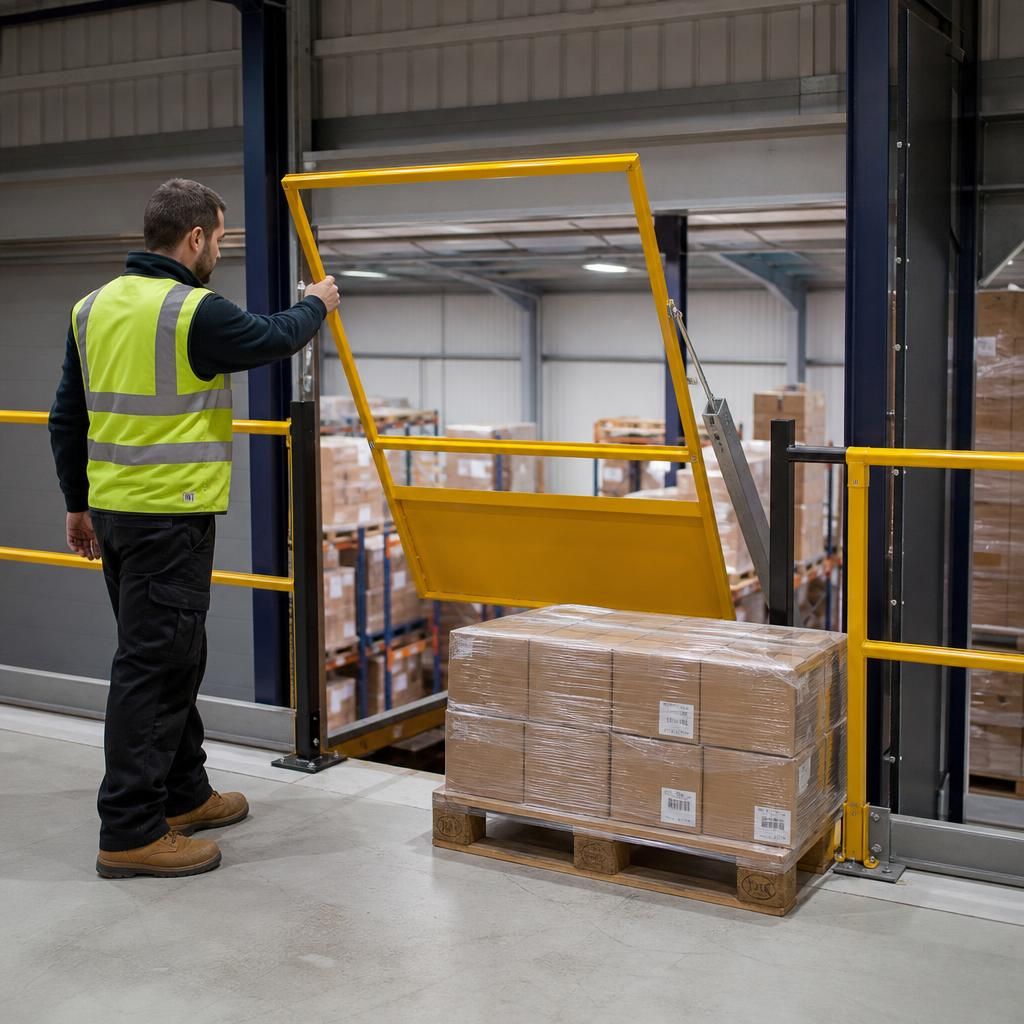
An Up & Over Pallet Gate System integrates with an existing mezzanine floor by connecting to suitable structural members at the pallet transfer opening. Before installation, the floor construction, support points, edge protection and surrounding layout must be assessed to confirm that the gate can be fixed securely and operated without compromising the structure.
The gate should be positioned to align with the pallet, handling equipment and available working space. Its supports must be installed using an approved fixing arrangement; drilling, welding or altering structural components without suitable technical confirmation can weaken the floor or create additional hazards. The completed installation should maintain continuous edge protection, provide adequate clearance for the gate’s movement and be checked for secure fixings and smooth operation before use.
Arrange an Up & Over Pallet Gate Site Assessment
Arrange an Up & Over Pallet Gate site assessment to confirm the existing mezzanine floor, fixing points, edge protection and operating area are suitable. Contact Able Racking to discuss the proposed installation and agree the appropriate next steps.