
Are there specific regulations or standards that Up & Over Pallet Gate Systems must adhere to?
Yes. Up & Over Pallet Gate Systems installed on mezzanine floors must be designed, installed and maintained in line with the Provision and Use of Work Equipment Regulations 1998 (PUWER), the Work at Height Regulations 2005 and applicable British or European standards, including BS EN ISO 14122 where relevant to permanent access and guarding. Compliance also depends on a suitable risk assessment, correct installation, safe operating procedures and regular inspection by competent personnel.
Yes. Up & Over Pallet Gate Systems on mezzanine floors must be designed, installed, used and maintained in accordance with the risks presented by the workplace and the load-handling activity. The principal UK requirements are the Provision and Use of Work Equipment Regulations 1998 (PUWER), the Work at Height Regulations 2005 and the Workplace (Health, Safety and Welfare) Regulations 1992. Depending on the design and installation, relevant British and European standards may also include BS EN ISO 14122 for permanent means of access and guarding, together with applicable structural design and fabrication standards.
There is not one single regulation that applies exclusively to every pallet gate. Compliance is established by considering the complete system: the gate, its counterbalance or operating mechanism, the mezzanine edge, the supporting structure, the loads being transferred and the way operatives use the equipment. A suitable risk assessment should therefore be completed before specification and reviewed if the layout, loads, access arrangements or working methods change.
Provision and Use of Work Equipment Regulations 1998
PUWER applies because an Up & Over Pallet Gate System is work equipment. It requires the equipment to be suitable for its intended use, properly installed and maintained, and operated only by people who have received appropriate information and instruction. In practice, this means the system should:
- Be selected for the intended pallet dimensions, loads, operating frequency and available clearance.
- Have adequate strength, stability and protection against foreseeable impact or misuse.
- Be fitted with suitable guards, stops, counterbalance arrangements and other safety features.
- Be positioned so that loading and unloading can be carried out without exposing people to avoidable risks.
- Have clearly understood operating instructions, including the required position of the gate while the loading side is unattended.
- Be inspected at suitable intervals and after events that could affect its safe condition, such as impact, unauthorised alteration or significant repair.
PUWER does not make routine inspection a paperwork exercise. Checks should be proportionate to the equipment and its use, with findings recorded and defects dealt with promptly. A competent person should examine the gate for damage, distortion, loose fixings, excessive wear, impaired movement and any change in the protection provided at the edge.
Work at Height Regulations 2005
Because the gate protects an exposed edge on a raised working platform, the Work at Height Regulations are central to the safety assessment. The system must help prevent people or materials falling and must be used as part of a properly planned work-at-height arrangement. The assessment should consider how pallets are presented, how the gate is opened and closed, whether people can reach the edge during loading, and what happens if a pallet is unstable or incorrectly positioned.
The gate should not be treated as a substitute for safe working practices. Operatives must understand when the loading aperture may be open, when the gate must be closed, and how to keep clear of moving components and the fall-risk area. The surrounding platform should also provide suitable edge protection, including any required handrails, guardrails and toe protection, with the arrangement coordinated so that the gate does not create an unprotected gap when operated.
Relevant standards and structural requirements
BS EN ISO 14122 can be relevant where the installation forms part of permanent access to, or guarding around, machinery or an industrial platform. The applicable part depends on the access and guarding arrangement. It may assist with considerations such as safe clearances, protection against falls, access design and the prevention of entrapment. It should not be quoted as automatic proof of compliance without checking that its scope matches the particular installation.
The supporting mezzanine and its connections must also be capable of carrying the imposed loads, including the gate, stored goods, operational forces and any foreseeable impact. Structural design should be based on the relevant UK-adopted Eurocodes, National Annexes and project specifications where applicable. Steelwork fabrication, protective finishes, fixings and connection details should be supported by appropriate design and installation information. Building control or other statutory approval may be relevant to the mezzanine project, but this does not replace the separate duties under PUWER or the Work at Height Regulations.
Risk assessment, documentation and inspection
A compliant installation should be supported by documentation that allows the duty holder to demonstrate how the risks have been controlled. This commonly includes:
- The manufacturer’s instructions, operating limitations and maintenance requirements.
- Design information confirming the intended loads, dimensions, fixing method and compatibility with the mezzanine.
- Installation and commissioning records, including confirmation that safety features operate correctly.
- A site-specific risk assessment and safe operating procedure.
- Inspection and maintenance records, including actions taken to correct defects.
- Evidence that relevant operatives have been instructed and are competent for the task.
Inspection frequency should reflect the intensity of use, environmental conditions, impact risk and the consequences of failure. Visual checks before use may be appropriate for busy loading points, supported by more detailed examinations at planned intervals. An inspection is also required when there is reason to suspect that the gate or surrounding structure has been damaged or has deteriorated. Any system that is bent, unstable, difficult to operate or no longer provides continuous edge protection should be taken out of service until assessed and repaired.
For an existing Up & Over Pallet Gate System, compliance should be reviewed if pallets, loads, forklifts, access routes or operating procedures change. Altering the gate, removing a guard, changing the counterbalance or attaching components without a suitable design review can invalidate the original assessment. Able Racking can assess the installation, identify safety-critical defects and advise on the inspection, repair and documentation requirements needed to keep the mezzanine loading area compliant.
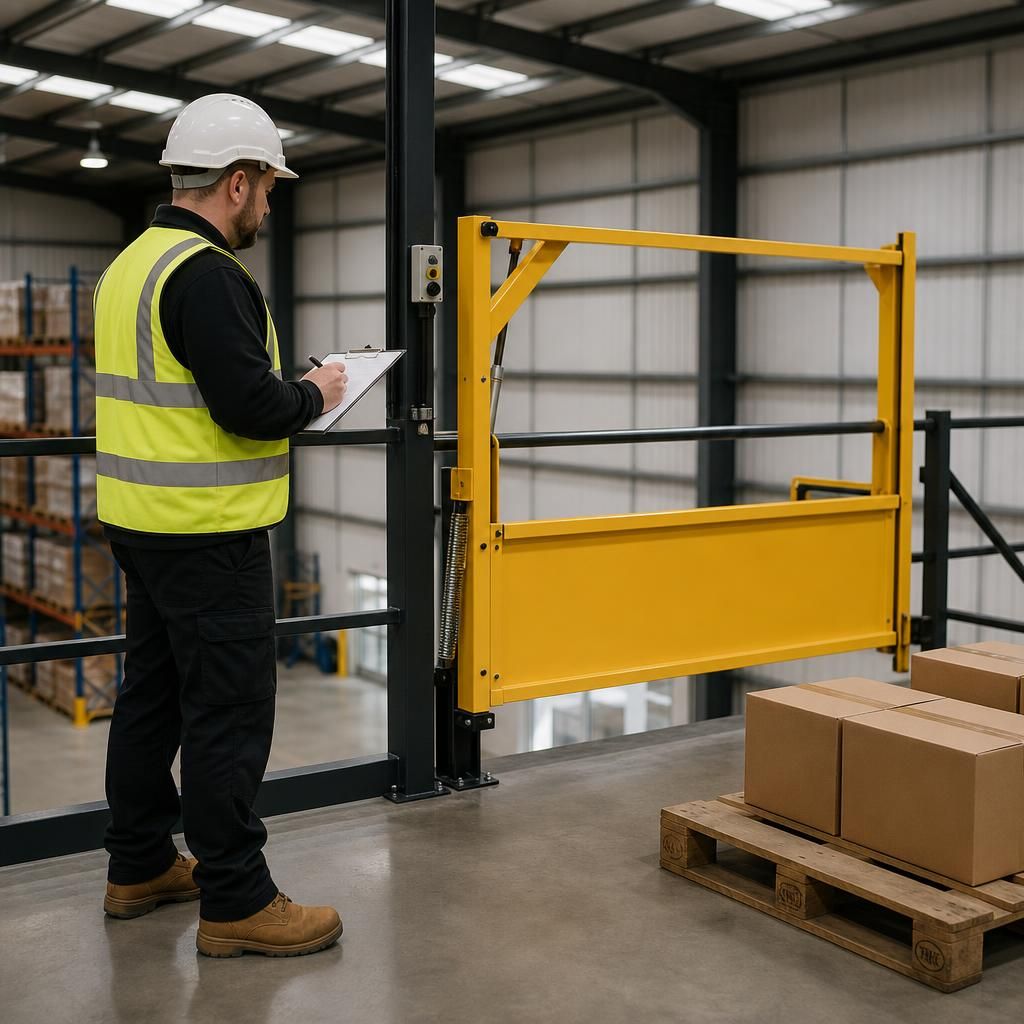
Compliance for an Up & Over Pallet Gate System depends on more than the gate itself; the complete arrangement must be assessed, installed and maintained to control fall risks at the mezzanine loading point.
A suitable risk assessment should consider the gate design, supporting structure, pallet dimensions, loads, operating method and surrounding edge protection. Keep the manufacturer’s instructions, installation details, operating procedures and inspection records together so the duty holder can demonstrate how risks are controlled.
Checks should identify damage, distortion, loose fixings, restricted movement and any loss of edge protection. If the gate is affected by impact, alteration or a change in use, it should be reassessed by a competent person before being returned to service.
Arrange an Expert Pallet Gate Compliance Assessment
Arrange an expert compliance assessment for your Up & Over Pallet Gate System to review its condition, supporting structure, edge protection and operating arrangements. Contact our team to identify any safety-critical issues and confirm the inspection or remedial work required.