
What types of mezzanine lift systems are available, and how do they differ?
Mezzanine lift systems include goods lifts, platform lifts, scissor lifts and vertical reciprocating conveyors, each designed for different load types, travel distances and access requirements. They differ in lifting capacity, platform size, speed, operating method and guarding, so the correct choice depends on the building layout, goods and intended use.
Mezzanine lift systems are vertical goods-handling solutions that move stock, materials or equipment between floor levels. The main types are goods lifts, platform lifts, scissor lifts and vertical reciprocating conveyors (VRCs). They differ in how they are loaded, the level of guarding provided, their lifting capacity, platform arrangement, travel distance, speed and suitability for people or goods.
The correct system depends on the building layout, the goods being moved, the frequency of use and whether the equipment is intended solely for goods or may carry people. A system designed for goods must not be used for passengers unless it has been specifically designed, certified and approved for that purpose.
Goods lifts
Goods lifts are enclosed vertical lifting systems designed to move pallets, cages, trolleys or other materials between levels. They normally have a solid platform or car, landing gates and interlocked doors to prevent access while the lift is moving. Some designs are suitable for loading with a pallet truck or forklift, subject to the manufacturer’s stated limits and the available loading arrangements.
Goods lifts are generally selected where loads are relatively heavy, the travel distance is significant or the equipment will be used frequently. They provide a more enclosed and controlled movement route than an open platform, which can help protect the load and reduce the risk of people entering the lifting zone. They are not automatically passenger lifts, and their controls, guarding and operating procedures must reflect their intended use.
Platform lifts
Platform lifts use an open or partially enclosed platform to move goods between levels. They are often suitable for boxes, wheeled equipment, work-in-progress materials and smaller loads that do not require a fully enclosed lift car. Their relatively simple layout can make them practical where space is restricted or where the operator needs clear access to the platform.
Platform lifts usually require substantial edge protection, landing gates and controls that prevent operation when a gate is open. The platform size, safe working load and loading direction must be matched to the goods and the surrounding floor layout. They are commonly used for goods only unless specifically designed and approved for passenger access.
Scissor lifts
Scissor lifts raise a platform using linked folding arms beneath it. They can be installed as fixed lifting tables or incorporated into a wider goods-handling arrangement. Their main advantage is the ability to provide a stable, spacious platform for lifting pallets, cages, machinery or bulky items through a relatively short vertical distance.
Scissor lifts need careful consideration of their base structure, platform stability and the space required beneath and around the mechanism. The moving arms create crush and shear hazards, so guarding, restricted access and suitable control arrangements are essential. They are usually most appropriate where the upper and lower levels are close together and loads need to be transferred vertically rather than carried through a fully enclosed shaft.
Vertical reciprocating conveyors
A vertical reciprocating conveyor, or VRC, moves goods on a platform between fixed levels. It is often used in warehouses, production areas and distribution facilities where materials need to travel repeatedly between floors. Unlike a continuous conveyor, it moves vertically between designated positions and normally requires an operator to load or unload at each level.
VRCs can be configured with single or multiple platforms, different loading directions and various forms of guarding. They are useful for repetitive movement between set levels, but they are not normally intended for carrying people. Access gates, interlocks and physical barriers must prevent entry to the platform or shaft while the equipment is operating.
Enclosed and open designs
The distinction between enclosed and open systems is important when comparing lift types. Enclosed goods lifts provide a defined shaft or car and can offer better protection for people, loads and adjacent work areas. Open platform systems may provide easier loading and visibility, but they demand robust guarding at the platform edges, landings and surrounding access points.
Through-floor systems can be suitable where the lift serves a small number of levels and the building structure permits an opening. Shaft-based systems may be preferable where there is a longer travel route, greater traffic around the lift or a need to separate the lifting operation from nearby activities. The available headroom, pit depth, floor strength and access clearances must be checked before a system is selected.
Key differences between the systems
- Load type: goods lifts and VRCs can be configured for pallets, cages and industrial materials, while platform and scissor lifts may be better suited to smaller or bulky items depending on their specification.
- Load capacity: the safe working load must include the goods, packaging, pallet, trolley or other handling equipment placed on the platform.
- Platform dimensions: the platform must accommodate the largest load without creating an obstruction or requiring unsafe positioning.
- Travel distance: scissor lifts are often suited to shorter rises, whereas goods lifts and VRCs can be designed for movement between more widely separated levels.
- Operating speed: higher usage may justify a faster system, but speed must remain compatible with safe loading, guarding and the building layout.
- Loading method: consider whether goods are loaded by hand, pallet truck, trolley or forklift and whether the approach route is level and unobstructed.
- Access and guarding: enclosed lifts offer a different level of separation from open platforms, but every design requires suitable gates, barriers and interlocks.
- Frequency of use: occasional transfers may not require the same configuration as a system operating continuously throughout a shift.
- People and goods: equipment intended for goods must not be treated as a passenger lift. Any requirement to carry people must be identified at the design stage.
How to choose the appropriate type
- Define the loads, including their dimensions, weight, centre of gravity and method of handling.
- Identify every level to be served and measure the available footprint, headroom, pit area and landing space.
- Assess the expected usage pattern, including peak periods, loading frequency and the number of operators.
- Decide whether the system must be enclosed, whether loads need protection and how access will be controlled.
- Check the building structure, fire separation, electrical supply and any changes required to floors, walls or guarding.
- Specify the required controls, emergency stopping arrangements, landing gates, interlocks and safe loading procedures.
- Confirm the applicable design, installation, examination, training and maintenance requirements before the equipment is commissioned.
Selection should be based on the complete movement process rather than the lift alone. A system may have adequate lifting capacity but still be unsuitable if the approach route is too narrow, the landing cannot accommodate the load, operators cannot see the platform or the surrounding area cannot be effectively guarded.
Once installed, the system should be used only within its stated limits. Operators need clear instructions on loading, positioning, controls, emergency procedures and reporting defects. Thorough examination, planned maintenance and prompt attention to damage or abnormal operation are also important for keeping the equipment safe and reliable throughout its working life.
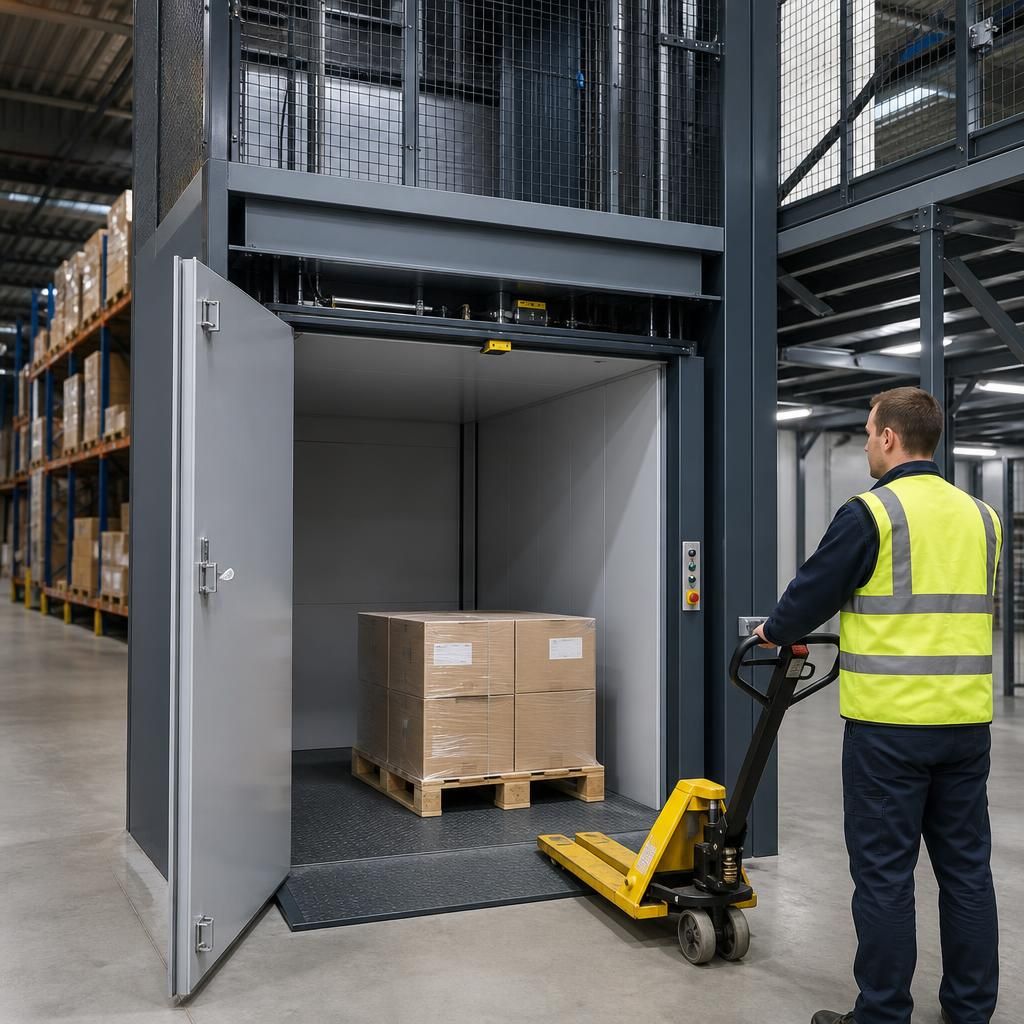
The main difference between mezzanine lift systems is how they move and protect the load. Goods lifts provide an enclosed route for pallets, cages and trolleys, while platform lifts and scissor lifts generally offer more open access for smaller or bulky items. Vertical reciprocating conveyors move goods between fixed levels and are well suited to repeated transfers.
Selection should start with the loading method and the surrounding access arrangements. Check the safe working load, platform dimensions, travel distance and available headroom, then confirm that landing gates, barriers and interlocks prevent access to the lifting area while the system is moving. Equipment designed for goods must not be used to carry people unless it has been specifically designed and approved for passenger use.
Choose the right mezzanine lift system
Contact our experienced team to compare lift options against your load requirements, available space and intended use. We can help you identify a safe, compliant and practical mezzanine lift system for your warehouse.