
What safety standards must mezzanine lift systems comply with?
Mezzanine lift systems must comply with UK workplace equipment requirements, including the Provision and Use of Work Equipment Regulations (PUWER) and, where they lift people or goods, the Lifting Operations and Lifting Equipment Regulations (LOLER). They also require suitable guarding, safe access and loading controls, risk assessments, competent installation and operation, planned maintenance, and thorough inspections at appropriate intervals.
Mezzanine lift systems must comply with UK workplace equipment and lifting-equipment requirements, principally the Provision and Use of Work Equipment Regulations (PUWER) and, where applicable, the Lifting Operations and Lifting Equipment Regulations (LOLER). They must also have suitable guarding, safe access arrangements, effective controls, load information, emergency provisions, competent installation and operation, planned maintenance, and thorough examinations at appropriate intervals.
PUWER requirements
PUWER applies to work equipment used by employees, including goods lifts, platform lifts and associated controls serving a mezzanine area. The equipment must be:
- Suitable for its intended use, the loads handled and the working environment
- Installed and positioned so it can be used safely
- Maintained in an efficient state, efficient working order and good repair
- Used only by people who have received suitable information, instruction and training
- Inspected where deterioration could create a significant risk
The employer must also consider foreseeable misuse, access for maintenance, electrical hazards, moving parts, trapping points and the effect of the lift on other warehouse activities. A lift that was suitable when installed may no longer meet PUWER expectations if its use, loading pattern, surroundings or operating conditions have changed.
When LOLER applies
LOLER applies to lifting equipment and lifting accessories used at work. A mezzanine lift that raises goods, equipment or people will normally need to be assessed against LOLER requirements, although the precise duties depend on the equipment’s design and function. The lift must be strong and stable enough for the loads imposed, and lifting operations must be properly planned, appropriately supervised and carried out safely.
LOLER also requires lifting equipment to receive suitable thorough examination by a competent person. The examination frequency should be set through a written examination scheme based on the manufacturer’s guidance, operating conditions, usage and risk. The competent person may specify different intervals or additional examinations where the equipment is heavily used, exposed to harsh conditions, modified or involved in an incident.
Guarding and landing protection
Open loading areas at an upper level present a significant fall and crush risk. Lift installations therefore need physical protection that prevents people from entering the lift shaft or stepping into an unoccupied opening. Depending on the design, this may include:
- Interlocked landing gates or doors
- Full-height shaft guarding or enclosed lift sides
- Guardrails, toe boards and suitable edge protection around loading areas
- Controls that prevent the lift from operating when a gate is open
- Protection against access beneath a raised platform where this could cause injury
- Measures preventing loads from falling from the platform
Guarding must not be treated as a removable convenience. If gates, interlocks or barriers are bypassed, damaged or left open, the lift should be taken out of service until the defect has been investigated and corrected.
Safe access, controls and operation
Controls should be clearly identified, positioned away from foreseeable danger and protected against accidental operation. The system should provide suitable stopping controls, emergency stop facilities where required, and a safe means of dealing with power failure or an obstruction. Where people could become trapped, the rescue and emergency-lowering arrangements must be understood, accessible and tested as part of the maintenance regime.
Safe operation also depends on clear information at each loading point. The displayed information should include the safe working load, any restrictions on load size or distribution, permitted users, operating instructions and actions to take if a fault occurs. Loads must be stable and positioned within the platform’s intended loading area. People should not travel on a goods-only lift, and a lift designed to carry people must have the appropriate safeguards for that purpose.
Design, installation and conformity
New equipment must be supplied and commissioned in accordance with the applicable UK product-safety requirements. Depending on the lift type and whether it is supplied as machinery, a lifting table or another category of equipment, this may include the Supply of Machinery (Safety) Regulations and relevant designated British or international standards. Standards in the BS EN 81 series may be relevant to certain lift arrangements, while BS EN 1570-1 may be relevant to lifting tables. The correct standard cannot be selected from the lift’s appearance alone; the intended use, travel, enclosure, control system and whether people are carried all matter.
The supplier or installer should provide appropriate technical information, operating instructions, conformity documentation, rated-load information and records of commissioning. Installation must account for the supporting structure, landing interfaces, electrical supply, guarding, clearances and interaction with nearby work equipment. Any alteration that changes the lift’s capacity, travel, controls, guarding or structural support should be assessed before the equipment is returned to service.
Risk assessment and workplace duties
The lift must form part of the site’s wider workplace risk assessment. This should consider loading and unloading, pedestrian and vehicle movements, unauthorised use, falling objects, falls from height, entrapment, power loss, fire arrangements, maintenance access and foreseeable operator errors. The assessment should identify who may be affected, including visiting drivers, contractors and employees working near the lift.
Employers must provide suitable training and supervision. Operators should know the safe working load, gate and interlock arrangements, permitted uses, daily checks, reporting process and emergency procedure. Training should be refreshed when the equipment or working method changes, or when inspection findings show that the existing arrangements are not being followed.
Inspection, examination and records
Routine pre-use checks should identify obvious damage, unusual noise, hydraulic or electrical faults, worn components, damaged gates, defective interlocks and problems with controls. These checks do not replace LOLER thorough examinations or planned servicing. A competent person should carry out the required examinations and record defects, recommendations and the date by which corrective action is required.
Keep the following information available at the workplace:
- Risk assessments and safe systems of work
- Manufacturer’s instructions and technical documentation
- Thorough examination reports and inspection records
- Maintenance, repair and modification records
- Operator training records
- Details of load limits and emergency arrangements
If a report identifies a defect presenting an imminent risk of serious injury, the lift must not continue in use until it has been made safe. Repairs should be completed by suitably competent personnel, followed by any inspection or examination needed to confirm that the system is safe to operate.
Compliance is therefore an ongoing process rather than a one-off installation certificate. The equipment, guarding, supporting structure, operating procedures and examination arrangements should be reviewed whenever the lift is modified, relocated, used for different loads, involved in an incident or subjected to changing workplace conditions.
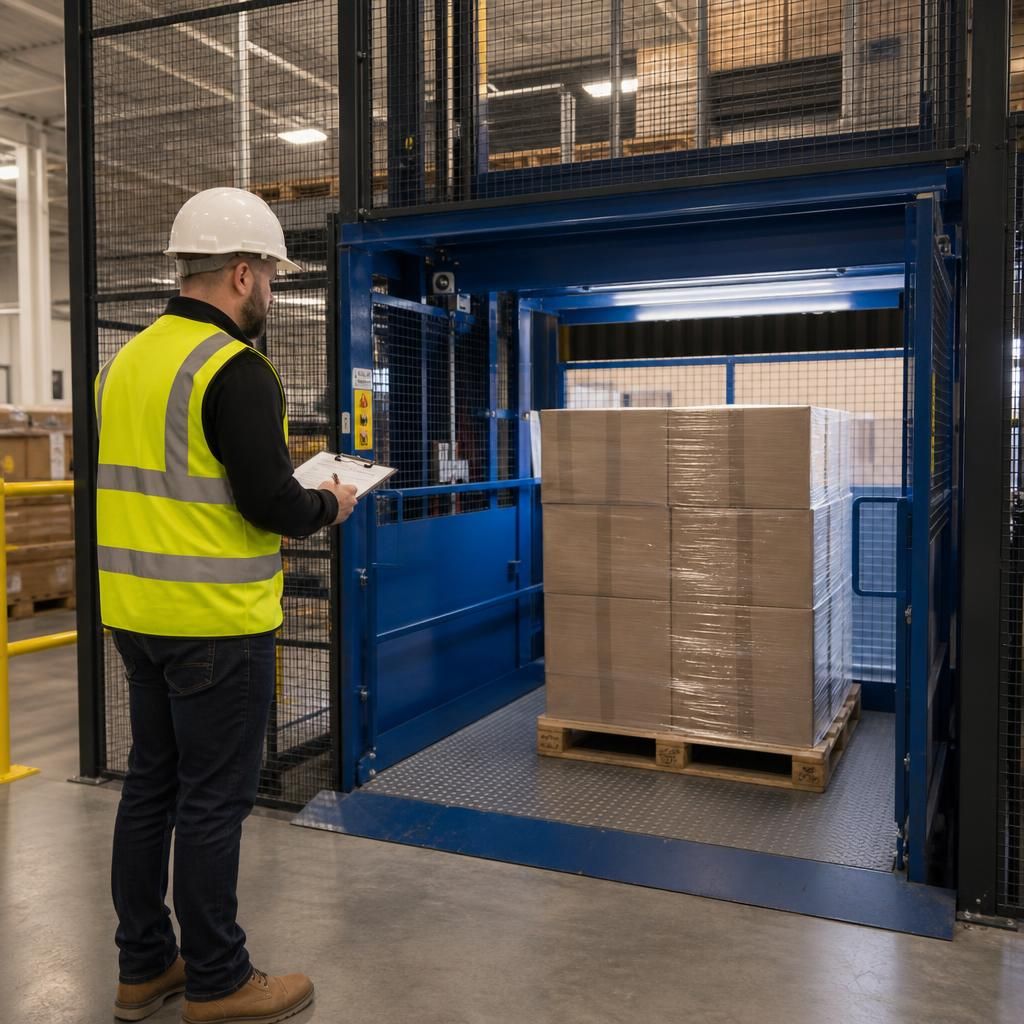
Landing protection is a core safety requirement for mezzanine lift systems because an open lift entrance can expose people to falls, moving equipment and falling loads. Each landing should have suitable guarding, such as an interlocked gate or door, that prevents access to the lift area when the platform is absent.
Interlocks should stop the lift from operating when a gate is open and prevent a gate from opening unless the platform is correctly positioned. Guardrails, toe boards, shaft protection and controls to prevent access beneath a raised platform may also be required, depending on the system design and risk assessment. These safeguards must not be bypassed or removed for convenience. Damaged gates, defective interlocks or missing barriers require the lift to be taken out of service until the fault has been repaired and its safe operation confirmed.
Arrange an expert mezzanine lift safety assessment
Arrange an expert mezzanine lift safety assessment to review guarding, controls, loading arrangements, maintenance and examination requirements. Our experienced team can identify defects and provide practical recommendations to support safe, compliant operation.