
What are the key maintenance considerations for mezzanine lift systems?
Key maintenance considerations for mezzanine lift systems include scheduled inspections, servicing of mechanical and electrical components, safety-device checks, lubrication, and prompt repair of faults. Maintenance should follow the manufacturer’s instructions and applicable UK requirements, with records kept to demonstrate that the lift remains safe, reliable and suitable for daily use.
Maintaining a mezzanine lift system requires planned inspections, competent servicing and prompt correction of defects affecting its structure, lifting mechanism, controls or safety devices. The maintenance programme should follow the manufacturer’s instructions, the lift’s intended use, a suitable risk assessment and applicable UK requirements, with clear records showing what was checked, what work was completed and whether the equipment was safe to return to service.
Use a planned maintenance schedule. Maintenance should not rely solely on reacting to breakdowns. The schedule should define routine operator checks, periodic servicing and formal examinations by a competent person. The required frequency depends on the type of lift, whether it carries people or goods, how often it is used, its environment and the manufacturer’s recommendations. A lift exposed to dust, moisture, impact risk or intensive use may require closer attention than one operating in a clean, controlled environment.
- Set out the checks required before use, during routine operation and at planned service visits.
- Identify the competent people responsible for inspections, repairs, examinations and authorising a return to service.
- Review the schedule after a breakdown, modification, unusual load, impact or change in operating conditions.
- Keep maintenance intervals aligned with the lift manufacturer’s instructions and any written examination scheme.
Inspect the lifting mechanism and supporting components. Mechanical parts should be checked for wear, distortion, corrosion, looseness, damage and abnormal noise. Depending on the design, this may include the mast or guides, rollers, bearings, chains, wire ropes, pulleys, drums, brakes, hydraulic equipment, drive units and fixing points. Components that are stretched, cracked, leaking, excessively worn or incorrectly aligned should be assessed by a competent person rather than left in service.
Particular attention is needed at connection points and areas subject to repeated movement. Lubrication should be applied only where specified by the manufacturer and with the correct product. Over-lubrication can attract dust or contaminate braking and traction surfaces, while using an unsuitable lubricant may damage seals or other components.
Check the platform, enclosure and access arrangements. The platform should remain level, stable and free from damage that could affect loading or safe movement. Inspect the deck, guardrails, gates, toe protection, enclosure panels, landing areas and structural fixings. Any gaps, bent components, loose fasteners or damaged guarding should be assessed promptly, particularly where they could allow a person, load or item to fall.
Landing gates and access barriers must close correctly and remain secure during operation. Their hinges, catches, locks and interlocks should be tested as part of planned servicing. A lift should not operate if an access gate is open or if a safety interlock has been bypassed.
Test safety devices and controls. Safety equipment should be tested under controlled conditions, not simply observed. Checks may include:
- Emergency stop controls and reset functions.
- Door and gate interlocks.
- Upper and lower travel limits.
- Overload protection where fitted.
- Braking and anti-drift arrangements.
- Emergency lowering or recovery systems.
- Audible and visual warnings.
- Control buttons, selector switches and remote controls.
- Guarding around moving parts.
Safety devices must be accessible, correctly labelled and capable of stopping or controlling the lift as designed. Repeated nuisance trips should be investigated rather than overridden, as they may indicate an underlying mechanical, electrical or control fault.
Maintain the electrical and hydraulic systems. Electrical inspections should cover cables, connectors, control panels, switches, sensors, earthing, protective devices and signs of heat or water damage. Hydraulic systems should be checked for leaks, hose deterioration, damaged fittings, fluid condition and correct operating pressure where relevant. Electrical or hydraulic work should be completed by suitably competent personnel, with the system isolated before work begins.
Isolation procedures are essential during maintenance. The lift should be taken out of service, its energy sources isolated and stored energy controlled before anyone works beneath, inside or near moving parts. Appropriate warning notices and physical barriers should be used to prevent operation while maintenance is underway.
Look for changes in the surrounding area. The lift may remain mechanically sound while its operating conditions become less suitable. Routine checks should consider:
- Obstructions around the lift, platform and landing gates.
- Changes to lighting, floor condition or access routes.
- New traffic routes or vehicle impact risks.
- Stored goods interfering with gates, controls or emergency access.
- Changes to the loads, dimensions or handling methods used.
- Unauthorised alterations to the supporting structure or guarding.
Any impact from a vehicle, falling load or other equipment should result in the lift being isolated until it has been assessed. The same applies after unusual vibration, uncontrolled movement, a failed safety device or an unexpected loss of power.
Separate routine checks from formal examinations. Operators can identify visible damage, unusual sounds, leaks, poor gate operation, defective controls and housekeeping issues during routine checks. These checks do not replace planned servicing or a formal thorough examination. Under the Lifting Operations and Lifting Equipment Regulations, lifting equipment must be thoroughly examined by a competent person at suitable intervals and after certain events that could affect its safety. The precise arrangements depend on the lift’s use and design, including whether it is intended to carry people.
PUWER requirements may also apply to the suitability, maintenance, guarding, control systems and safe use of the work equipment. The responsible person should retain the relevant examination report and act on any defects within the stated timescale. A defect categorised as requiring immediate action should result in the lift being withdrawn from use until the issue has been rectified and the equipment has been confirmed safe.
Keep complete maintenance records. Records should identify the lift, inspection or service date, person completing the work, findings, parts replaced, defects raised, corrective action and the date the lift was returned to service. Keep examination reports, manufacturer information, risk assessments, operating instructions and evidence of relevant training together where they can be readily accessed by responsible staff.
Good records help identify recurring faults and support decisions about component replacement, refurbishment or upgrading. They also provide evidence that maintenance has been managed systematically when the equipment is inspected or its use changes.
Train users to report defects. Users should understand the lift’s rated capacity, permitted load dimensions, loading procedure, access controls and emergency arrangements. They should never use a lift showing damage, unusual movement, leakage, an open gate, a defective alarm or any other warning sign. Faults should be reported immediately, with the equipment isolated where continued operation could create a risk.
For a reliable maintenance arrangement, combine daily user checks with planned technical servicing and independent thorough examinations. Do not continue operating a lift because a fault appears intermittent or because production is under pressure. A competent assessment, suitable repair and documented return-to-service decision provide the safest basis for continued operation.
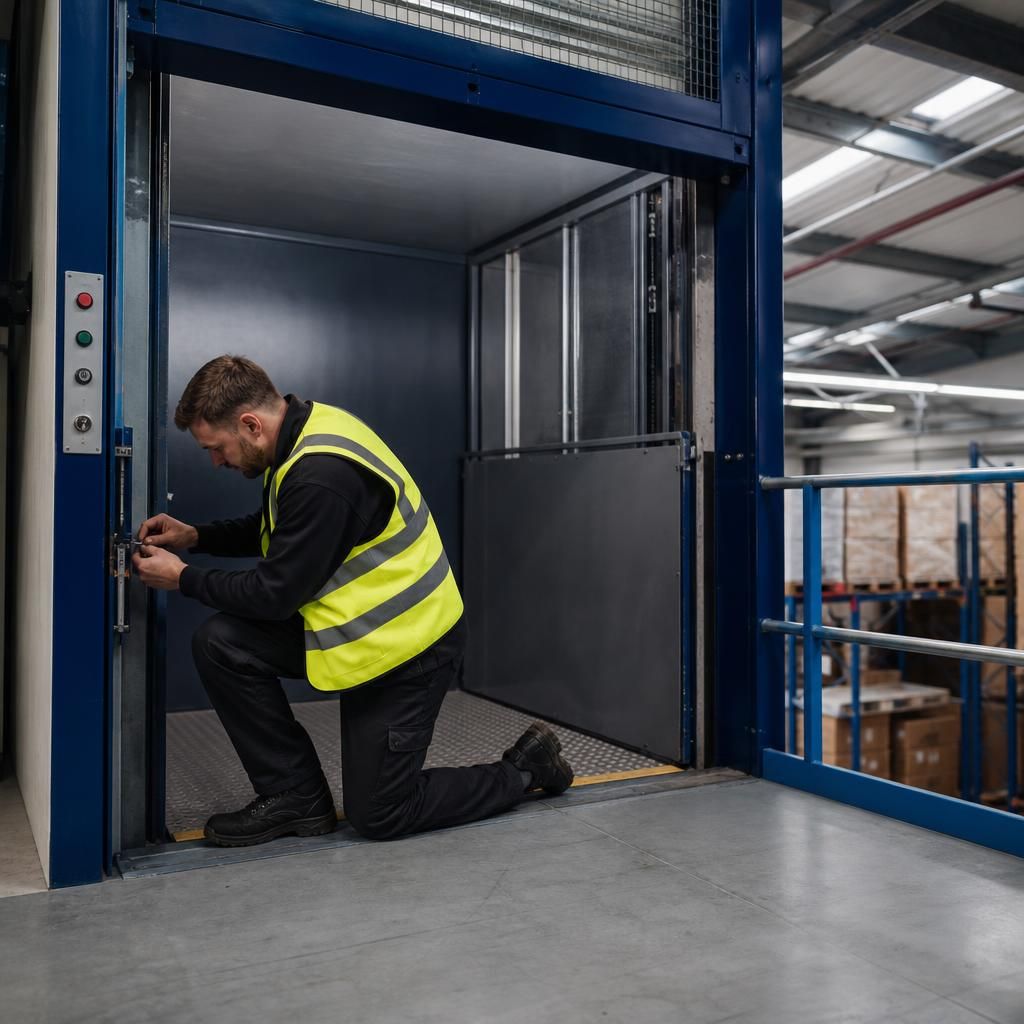
Safety-device testing is a critical part of maintaining a mezzanine lift system. During planned servicing, a competent person should test gate and door interlocks, travel limits, emergency stops, brakes, overload protection and emergency lowering systems under controlled conditions. These devices must prevent movement when access is unsafe and stop or control the lift as intended.
A failed or intermittently operating safety device should never be bypassed. Isolate the lift, record the defect and arrange competent repair before it is returned to service. Testing results and corrective actions should be retained with the lift’s maintenance and examination records.
Arrange a Mezzanine Lift System Maintenance Review
Arrange a mezzanine lift system maintenance review with Able Racking to assess inspections, servicing records, safety devices and any outstanding defects. Our experienced team can help confirm that your system is maintained in line with the manufacturer’s guidance and applicable UK requirements.