
How can I determine the best type of lift system for my mezzanine loading needs?
Determine the best lift system for mezzanine loading by assessing the goods’ weight and dimensions, required throughput, travel height, available space, and how operators will load and unload it. A site assessment can then establish whether a goods lift, vertical reciprocating conveyor or another solution provides the safest and most efficient fit for your operation.
The best lift system for mezzanine loading is determined by the goods being moved, required throughput, travel height, available floor space, loading method and the level of protection required around the equipment. In most applications, the practical choice is between a dedicated goods lift, a vertical reciprocating conveyor (VRC), or a lift table. A site assessment should confirm which option safely accommodates the load, integrates with the mezzanine and supports the way your team operates.
Start with the operational requirements
Before comparing equipment, define how the lift will be used. The following information will influence the specification:
- Load type: Establish whether the system will carry pallets, stillages, cages, cartons, totes, long items or mixed loads.
- Maximum load: Consider the heaviest complete load, including the pallet or transport container, rather than the average load.
- Load dimensions: Measure the maximum length, width and height, allowing sufficient clearance for safe positioning and movement.
- Travel distance: Confirm the vertical distance between the lower and upper loading levels, including any required clearance above the platform.
- Throughput: Assess how frequently the lift will operate and whether goods must be moved continuously or only at set intervals.
- Loading method: Decide whether operators will load manually, use pallet trucks, or approach the lift with powered handling equipment.
- Available space: Allow for the lift shaft or frame, landing gates, controls, guarding, maintenance access and safe approach areas.
- Environmental conditions: Account for temperature, dust, moisture, wash-down requirements and any potentially corrosive or hazardous materials.
It is also important to examine the movement of goods before and after the lift journey. A suitable system can still create delays if operators have to make awkward turns, wait for access or transfer loads between incompatible handling methods.
Goods lifts for enclosed vertical movement
A goods lift is generally suited to heavier or larger loads that need to travel between clearly defined levels. It provides an enclosed or substantially protected lifting area and can be configured with access doors at each landing. This makes it appropriate where goods need to be transferred securely between a warehouse floor and a mezzanine, particularly when the load is handled by pallet truck or other mobile equipment.
Goods lifts are often selected when the operation requires:
- Higher load capacity than a small platform lift can provide.
- A spacious platform for pallets, cages or bulky items.
- Controlled access at more than one landing.
- Protection against people entering the lifting zone during operation.
- A robust installation designed for regular industrial use.
A goods lift must not be treated as a passenger lift unless it has been specifically designed, assessed and approved for that purpose. Procedures should make clear that people remain outside the lift during movement unless the equipment is expressly intended for personnel transport.
Vertical reciprocating conveyors for regular goods transfer
A VRC moves goods vertically between fixed levels on a platform or carrier. It can be an efficient solution where the load follows a repeatable route and the operation does not require people to travel with the goods. VRCs are commonly considered for pallets, boxes, totes and other unit loads moving between a ground-level handling area and a mezzanine.
This type of system may be suitable where:
- The loading and unloading points are fixed.
- Goods movement is frequent but follows a consistent process.
- There is a need to separate the lifting area from pedestrian routes.
- The available footprint is limited and a compact vertical arrangement is beneficial.
- The operation would benefit from straightforward controls and repeatable cycles.
The platform, enclosure, gates and controls must be specified as one system. A VRC should not be selected solely by its lifting capacity. The platform size, approach arrangement, guarding and method of transferring the load are equally important to safe and efficient operation.
Lift tables and smaller platform systems
A lift table or compact platform lift can be appropriate for lighter loads, limited travel distances or applications where goods are transferred between closely positioned levels. These systems may suit cartons, components or individual containers, especially where a full goods lift would be unnecessary.
However, a smaller platform system may not be appropriate for large pallets, frequent powered truck access or demanding throughput. Check the platform dimensions, rated capacity, loading edge, guarding and approach space carefully. The equipment must remain stable when the load is placed on or removed from the platform, not just when it is stationary and evenly loaded.
Compare the main selection factors
The most suitable system is the one that meets the operational requirement without introducing avoidable handling or safety risks. Compare each option against the following points:
- Capacity and stability: The rated capacity must cover the complete load and any foreseeable uneven loading. Consider the centre of gravity for tall, irregular or fluid loads.
- Speed and throughput: Faster movement is not automatically more efficient. The complete cycle includes loading, door operation, travel, unloading and return.
- Platform dimensions: The load should fit without overhang that could interfere with guarding, doors or the lift structure.
- Landing arrangement: Each landing needs a safe approach, suitable gates and a clear method for transferring goods.
- Controls: Controls should be positioned so operators can see the platform and landing area where necessary. Emergency stopping arrangements must be readily accessible.
- Integration: Consider how the lift will work with conveyors, pallet trucks, loading bays, doors, fire protection and existing traffic routes.
- Maintenance access: The design should allow competent technicians to inspect and maintain the equipment without exposing them to unnecessary hazards.
- Future use: Allow for likely changes in load dimensions, handling equipment and operating patterns, but avoid specifying unnecessary capacity or complexity.
Safety and compliance requirements
Lift selection should follow a documented risk assessment covering loading, unloading, normal operation, foreseeable misuse, cleaning, maintenance and emergencies. The assessment should consider both operators and anyone who may pass near the equipment.
Key protective measures normally include guarded sides, landing gates, interlocks, anti-drop protection where applicable, suitable emergency stops, clear signage and controlled access to the lifting zone. The system should prevent a landing gate from being opened when the platform is absent and prevent movement when a gate or guard is not correctly closed, subject to the design and applicable requirements.
Industrial lifting equipment may be subject to requirements under the Provision and Use of Work Equipment Regulations and the Lifting Operations and Lifting Equipment Regulations. The exact duties depend on the equipment design and how it is used. The supplier, installer and duty holder should establish the required examination, inspection, maintenance and operator training arrangements before the system is put into service.
Documentation should include operating instructions, limitations, inspection information, emergency procedures and records of relevant examinations. Operators should be trained in the normal loading process, safe positioning of goods, use of gates and controls, reporting of faults, and what to do if a load or platform stops unexpectedly.
Use a site assessment before final specification
A site assessment is the most reliable way to confirm the correct lift type. It should review the structural support available for the equipment, the proposed openings in the mezzanine, landing levels, floor condition, headroom, electrical supply, access for installation and the route used by people and handling equipment.
The assessment should also test the proposed loading sequence. For example, a lift may have adequate capacity but still be unsuitable if a pallet truck cannot approach squarely, if the landing is too narrow to turn safely, or if the upper-level gate opens onto an unprotected edge. These practical details often determine whether the system improves productivity or creates additional handling steps.
In general, choose a goods lift where heavier or bulky loads require protected movement between levels; consider a VRC where fixed-point goods transfer is frequent and repeatable; and assess a lift table for lighter loads or shorter, more limited movements. The final decision should be based on the complete process, supported by a competent design review, risk assessment and installation plan rather than on lift capacity alone.
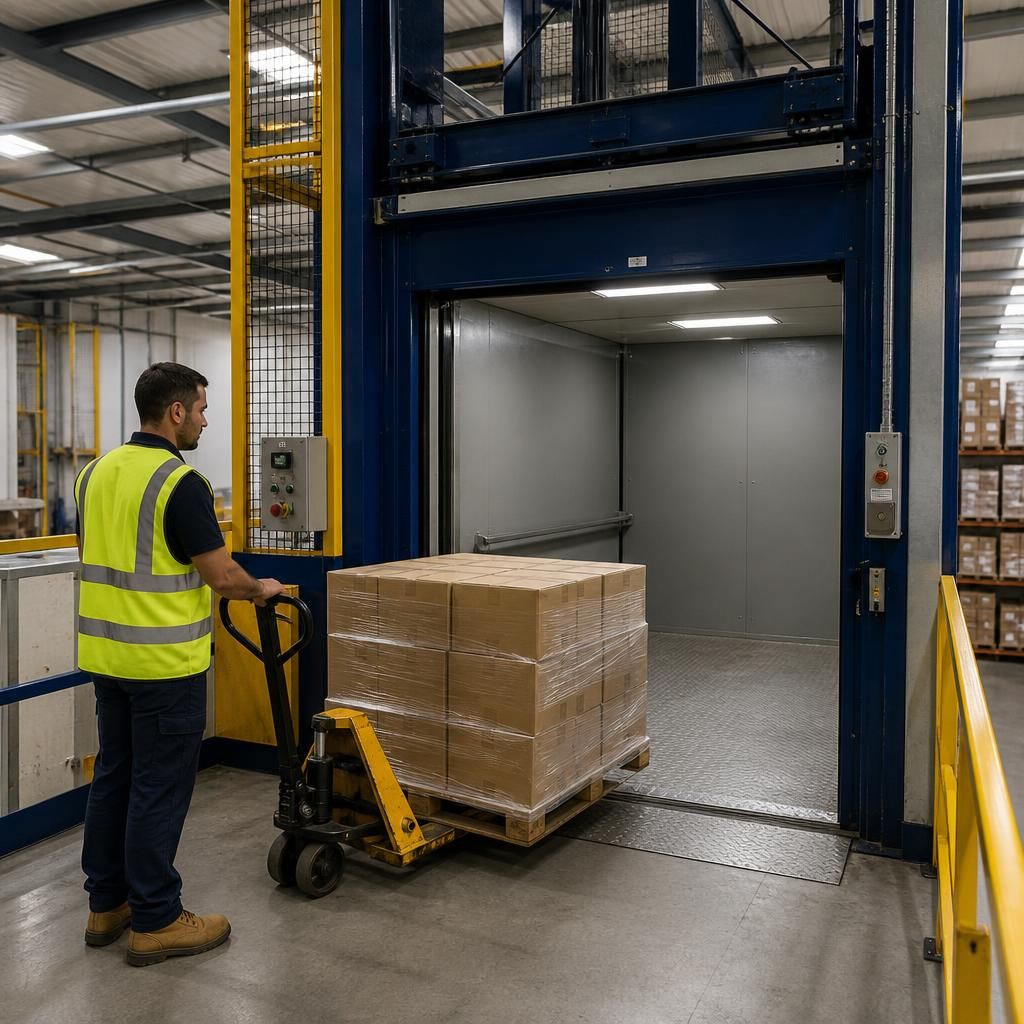
A site assessment is essential for selecting a lift system that suits the load, travel height, available space and method of operation. It confirms whether a goods lift, vertical reciprocating conveyor or lift table can be installed and used safely between the warehouse floor and mezzanine.
The assessment should examine landing positions, platform dimensions, headroom, floor and structural conditions, guarding, access gates, electrical requirements and the approach routes used by pallet trucks or other handling equipment. It should also review the full loading cycle, as a lift with sufficient capacity may still be unsuitable if operators cannot position loads safely or move them clear of the landing.
Using these findings, the system can be specified around the complete process rather than capacity alone. This helps ensure the lift integrates with existing traffic routes, supports efficient goods movement and provides suitable protection during loading, unloading, operation and maintenance.
Discuss your mezzanine lift system requirements
Discuss your mezzanine lift system requirements with our experienced team to review your loads, travel height, available space and operating process. We can help identify a practical, safe solution suited to your site and handling needs.