
What materials are typically used for mezzanine edge protection and gates in industrial settings?
Industrial mezzanine edge protection and gates are typically made from galvanised or powder-coated steel, often combined with welded mesh infill, tubular frames and steel toe boards. These materials provide the strength, visibility, impact resistance and corrosion protection needed to safeguard open edges and control the movement of goods and people.
Industrial mezzanine edge protection and gates are typically manufactured from galvanised or powder-coated steel, with welded mesh, tubular sections and steel toe boards selected according to the application. These materials provide the load-bearing strength, impact resistance, visibility and corrosion protection needed to protect open edges and control the movement of people, equipment and goods.
Steel is the most common structural material because it offers a reliable combination of strength, rigidity and durability. It is used for upright posts, handrails, midrails, gate frames, hinges, counterbalance components and supporting brackets. The steel specification and section size should be selected from the design loads, opening dimensions, expected impact and the way the gate will be used. A gate intended for frequent pallet transfer may require a more substantial frame than one used only for occasional pedestrian access.
Galvanised steel has a zinc coating applied to protect the underlying steel from corrosion. It is particularly suitable for warehouses and industrial areas where the installation may be exposed to moisture, condensation or variable temperatures. Galvanising provides robust protection and is often preferred where a hard-wearing finish is more important than a particular colour. Any cut edges, drilled areas or damaged coating should be assessed and treated appropriately to prevent corrosion developing.
Powder-coated steel is another widely used option. The steel is cleaned and treated before a dry powder coating is applied and cured to form a durable surface. Powder coating can improve resistance to general wear and gives the installation a consistent finish, often making different safety components easier to identify. It is available in a range of colours, although the coating should not be relied upon as a substitute for correct design, inspection or maintenance.
Some systems use galvanised steel beneath a powder-coated finish, combining corrosion protection with additional surface protection and visual identification. The suitability of this arrangement depends on the preparation and quality of the coating process, as well as the environment in which the edge protection or gate will be installed.
Welded wire mesh is commonly used as an infill panel within steel frames. Mesh helps prevent people, tools and materials from passing through the protected edge while preserving visibility between the working platform and the area below. It can also make it easier for operators to see approaching loads and communicate with colleagues. Mesh aperture, wire diameter, panel strength and fixing method must be appropriate for the foreseeable use; an open panel should not create a risk of items passing through or becoming trapped.
Tubular steel sections are frequently used for handrails, midrails and gate frames. Tubes provide a smooth, continuous surface that is easy to grip and relatively straightforward to clean. Their closed profile also avoids some of the dirt and debris accumulation associated with open sections. The joints, welds and connections are as important as the tube itself, because poorly finished or inadequately secured connections can create sharp edges, loosen under use or reduce the overall strength of the system.
Steel toe boards are installed along the lower edge of the protection where there is a risk of items being kicked, rolled or pushed from the platform. They are usually formed from folded or flat steel and may be galvanised or powder coated to match the rest of the system. Toe boards should be securely fixed, continuous where required and positioned so that they do not interfere with doors, pallet transfer equipment or the safe operation of the gate.
Gate construction varies according to the intended function. Common arrangements include:
- Hinged gates: steel frames with hinges, latches and controlled opening to provide pedestrian access.
- Loading gates: robust steel assemblies designed to maintain edge protection while goods are transferred through a designated opening.
- Sliding gates: steel and mesh panels that move horizontally where a swinging gate would obstruct the working area.
- Pallet gates: counterbalanced or interlocking designs that use steel barriers to protect the open edge while loads are being placed or removed.
Gate hardware may include steel hinges, locking pins, latches, handles, guide tracks, rollers and counterbalance components. These parts need to be compatible with the gate weight and duty cycle. A latch should engage positively and resist accidental release, while any interlock or counterbalance should continue to function if the gate is operated repeatedly during a working shift. Moving components may also include polymer rollers, bushes or protective covers to reduce friction and wear, but these do not replace the structural steelwork.
Aluminium is sometimes used for selected components where low weight, ease of handling or resistance to particular corrosive conditions is important. It is less commonly used for heavily loaded structural barriers because its strength, stiffness and connection details differ from steel. Aluminium and steel should not be combined without considering galvanic corrosion, thermal movement, fixing compatibility and the design loads. Stainless steel may be appropriate in unusually corrosive or hygiene-sensitive environments, although its higher material cost means that it is normally specified only where its properties are necessary.
Plastic, rubber and composite materials are generally used as secondary components rather than the primary barrier. Examples include impact buffers, edge trims, wheel guides, protective caps, rollers and seals. They can reduce damage to finishes and improve day-to-day operation, but they should not be treated as substitutes for steel posts, rails, mesh panels or properly designed gate frames unless the system has been specifically engineered and tested for that purpose.
Material selection should take account of the environment as well as the intended use. Important considerations include exposure to water or chemicals, temperature changes, cleaning methods, airborne dust, vehicle movements, the frequency of loading and unloading, and the likely severity of impact. The finish must remain intact, fixings must be suitable for the supporting structure, and drainage should be considered where water could collect inside sections or around base plates.
The complete system matters more than the material name alone. A well-finished steel barrier can still be unsafe if it has inadequate fixings, poorly aligned panels, weak welds, unsuitable apertures or a gate that does not close reliably. Installation should therefore follow the approved design and manufacturer’s instructions, with attention to edge continuity, opening protection, clearances, access routes and the interaction between the gate and material-handling equipment.
During inspections, check for corrosion, damaged coatings, bent posts or rails, cracked welds, loose bolts, distorted mesh, missing toe boards and deterioration around floor fixings. Gates should be checked for smooth movement, positive closure, effective latching and any abnormal play in hinges, rollers or counterbalance parts. Damage should be assessed by a competent person rather than simply repainted, as a surface repair will not correct a distorted frame or weakened connection.
For most industrial applications, galvanised or powder-coated steel with welded mesh and steel toe boards provides a practical balance of durability, visibility and maintainability. The correct choice should nevertheless be based on the specific loading arrangement, operating environment, access requirements and design assessment. Able Racking can help assess the existing installation, identify defects and recommend suitable repairs or replacement components where the material or configuration no longer provides dependable protection.
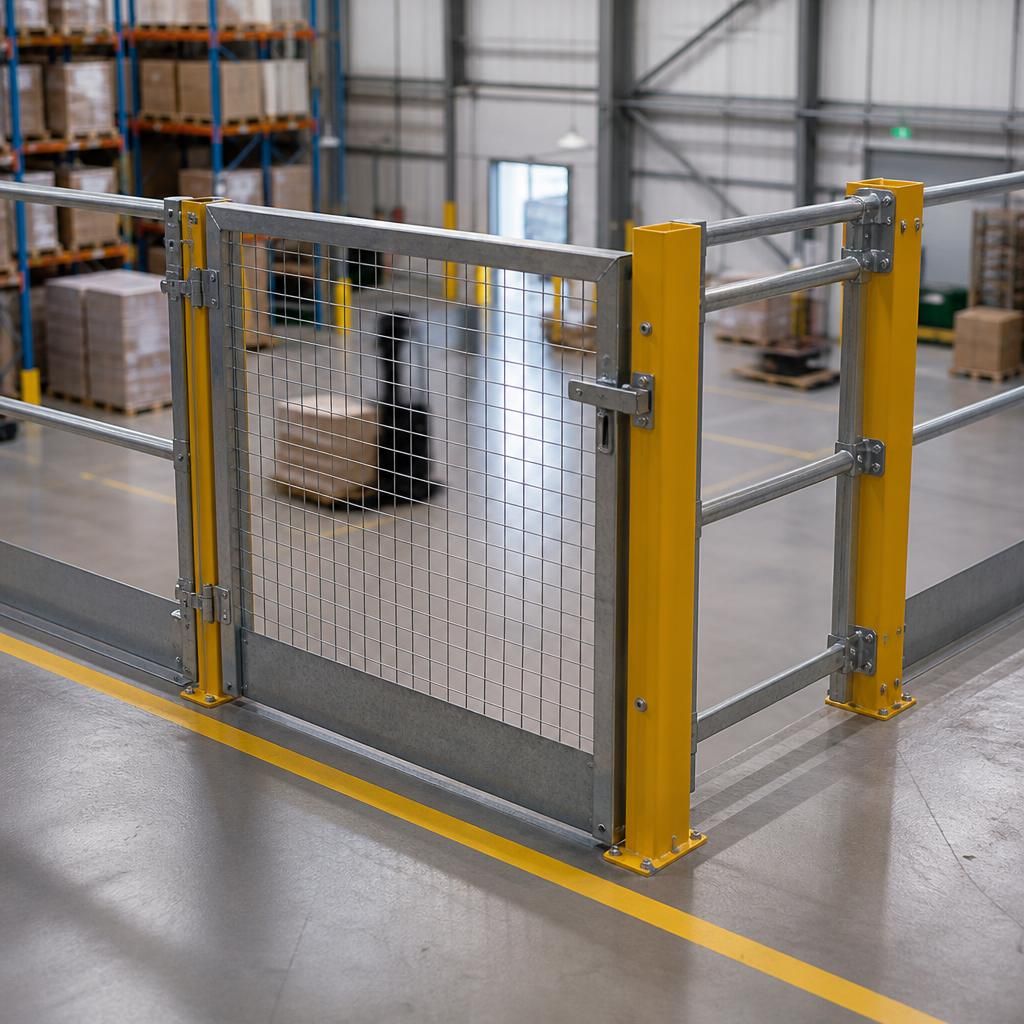
Galvanised steel is often selected for industrial edge protection and gates because its zinc coating helps protect the underlying steel from corrosion. Powder-coated steel provides an additional durable finish and can improve visual identification, while welded mesh maintains visibility and helps prevent tools or materials passing through the protected edge.
The correct specification depends on the environment and duty of the installation. Moisture, cleaning chemicals, vehicle movements, pallet transfer activity and the frequency of gate operation should all be considered. Steel toe boards, secure fixings and correctly sized gate hardware complete the system, but every component must be designed, installed and maintained as part of the same safety arrangement.
Arrange an expert edge protection assessment
Arrange an expert edge protection assessment to confirm that your materials, fixings and gate arrangements remain suitable for the working environment and intended use.