
What factors should be considered when installing mezzanine floor safety gates?
When installing mezzanine floor safety gates, consider workplace safety requirements, the platform’s layout and load-handling activities, the gate’s suitability for daily use, and compatibility with the existing edge protection. The installation should also provide secure guarding, controlled access, safe pallet transfer, clear operating space and straightforward inspection and maintenance.
Installing mezzanine floor safety gates requires more than selecting a suitable gate and fixing it to the platform. The installation must be based on a site-specific risk assessment, comply with applicable workplace safety requirements, prevent falls from open edges, and support the way people and goods are moved during daily operations. The gate must also integrate with the existing edge protection, provide controlled access, and remain practical to inspect and maintain.
Start with a detailed risk assessment
The first consideration is how the platform is used and what hazards arise when goods are loaded, unloaded or transferred at the edge. The assessment should consider:
- the height and location of the platform;
- the type, size and weight of goods being transferred;
- how goods arrive at and leave the gate;
- the equipment used for handling, such as pallet trucks or forklift trucks;
- the number and frequency of loading activities;
- pedestrian routes, access points and nearby work areas;
- the possibility of goods being pushed, dropped or displaced; and
- how the gate will be used during normal work and foreseeable misuse.
A gate selected without understanding these activities may create additional risks. For example, an operator may need to stand close to the platform edge to open it, or a gate may obstruct the safe approach of handling equipment. The assessment should therefore cover the complete transfer process rather than the gate in isolation.
Confirm legal and safety requirements
Work at height duties require open edges and access points to be protected so that people and objects cannot fall. The design should be reviewed against the relevant requirements of the Health and Safety at Work etc. Act, the Work at Height Regulations and applicable British or European standards. The precise requirements depend on the installation, its use and the wider workplace arrangements.
Compliance is not established simply because a gate is manufactured for industrial use. The completed installation, including its supporting structure, guarding, access arrangements and operating method, must be suitable for the intended application. Employers should retain the risk assessment, design information, installation records and inspection findings as part of their safety documentation.
Choose the correct gate arrangement
The gate type should match the transfer task and the available space. Common arrangements include pallet gates, hinged gates and sliding gates, although the most suitable option depends on the layout and operating method.
- Pallet gates are designed to protect the open platform edge while goods are transferred. They must provide a protected position for the operator and should not allow the load to pass through an unguarded opening.
- Hinged gates can be suitable where there is enough room for the gate to open without striking people, loads, vehicles or nearby structures.
- Sliding gates can be useful where a swinging gate would interfere with traffic routes or working space, provided the track and operating mechanism are protected from damage and obstruction.
The gate should not be selected solely on purchase cost or available opening width. Its movement, guarding arrangement, access control and compatibility with the handling process are equally important.
Check dimensions and load requirements
The opening must be large enough for the goods and handling equipment, but not so large that it creates unnecessary exposure to a fall. Measurements should include the width, height, depth and turning space required for the largest intended load. Allowance may also be needed for packaging, irregular loads and the safe positioning of equipment.
The supporting structure must be capable of resisting the forces imposed by the gate, its hinges or tracks, normal operation and reasonably foreseeable impact. The design should account for the gate’s own weight and any loads that could be applied accidentally. Fixings must be appropriate for the platform construction and installed in accordance with the manufacturer’s instructions or the approved design.
Maintain continuous edge protection
When the gate is closed, it should form part of a continuous protective barrier with the surrounding guardrails, toe boards and other edge protection. Gaps, low points and openings should be controlled so that people cannot fall through or under the guarding and goods cannot slide from the platform.
The gate arrangement should also prevent the operator from being exposed to the open edge while goods are being transferred. Where a loading gate has two operating positions, the design should make it clear which position provides protection and which position permits loading. The surrounding guardrails must not be removed or left incomplete to accommodate the gate unless the whole arrangement has been designed and assessed as a system.
Consider operator protection and gate movement
Safe operation depends on the gate being easy to use from a protected position. Handles, latches and controls should be reachable without leaning beyond the edge or placing hands where they may be trapped. Moving parts should not create avoidable crushing, shearing or trapping points.
The gate should be stable throughout its movement and should not swing or slide unexpectedly. Self-closing arrangements, positive latches or other control measures may be appropriate, depending on the design and risk assessment. The operating sequence should be straightforward, and workers should not need to bypass the gate or remove guarding to complete routine tasks.
Plan the loading and unloading method
A safety gate is only effective when the transfer procedure is also safe. The installation should define where goods are positioned, how the operator communicates with equipment drivers, and when the gate may be opened or moved. Clear floor markings, exclusion zones and agreed signals may be needed where vehicles or powered handling equipment approach the platform.
Loads should remain stable during transfer and should not be placed against the gate unless the design specifically permits this. The procedure should address damaged pallets, uneven loads, restricted visibility and situations where a load cannot be positioned squarely. If the gate is intended for occasional rather than continuous loading, that limitation should be reflected in the risk assessment and staff instructions.
Check compatibility with the existing structure
Before installation, the platform structure, guardrails, toe boards, access stairs and adjacent equipment should be surveyed. The installer needs to confirm that there is sufficient structural capacity and that the proposed fixing points will not weaken the platform or interfere with services, floor finishes or other safety systems.
Any changes to the platform or its edge protection should be controlled through the site’s modification process. Unauthorised drilling, cutting or removal of structural or protective components can affect the integrity of the installation. Where the arrangement is unusual or subject to significant loads, competent structural advice should be obtained before work begins.
Allow for the working environment
The surrounding environment can affect both the choice and performance of the gate. Consider available headroom, lighting, dust, moisture, temperature, corrosive substances, vehicle movements and the likelihood of impact. A gate used in a busy industrial area may require additional protection from vehicles or handling equipment.
Visibility is also important. Operators should be able to see the load, the platform edge and nearby people, or use a defined communication method where visibility is restricted. The gate and its guarding should not create blind spots that make loading or access less predictable.
Provide suitable access control
The installation should distinguish between authorised access and goods transfer. Where people need to enter the platform, a suitable guarded access point and safe route should be provided. A loading gate should not be treated as a general pedestrian entrance unless it has been designed and assessed for that purpose.
Where unauthorised use could create a fall risk, the gate may require a locking device, controlled access arrangement or clear local instructions. The control method must not encourage workers to leave the gate open or defeat its protective features to save time.
Consider materials and durability
Materials should be suitable for the environment and the expected use. Steel is commonly selected for its strength and resistance to impact, while coatings or finishes may be needed in damp or corrosive conditions. The gate should be robust enough for regular operation, but its weight must remain manageable for the people expected to use it.
Welds, hinges, latches, tracks, mesh and fixings should be accessible for inspection and protected against damage where necessary. The design should avoid areas where debris can accumulate and prevent the gate from closing or latching correctly.
Plan installation, commissioning and handover
Installation should be completed by competent operatives using the approved design and manufacturer’s instructions. On completion, the gate should be checked for secure fixing, correct alignment, smooth movement, reliable latching and continuity with the surrounding edge protection.
Commissioning should include a practical check using the intended transfer process. Any problems with approach space, visibility, handling equipment or operator access should be corrected before the gate is placed into service. The handover should include installation information, operating instructions, inspection requirements and details of any restrictions.
Include training and ongoing inspection
Employees should understand when the gate may be opened, how it must be secured, what loads are permitted and what defects must be reported. Training should reflect the actual gate installed and the site’s transfer procedure rather than relying only on general safety information.
Routine checks should look for loose or damaged fixings, distortion, corrosion, worn hinges or tracks, defective latches, missing guarding and any obstruction to movement. A more thorough inspection should be completed at suitable intervals and after impact, alteration or an incident. Any gate that does not close, latch or provide continuous protection should be taken out of use until it has been assessed and repaired by a competent person.
Key installation principle
The safest installation is one that combines a suitable gate with sound structural fixing, continuous edge protection, a controlled transfer procedure and clear maintenance arrangements. Reviewing these factors before installation helps ensure the gate protects people during real working activities, supports efficient goods handling and remains suitable throughout its service life.
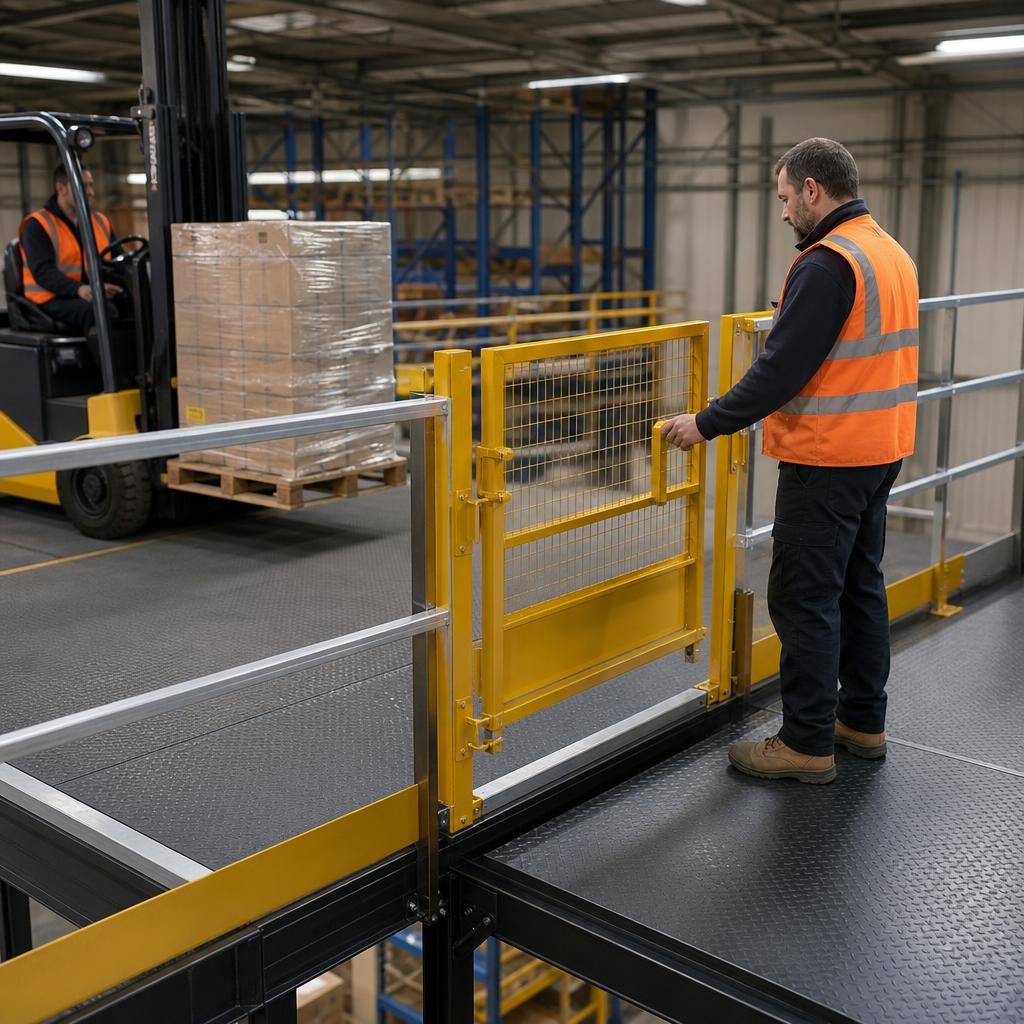
A mezzanine floor safety gate must maintain continuous edge protection while goods are being transferred. The surrounding guardrails and toe boards should work with the gate as one protective system, preventing people or loads from passing through an unguarded opening.
The arrangement should keep the operator in a protected position and make the safe operating sequence clear. Check that the gate closes securely, latches correctly and cannot be left in a position that exposes the edge. The opening must also suit the load and handling equipment without requiring workers to lean over the edge or remove other protective components.
Discuss Your Mezzanine Floor Safety Gate Requirements
Speak to our team about your mezzanine floor safety gate requirements, including site layout, loading activities, structural fixing and ongoing inspection needs. We can help you review the proposed arrangement and identify the controls needed for safe, compliant operation.