
What are the different types of mezzanine safety gates and how do they function?
Mezzanine safety gates include pallet gates, sliding gates and swing gates, each designed to maintain edge protection while allowing goods to pass safely between floor levels. They function by providing a controlled opening that can be accessed for loading or movement, then closed or repositioned to prevent people, pallets and materials from falling.
Mezzanine safety gates are controlled access barriers fitted at open edges where goods or equipment need to pass between a floor and a raised working level. The main types are pallet gates, sliding gates, swing gates and vertical lift gates. Each creates a protected opening during loading or access, then returns to a closed or guarded position to reduce the risk of people, pallets and materials falling from the edge.
The correct gate depends on the way goods are handled, the available space, the opening dimensions, the traffic around the loading point and the level of protection required. A gate should form part of a complete edge protection system, not be treated as an isolated item of equipment.
Pallet gates
Pallet gates are designed for transferring pallets and other bulky loads to and from a mezzanine. The most common design uses a hinged, counterbalanced gate with two barrier positions. When the gate is in one position, it closes the exposed loading edge while allowing the operator to access the opposite side. The gate is then moved to transfer the load, keeping the open edge protected by the remaining barrier.
This arrangement is often called an up-and-over or counterbalanced pallet gate. Its operating movement is normally assisted by a counterbalance mechanism, which makes the gate easier to reposition without relying on powered equipment. The system must be correctly balanced and maintained so that it does not drop, drift or become difficult to operate.
Pallet gates are suitable where loads are moved with handling equipment and where a clear opening is required. They need enough overhead and surrounding clearance for the barrier to travel safely. The operating area should also be kept free from obstructions, stored goods and unauthorised access.
Sliding safety gates
Sliding gates move horizontally along a track or guided frame. Depending on the design, the gate may slide to one side or consist of sections that move across the opening. When closed, the barrier protects the edge. When access is needed, the gate is moved away from the opening while the load is transferred or personnel pass through under controlled conditions.
A sliding gate can be useful where there is limited space above the opening and where a hinged movement would interfere with lighting, structures or handling equipment. It can also provide a practical solution for wider openings. The track, rollers, stops and guide points are important safety components: damage, contamination or poor alignment can make the gate difficult to move or prevent it from closing fully.
Sliding gates are not automatically safer simply because they move horizontally. The opening must still be controlled, the gate must be capable of being secured in its safe positions and the surrounding area must be arranged to prevent people being trapped or struck during movement.
Swing gates
Swing gates are mounted on hinges and open in an arc, much like a conventional personnel gate. They are generally used where people need controlled access through an edge protection line, or where smaller items are being passed through rather than full pallets.
A suitable swing gate will normally include a secure latch and may be self-closing. The hinges, latch and closing mechanism must be strong enough for the operating environment and the gate should not be capable of being left accidentally in an unsafe position. Where the gate opens towards a walkway or working area, the movement must not create a collision or trapping hazard.
Swing gates are relatively straightforward, but they require adequate clearance for the door leaf. They may be unsuitable for pallet transfer points because the arc of movement can conflict with handling equipment or reduce the usable opening.
Vertical lift gates
Vertical lift gates move upwards to provide access and lower again to close the opening. They can be considered where floor space is restricted and there is sufficient clear height above the loading point. Some are manually operated, while others use assisted mechanisms.
The lifting system, guides and retaining components need regular inspection. A gate that rises unexpectedly, falls under its own weight or fails to remain in the intended position presents a serious hazard. The design should also prevent access beneath a raised barrier unless the arrangement has been specifically assessed and controlled.
How the safety function works
Regardless of the gate style, the protective principle is the same:
- The gate maintains a physical barrier across an exposed edge when the opening is not actively being used.
- A controlled movement creates access for a pallet, load or authorised person.
- The gate is then returned to a closed, guarded or otherwise safe position before normal work continues.
- Posts, rails, toe protection and the surrounding structure help prevent people or materials bypassing the gate.
- Locks, latches, stops, counterbalances and guides help keep the gate stable and predictable during operation.
Some systems are designed so that one barrier remains closed while the other is opened. This reduces the likelihood of an unprotected opening being created during pallet handling. However, the exact operating sequence must be understood by everyone who uses the gate, and the system must not be modified or defeated to speed up loading.
Comparing the main gate types
- Pallet gates: best suited to frequent transfer of pallets or large loads where a protected loading position is needed.
- Sliding gates: useful where horizontal movement is preferable or overhead clearance is limited.
- Swing gates: suitable for controlled personnel access and smaller transfer points where there is room for the gate to open.
- Vertical lift gates: considered where floor space is restricted but adequate height is available.
Selection should consider the load dimensions and weight, handling method, opening width, operating frequency, available clearance, floor loading, guarding layout and the competence of the people using the equipment. The gate must also be compatible with the existing edge protection and securely fixed to a suitable structure.
Safe use and inspection
Operators should be trained to use the gate as intended and should never climb over, pass beneath or work through an unprotected opening. Loads should be stable before transfer, and handling equipment should approach squarely and at a controlled speed. The area should be kept clear so the gate can open, close and latch without obstruction.
Before use, check for damage, loose fixings, bent components, missing pins, worn hinges, damaged tracks, faulty rollers and ineffective latches or stops. A gate that does not close fully, remains difficult to move or shows signs of impact should be taken out of service until it has been assessed and repaired by a competent person.
Regular inspections should be based on the operating environment, frequency of use and any relevant risk assessment or manufacturer instructions. Inspection records should identify defects, actions taken and any restrictions placed on the equipment. Repairs should use suitable components and should not alter the gate’s original safety function.
A properly selected and maintained safety gate provides a controlled loading or access point without leaving the mezzanine edge unnecessarily exposed. The best solution is the one that matches the movement of goods and people, integrates with the surrounding protection and remains easy for trained operators to use correctly.
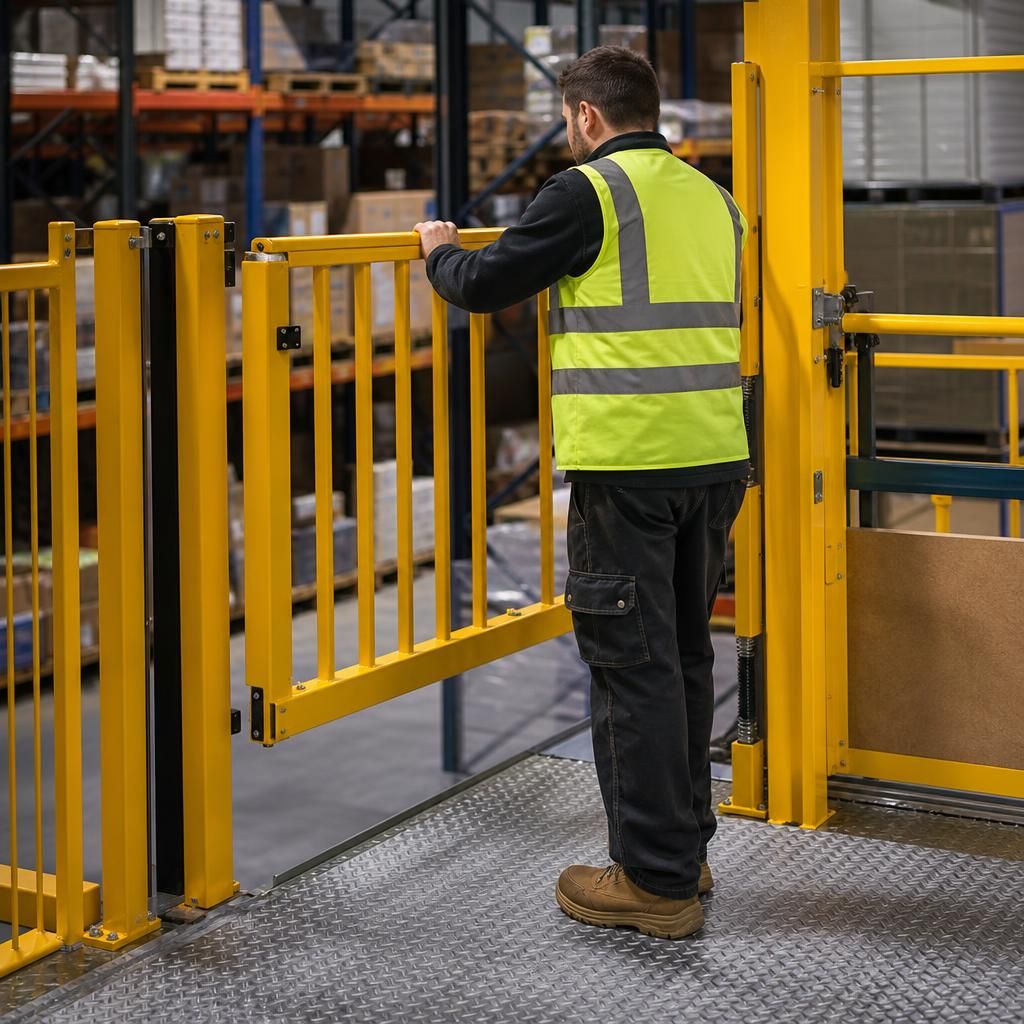
A counterbalanced pallet gate protects an open mezzanine loading edge by using two barrier positions: one closes the edge while the other allows a pallet or load to be transferred. As the gate is repositioned, the exposed side remains guarded, reducing the risk of a person, pallet or material falling through the opening.
The counterbalance makes the gate easier to operate manually, but it must be correctly adjusted and maintained. Operators should move it only from the designated position, keep the loading area clear and confirm that the barrier is fully seated before normal work resumes. A gate that drops, drifts, sticks or fails to close should be removed from service until it has been assessed by a competent person.
Talk to us about the right mezzanine safety gate
Talk to Able Racking about selecting, installing or reviewing the right mezzanine safety gate for your loading point and working practices. Our experienced team can help you confirm that the gate integrates correctly with your existing edge protection and remains safe to operate.