
What safety standards do mezzanine sliding gates need to meet in the UK? — They must provide secure edge protection and controlled access, withstand foreseeable loads, and operate safely under a suitable risk assessment. Compliance commonly involves the Work at Height Regulations, PUWER, relevant guarding principles in BS EN ISO 14120 and access requirements in BS EN ISO 14122, with installation and inspection carried out by competent persons.
Mezzanine sliding gates must provide effective edge protection, controlled access and safe operation, with the design able to withstand foreseeable loads and workplace use. Compliance is typically assessed under the Work at Height Regulations 2005 and PUWER 1998, alongside relevant guarding principles in BS EN ISO 14120 and access requirements in BS EN ISO 14122, with installation and inspection completed by competent persons.
Mezzanine sliding gates in the UK must provide effective edge protection, prevent unintended access to open edges, withstand foreseeable workplace loads and operate safely throughout their use. Compliance is normally demonstrated through a suitable risk assessment, competent design and installation, appropriate guarding, safe operating procedures and planned inspection. The main legal framework commonly considered includes the Work at Height Regulations 2005, the Provision and Use of Work Equipment Regulations 1998 (PUWER) and the Workplace (Health, Safety and Welfare) Regulations 1992, supported by relevant British and international standards.
There is not one single UK standard that covers every type of mezzanine sliding gate. The requirements depend on the gate’s design, location, loading arrangements, frequency of use, whether it is manually or mechanically operated, and the consequences of a person or load passing through the access opening. A competent person should assess the complete arrangement rather than treating the gate as an isolated component.
Work at Height Regulations 2005
The Work at Height Regulations are central because a gate protects an opening at the edge of an elevated working platform. The system must prevent falls wherever reasonably practicable and be suitable for the work being carried out. In practice, this means the gate should:
- Provide continuous protection when the access opening is not in use.
- Prevent a person from walking or falling through the opening during normal operations.
- Remain stable under foreseeable pushing, leaning and impact forces.
- Be designed so that opening it does not expose an unprotected edge unnecessarily.
- Allow people to load and unload safely without requiring unsafe reaching, climbing or leaning.
- Be maintained in an effective condition and inspected at suitable intervals.
Where pallets or other loads are transferred through the opening, the operating method is particularly important. A gate should not simply be opened while a person is standing beside an unprotected edge. The risk assessment should define when the gate may be opened, who controls it, how the load is positioned and how the opening is protected at every stage.
Guarding and edge protection
The gate should form part of a properly designed edge protection system, including the surrounding handrails, posts, access arrangements and any toe boards or intermediate rails required by the risk assessment. Relevant guarding principles in BS EN ISO 14120 can help with the design of fixed and movable guards, including strength, resistance to foreseeable use, secure fixing and prevention of easy bypassing.
BS EN ISO 14122 may also be relevant where the installation includes permanent access to machinery or industrial platforms. Its provisions can assist with the design of safe access, platforms, stairs, guardrails and openings. It should not be treated as an automatic certification route for every gate; the applicable parts must be identified according to the equipment and access arrangement.
Important design points include avoiding footholds or climbable gaps, preventing the gate from being lifted or displaced unintentionally, and ensuring that the movement of the gate does not create trapping, shearing or crushing points. If materials could fall from the platform, additional measures may be needed to prevent objects passing through or beneath the gate.
PUWER and safe operation
PUWER can apply because a sliding gate is work equipment when it is used by employees as part of their work. The equipment must be suitable for its intended purpose, properly maintained and used by people who have received adequate information, instruction and training. The gate should be assessed for:
- Structural suitability for the loads and forces likely to occur.
- Safe manual movement, including handle position, running resistance and accessible controls.
- Unintended movement, derailment or release.
- Trapping and crushing risks at the leading edge, rollers, guides, stops and adjacent structure.
- Visibility of the travel path and communication between the people handling the load.
- Safe operation if the gate is damaged, obstructed or only partly closed.
Where the gate is powered, additional controls are normally required. These may include suitable guarding, emergency stopping arrangements where justified, prevention of unexpected start-up, protection against excessive closing force and controls positioned away from danger points. The manufacturer’s instructions must be followed, and the equipment should be inspected and maintained by people with the necessary competence.
Workplace access and the surrounding platform
The Workplace (Health, Safety and Welfare) Regulations 1992 require workplaces and access routes to be maintained so they are safe and suitable for their use. The area around the gate should therefore provide adequate space for operators, a stable and unobstructed working surface, suitable lighting and a safe route for moving loads. The gate must not create a new trip hazard, obstruct an escape route or require operators to work in an unsafe position.
Where the platform forms part of a larger building or workplace alteration, other requirements may also need consideration, including building control requirements, fire precautions, emergency access and the structural design of the supporting platform. These matters should be confirmed with the designer, principal contractor or responsible building professional rather than assumed from the gate specification alone.
Structural design and foreseeable loads
The gate, its posts, tracks, hinges or guides and their fixings must be suitable for the structure to which they are attached. The design should account for foreseeable horizontal forces, accidental impact, repeated use, the weight of the gate and any loads imposed during normal handling. The supporting platform must also be capable of carrying the relevant imposed loads without excessive movement that could affect the gate.
For bespoke or heavily used installations, the responsible designer may need to provide calculations, drawings, material specifications and fixing details. Where structural steelwork is fabricated for the installation, the relevant execution and fabrication requirements should be established by the project’s competent structural designer. A visual resemblance to a compliant gate is not evidence that the complete installation is suitable.
Risk assessment and operating controls
A written risk assessment should cover the complete process, not just the closed position of the gate. It should consider the people using the platform, the loads being handled, pedestrian and vehicle movements, foreseeable misuse, falling objects, damaged components and emergency situations. Suitable controls may include:
- Restricting access to trained and authorised operators.
- Using a defined loading and unloading sequence.
- Keeping people clear of the opening while loads are being positioned.
- Using barriers, warning signs or a controlled exclusion area where appropriate.
- Providing instructions for dealing with a jammed, damaged or partially open gate.
- Preventing simultaneous conflicting movements where more than one access point is involved.
Training should be specific to the installed gate and the work activity. Operators need to understand the gate’s intended use, its limitations, the location of danger points, the checks required before use and the action to take if a defect is found. Training records and operating instructions should be retained with the site’s safety documentation.
Inspection, examination and maintenance
The gate should be checked before use where the risk assessment identifies that this is necessary, and it should receive periodic inspection at intervals based on use, environment and previous findings. Inspections should be carried out by a competent person and should include:
- Posts, guardrails, frames, welds and visible deformation.
- Tracks, rollers, guides, stops, hinges, bearings and fixings.
- Locks, latches, catches and any interlocking or control devices.
- Evidence of corrosion, impact damage, loose components or abnormal movement.
- Clearances, closing action and the effectiveness of the edge protection.
- Any signs that the supporting platform or connections have moved.
Defects that could affect fall protection or safe operation should be dealt with promptly. The gate should be taken out of service where necessary, with a clear process for reporting defects and authorising its return to use. Inspection findings, repairs, replacement parts and any changes to the installation should be recorded.
What evidence demonstrates compliance?
For an existing installation, useful compliance evidence may include the original design information, structural calculations where applicable, manufacturer’s instructions, installation records, risk assessments, operator training records and inspection reports. Documentation should identify the gate, its location, its intended use and any limitations. It should also show that significant changes, damage or changes in loading have been reviewed by a competent person.
In summary, a compliant mezzanine sliding gate is not defined by its appearance alone. It must work as part of a complete edge protection and access system, be structurally suitable, control the risks associated with handling loads at an elevated opening and be kept in safe working order. Able Racking can help review the physical condition, operation and supporting safety arrangements, identify defects and recommend proportionate remedial action based on the installation’s actual use.
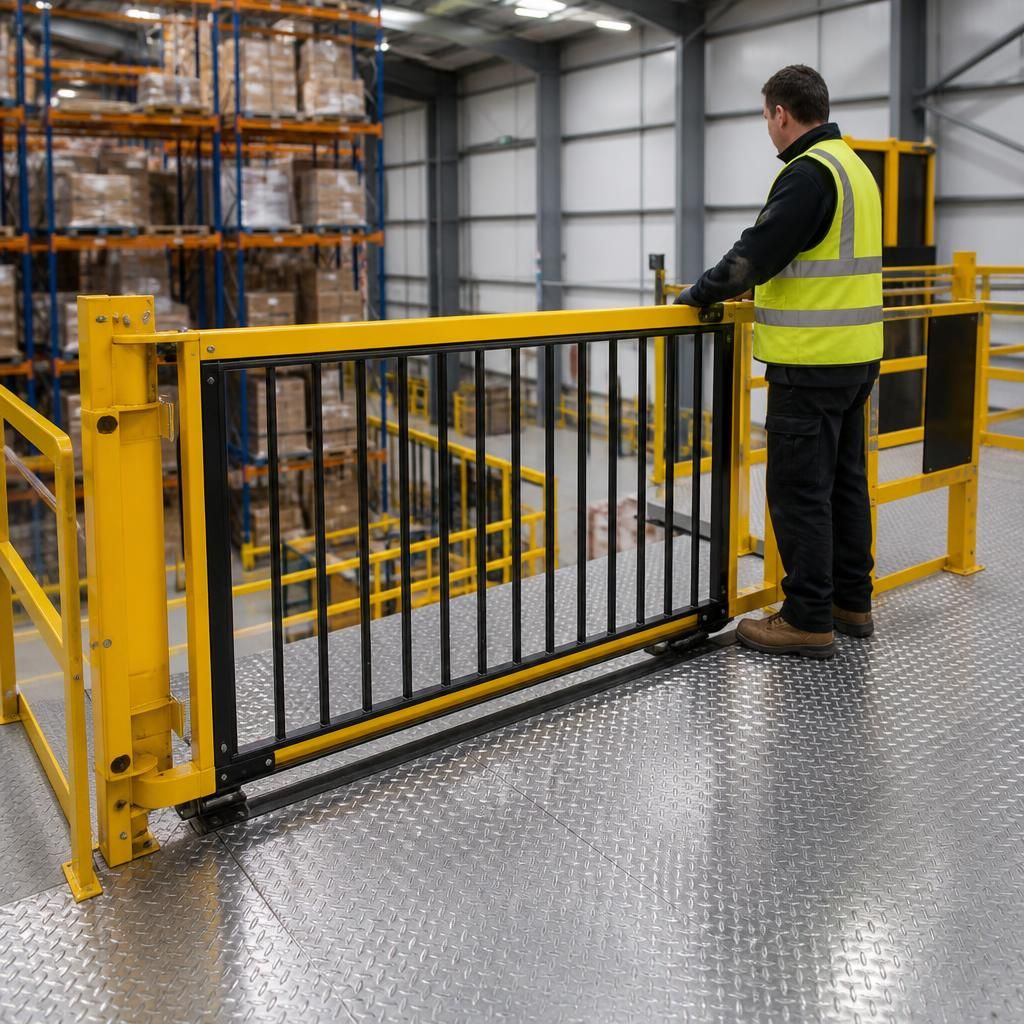
Mezzanine sliding gates must maintain edge protection whenever the access opening is not being used. They should prevent people from falling through the opening, remain secure under foreseeable pushing or impact forces, and allow pallets or other loads to be transferred without placing operators beside an unprotected edge.
The gate is only one part of the safety arrangement. Its operation should be covered by a suitable risk assessment, with defined loading procedures, trained operators and clear instructions for damaged or obstructed equipment. Surrounding guardrails, locks, guides and fixings should be inspected regularly so that the complete installation remains safe and effective.
Arrange an expert mezzanine sliding gate safety assessment
Arrange an expert mezzanine sliding gate safety assessment to review edge protection, operation, structural condition and inspection requirements. Contact Able Racking to discuss your installation and any corrective work needed.