
What safety standards do mezzanine sliding gates need to comply with?
Mezzanine sliding gates should be designed, installed and maintained to protect people from falls and comply with the UK Work at Height Regulations, PUWER and relevant provisions of BS EN ISO 14122, supported by a suitable risk assessment. The gate, guarding, interlocks and access arrangements must be appropriate for the specific mezzanine, loading activity and workplace layout.
Mezzanine sliding gates must be designed, installed and maintained to prevent falls from the edge of the mezzanine while allowing goods to be transferred safely. In the UK, compliance is normally based on a suitable and sufficient risk assessment, the Work at Height Regulations, the Provision and Use of Work Equipment Regulations (PUWER) where applicable, and relevant parts of the BS EN ISO 14122 series for permanent means of access to machinery and industrial platforms. The precise requirements depend on the gate design, the mezzanine layout, the goods-handling process and whether people can be exposed to an open edge.
There is not one single British Standard that covers every sliding gate arrangement. A competent designer or installer should assess the complete system, including the gate, edge protection, supporting structure, access route, loading activity and any powered or interlocked components. The completed installation should provide effective fall protection without creating additional trapping, impact or handling risks.
Work at Height Regulations
The Work at Height Regulations require work at height to be properly planned, appropriately supervised and carried out using suitable equipment. A mezzanine loading point is a work-at-height area because a person could fall from the platform when the gate is open or when goods are being moved through the opening.
In practical terms, the installation should:
- Prevent people from reaching or stepping into an unprotected edge wherever reasonably practicable.
- Provide collective protection rather than relying solely on personal protective equipment.
- Remain stable and effective during normal loading, unloading, cleaning and maintenance activities.
- Be suitable for the foreseeable size, weight and handling method of the goods.
- Include safe procedures for opening, closing and securing the gate.
- Be inspected after installation and at suitable intervals, particularly after alteration, impact or suspected damage.
A sliding gate should not be treated as compliant simply because it closes across an opening. Its position, travel, locking arrangement and relationship with the platform edge must all prevent a person from falling through or around the protected area.
BS EN ISO 14122 and permanent access arrangements
The BS EN ISO 14122 series is commonly used when assessing permanent access to machinery and industrial platforms. Its provisions can be relevant to the design of the mezzanine access route, working platform, guardrails, openings and associated protective arrangements. The applicable parts should be selected according to the installation rather than applied as a generic checklist.
Important design considerations include the height and continuity of edge protection, the dimensions of openings, the strength and rigidity of the guarding, safe movement around the gate and the prevention of objects or people passing through unprotected spaces. The gate should integrate with the surrounding guarding so that moving it does not leave an avoidable gap at the platform edge.
Where the gate forms part of a pallet transfer point, the design should also account for the way a pallet is positioned and removed. The protected arrangement must not depend on a worker standing at the edge to guide a load or manually hold the gate in an unsafe position.
PUWER requirements
PUWER may apply where the sliding gate is work equipment used by employees. This is particularly relevant to powered gates, gates with mechanical operating systems, or manually operated equipment presenting foreseeable mechanical risks. PUWER requires equipment to be suitable for its intended use, maintained in an efficient state, and inspected where deterioration could create danger.
For a gate system, this means considering:
- Safe manual forces and operating handles.
- Guards against crushing, shearing, trapping and impact points.
- Stops or travel limits that prevent the gate leaving its track.
- Secure locking or holding arrangements.
- Controls that are clearly identified and positioned away from danger.
- Emergency stopping or release arrangements where powered movement creates a significant risk.
- Instructions, training and maintenance information for users.
Powered equipment may also require consideration of machinery safety principles, including risk reduction through inherently safe design, guarding and control-system protection. Any interlock or sensor must be selected and installed for the actual risk; it should not be added as a substitute for sound physical edge protection.
Construction and structural requirements
The supporting steelwork, fixings and gate frame must be capable of resisting foreseeable loads, including normal operation, accidental contact and the forces generated when a gate is stopped or secured. The design should be checked against the relevant structural requirements for the building and platform. Where structural steelwork is fabricated or modified, the responsible parties should establish the appropriate specification, fabrication controls and installation records.
Materials and finishes should suit the working environment. Corrosion, contamination, temperature, cleaning chemicals and outdoor exposure can affect the performance of tracks, rollers, hinges, locks and fixings. A design that is adequate in a clean indoor area may require different protection in a damp, dusty or corrosive workplace.
Risk assessment and site-specific compliance
A documented risk assessment should identify how people and goods interact with the gate. It should consider pallet dimensions, vehicle or handling equipment movements, visibility, pedestrian access, traffic routes, loading frequency, foreseeable misuse and recovery from a jam or failed component. It should also address whether the gate can be opened while a person is in an unsafe position or while a load is not properly supported.
Controls may include a self-closing or self-securing mechanism, a positive locking device, physical interlocking with the loading process, warning notices, restricted access and defined operating procedures. The correct control depends on the risk; warning signs alone are not an adequate substitute for a physical safeguard where a fall remains possible.
Inspection, maintenance and records
Compliance continues after installation. The gate should be included in the workplace inspection and maintenance schedule, with checks covering the frame, track, rollers, fixings, locks, stops, guarding, interlocks and any visible deformation or corrosion. Inspections should be carried out by a competent person at intervals based on use, environment and risk, and after events such as impact, alteration or prolonged disuse.
Keep records of the risk assessment, design information, installation checks, operating instructions, training, inspections, repairs and any changes to the system. Defects that could affect fall protection or safe operation should be dealt with promptly, and the gate should be taken out of service where continued use presents a significant risk.
A competent assessment is therefore essential. The correct approach is to verify the complete mezzanine sliding gate arrangement against the relevant UK legislation, applicable BS EN ISO 14122 provisions, manufacturer instructions and the actual conditions of use. This provides a more reliable basis for compliance than selecting a gate solely by size, appearance or lifting capacity.
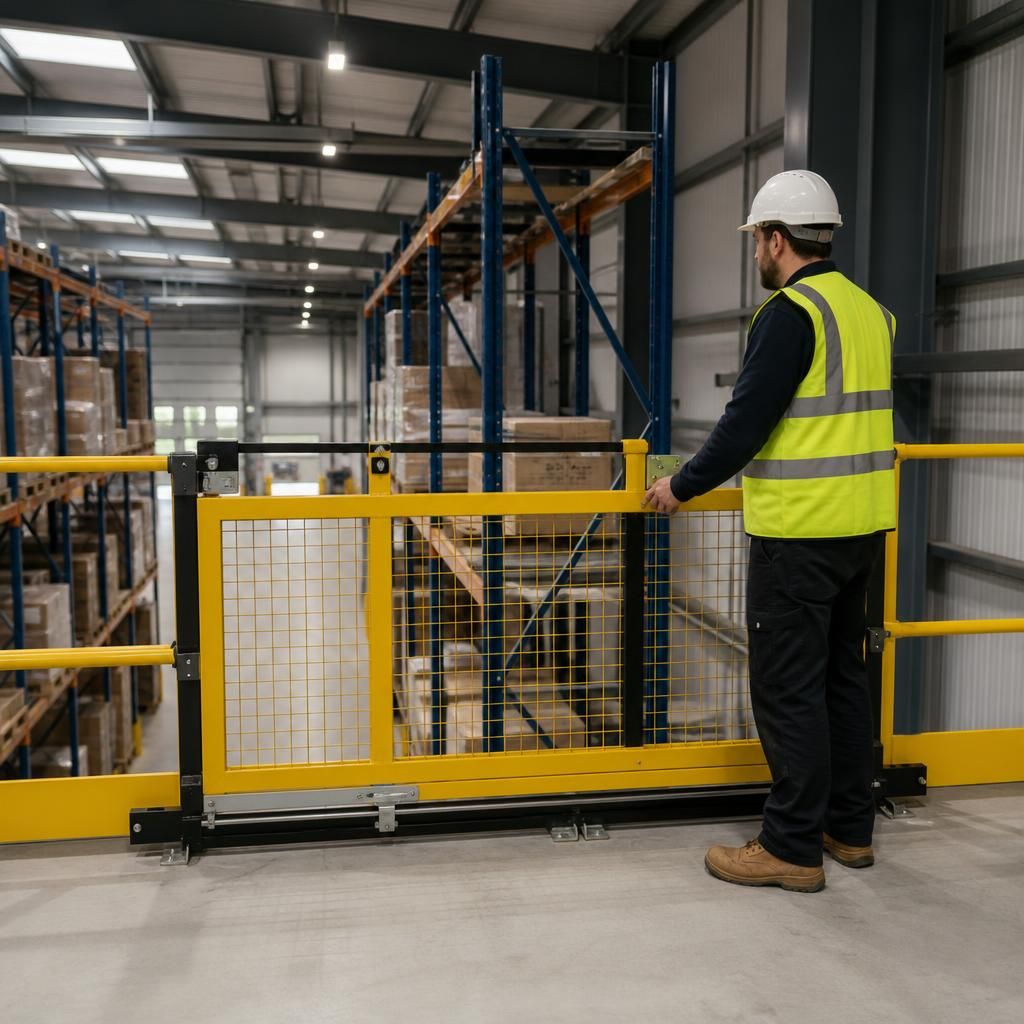
Compliance for a mezzanine sliding gate depends on the complete loading-point arrangement, not the gate alone. The gate, surrounding guardrails, supporting structure, locks and operating method must work together to prevent falls while allowing goods to be transferred safely.
A site-specific risk assessment should consider pallet sizes, handling equipment, pedestrian movements, visibility, foreseeable misuse and what happens if the gate is left open or a load becomes unstable. Controls may include positive locking, self-securing operation, suitable stops and restricted access. Where powered movement or interlocking is used, additional safeguards may be needed to control trapping, crushing and impact risks.
Compliance also requires continued inspection and maintenance. Check the frame, track, rollers, fixings, locks and surrounding protection for damage, wear, corrosion or deformation, particularly after an impact or alteration. Keep records of the assessment, installation checks, inspections, repairs and user training so the system can be managed safely throughout its working life.
Check Your Mezzanine Sliding Gate Compliance
Ask Able Racking to review your mezzanine sliding gate arrangement, risk assessment and inspection records to confirm that the system remains suitable for its intended use. Our experienced team can identify compliance gaps and recommend practical corrective action where required.