
What materials are used in the construction of mezzanine sliding gates?
Mezzanine sliding gates are typically constructed from robust steel, often galvanised or powder coated to resist corrosion and wear. Safety-focused components may include mesh infill, steel frames, guide rails, rollers, hinges, locking mechanisms and protective finishes selected to suit the site environment and expected use.
Mezzanine sliding gates are usually constructed from engineered steel, with mesh or solid infill panels, steel guide components and safety-focused hardware. The precise specification depends on the gate design, the load-handling process, the opening size and the environment in which the gate will operate.
Steel frames and support members
Structural steel is commonly used for the main frame because it provides the stiffness and strength needed for repeated opening, closing and impact-resistant operation. Box section or formed steel members may be used for the gate frame, posts, guard sections and supporting structure. These components must be suitably sized and securely connected so that the gate remains stable when operated and does not create excessive movement at the edge of the mezzanine.
Steel is also used for guide rails, brackets, stops and other load-bearing elements. Welded construction can provide a robust assembly, while bolted connections may assist with installation, adjustment and future maintenance. The appropriate arrangement should be confirmed against the manufacturer’s design and the conditions at the site.
Mesh infill panels
Welded wire mesh is a common infill material. It creates a physical barrier while allowing visibility through the gate, which helps operators see whether the loading area is clear. Mesh can also allow light and air to pass through and may make it easier to identify activity on the opposite side of the opening.
The mesh aperture and wire diameter should be selected to prevent people, packages or equipment passing through unintended gaps. The infill should be firmly attached to the frame, with edges and fixings arranged so they do not introduce sharp projections or snagging points. Mesh is often preferred where visibility and ventilation are important, whereas a solid panel may be considered where greater separation or containment is required.
Solid steel panels
Some sliding gates use sheet steel or other solid panels instead of mesh. Solid steel can provide a more enclosed barrier and may be useful where the process requires reduced visibility, improved separation or protection from falling items. It is heavier than mesh, however, so the track, rollers and supporting structure must be designed for the additional weight.
Solid panels may be formed, folded or reinforced to resist distortion. Their design should not obstruct essential sightlines or make it difficult for operators to confirm that the gate is correctly positioned before loading begins.
Surface protection
Steel components are generally protected with either galvanising, a powder-coated finish, paint or a combination of treatments. Galvanised steel has a zinc coating that helps protect the underlying steel from corrosion, making it suitable for many warehouse and industrial environments. Powder coating provides a hard, even finish and can improve resistance to everyday wear, provided the coating is not damaged.
Painted finishes may be appropriate for internal areas where exposure to moisture and corrosive substances is limited. The correct treatment depends on humidity, temperature, cleaning methods, chemical exposure and the likelihood of impact. Any damaged coating should be repaired promptly, because exposed steel can begin to corrode and may eventually affect the gate’s operation.
Tracks, rollers and bearings
Sliding movement is provided by steel or other suitably durable guide tracks, rollers and bearing assemblies. These parts must support the gate’s weight while allowing controlled movement without excessive friction, binding or lateral sway. Rollers may incorporate sealed bearings to reduce the entry of dust and to limit routine lubrication requirements, although they still need inspection.
Track materials and profiles should be compatible with the gate design and installed so that they remain aligned. Stops or end buffers are commonly included to control the travel of the gate and prevent it being pushed beyond its intended position. Debris, impact damage or misalignment can place additional stress on the rollers and frame, so these areas should be kept clean and checked during planned maintenance.
Locks, handles and safety components
Handles, latches, locking devices and catch mechanisms are usually made from steel or other hard-wearing materials suited to frequent use. The locking arrangement should make it clear when the gate is closed and secured. Depending on the design, the system may include a self-closing mechanism, a captive latch, an interlock or controls that prevent unsafe operation.
Where the gate forms part of a loading procedure, additional safety components may include warning signage, visual indicators, safety chains, edge protection and guarding around moving parts. These items are not simply decorative additions: they should support the safe sequence of opening, loading, closing and securing the gate.
Materials for specific environments
Standard coated steel is often suitable for dry internal industrial areas. Stainless steel, specialised coatings or additional corrosion protection may be considered in damp, cold, washdown or chemically exposed environments. Material selection should also take account of temperature changes, cleaning products and contact with pallets or handling equipment.
Materials should be selected as part of the complete gate design rather than chosen independently. A lightweight infill does not remove the need for a suitably strong frame, and a corrosion-resistant finish cannot compensate for an incorrectly aligned track or unsuitable hardware.
What to confirm before installation
- Whether the frame, infill and supporting structure are suitable for the intended use.
- Which finish is appropriate for the site’s moisture, cleaning and corrosion conditions.
- Whether the track, rollers and bearings are rated for the gate’s weight and operating frequency.
- Whether mesh apertures, panel gaps and edge details prevent foreseeable access or falling-item risks.
- How the latch, lock, stops and any interlocking or warning features will operate.
- Whether the completed installation will be inspected, recorded and maintained in accordance with the manufacturer’s instructions and the site’s risk assessment.
A competent assessment should consider the complete assembly, including the supporting edge protection and the way the gate is used. Choosing durable materials is important, but correct design, installation, adjustment and regular inspection are equally necessary for reliable long-term performance.
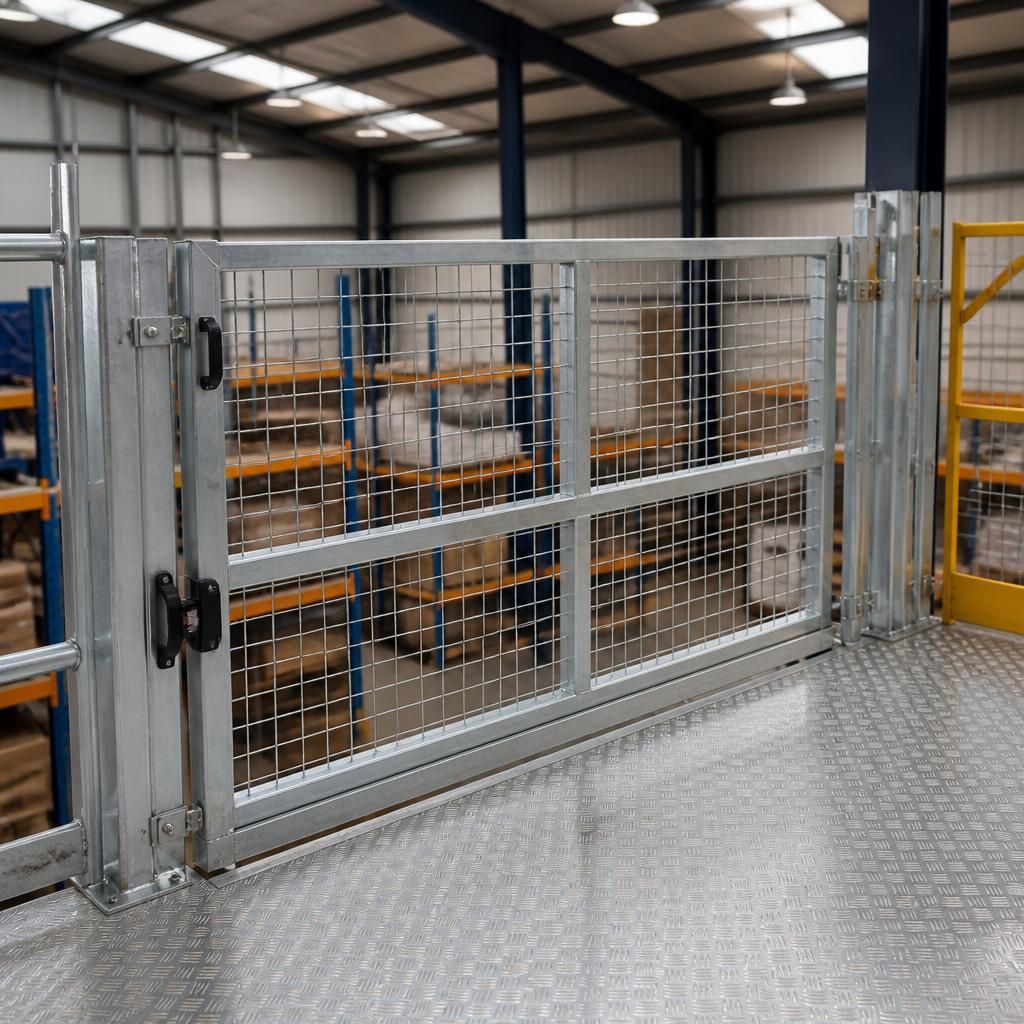
Steel is the primary material used for most mezzanine sliding gate frames, with the surface protected by galvanising, powder coating or paint. The appropriate finish depends on the site environment, including moisture, cleaning processes, chemical exposure and the likelihood of impact.
Galvanised steel provides effective corrosion resistance for many industrial areas, while powder coating offers a durable, even finish in suitable internal conditions. Stainless steel or specialist coatings may be more appropriate in damp, washdown or chemically exposed areas. Any damaged coating should be repaired promptly to prevent corrosion affecting the gate frame, track or moving components.
Discuss the Right Materials for Your Mezzanine Sliding Gate
Speak to our team to discuss the most suitable materials, finishes and safety components for your mezzanine sliding gate. We can help assess the site environment, operating requirements and supporting structure before installation.