
What are the benefits of using mezzanine sliding gates over traditional swing gates?
Mezzanine sliding gates offer a safer, more space-efficient alternative to traditional swing gates by moving within the gate line rather than projecting into busy working areas. They help maintain clear access, reduce obstruction risks and support safer pallet handling when correctly designed, installed and maintained.
Mezzanine sliding gates offer several practical advantages over traditional swing gates, particularly in warehouses and industrial facilities where space, access and safe load transfer are important. Because the gate moves sideways within its operating area rather than swinging out into the surrounding workspace, it can reduce obstructions, improve movement around the loading point and support safer day-to-day handling when properly designed, installed and maintained.
Better use of available space
A swing gate requires a clear arc in front of and behind the access point. That space must remain unobstructed whenever the gate is opened, which can limit the position of walkways, work areas, equipment and stored goods. A sliding gate generally operates parallel with the edge of the mezzanine, making better use of the available footprint and reducing the amount of space needed for opening.
This is particularly useful where the loading area is close to a working aisle, column, conveyor, staircase or other fixed obstruction. The gate can be designed to suit the available layout instead of requiring a large clear zone for its movement.
Reduced obstruction and collision risk
When a swing gate opens into a busy work area, it can obstruct pedestrians, vehicles or operators working near the edge. It may also be struck if someone is unaware that the gate is open or if equipment is manoeuvred too close to its swing path. A sliding arrangement removes this outward sweep and can help keep the surrounding floor space clear.
This does not remove the need for suitable operating procedures. Users still need to understand when the gate may be opened, how loads are transferred and how the gate is secured before the area is used. However, removing the swing path can make the access point easier to manage and less vulnerable to accidental impact.
Safer pallet and goods transfer
Sliding gates can make it easier to position handling equipment and goods close to the loading edge without the gate leaf interfering with the transfer process. Once the gate is correctly opened and secured, operators have a more predictable working area for moving pallets, components or other materials between floor levels.
The gate should be selected and configured so that its movement, clear opening and protective arrangement suit the loads being handled. It must not be treated as a substitute for a suitable loading procedure, edge protection or competent supervision. The safe system should ensure that the opening is protected whenever goods are not being transferred.
Improved pedestrian access around the gate
Where pedestrian routes pass near the access point, a sliding gate can help maintain a clearer passage because it does not project across the route while opening. This can reduce inconvenience and help separate people from load-transfer activities, provided the layout includes adequate guarding and clearly defined pedestrian areas.
Good design should also consider pinch points, finger traps, the force needed to move the gate and the possibility of people standing in its travel path. Stops, handles, guarding and other protective features should be chosen to control these risks.
More predictable operation
A well-designed sliding gate follows a defined track or guided movement. This can make its operation more consistent than a swing gate that may be affected by its opening arc, surrounding obstructions or the position of hinges. Operators can see where the gate is intended to travel and where it should be secured.
In busy facilities, consistent operation is valuable because it reduces the likelihood of the gate being left in an awkward position or opened into a pedestrian route. Clear instructions and appropriate signs should still be provided, especially where different people use the loading point.
Greater flexibility for facility layouts
Sliding gates can be suitable for access points where the building layout leaves limited room for a conventional swing arrangement. They may be incorporated around structural columns, restricted aisles and other fixed features, subject to a competent design assessment.
The final arrangement should account for the width and height of the opening, the direction of goods movement, available clearance, the position of edge protection and any interaction with lifting equipment. A gate that fits the opening but restricts handling movements is not an effective solution.
Potentially lower exposure to impact damage
Removing the swing arc can reduce the chance of a gate being hit by pedestrians or handling equipment while it is being opened. A sliding gate can also be positioned more closely within its intended line, helping to keep the protective structure aligned with the edge of the platform.
Impact protection may still be necessary where vehicles or powered handling equipment operate nearby. The gate, its track, posts, fixings and surrounding structure should be inspected for damage after any collision or suspected impact. A gate that appears to operate normally may still have weakened components or altered alignment.
Comparison with traditional swing gates
- Operating space: a sliding gate moves sideways, while a swing gate needs room for its leaf to rotate.
- Obstruction: sliding movement can keep nearby routes and work areas clearer.
- Loading access: a sliding gate may provide a more convenient opening for transferring goods where space is restricted.
- Layout suitability: sliding designs can work well around fixed obstacles, although the track and receiving area must remain clear.
- Risk control: both types require edge protection, controlled use, suitable guarding and regular checks; neither is safe solely because of its operating direction.
Important design and safety limitations
The benefits depend on the gate being correctly specified for the mezzanine, the loads and the working environment. The arrangement should prevent access to the unprotected edge when the loading opening is not in use. It should also avoid creating gaps, climbable features or openings through which a person or load could pass unintentionally.
Consideration should be given to the gate’s structural support, travel path, locking or securing method, guarding interface, visibility and compatibility with the existing floor and edge protection. Where the gate is powered, additional controls may be required, including protection against unintended movement and suitable emergency arrangements. Manual gates should be light enough for safe operation and should not require excessive force.
Installation and ongoing care
Installation should be completed by competent personnel in accordance with the design requirements and the manufacturer’s instructions. The finished gate should be checked for alignment, secure fixings, smooth movement, effective stops and reliable operation in both normal and loading conditions.
Routine inspections should look for worn rollers, damaged tracks, loose fixings, corrosion, distorted guards, defective locks and changes in the way the gate operates. Any fault that could affect edge protection or safe goods transfer should be dealt with promptly, and the gate should be taken out of service where necessary until it has been made safe.
Overall, mezzanine sliding gates are often preferable to swing gates where working space is limited or where an outward-opening leaf would interfere with people, equipment or load transfer. Their main advantage is the more controlled use of space, but they must form part of a complete safety arrangement rather than being considered in isolation.
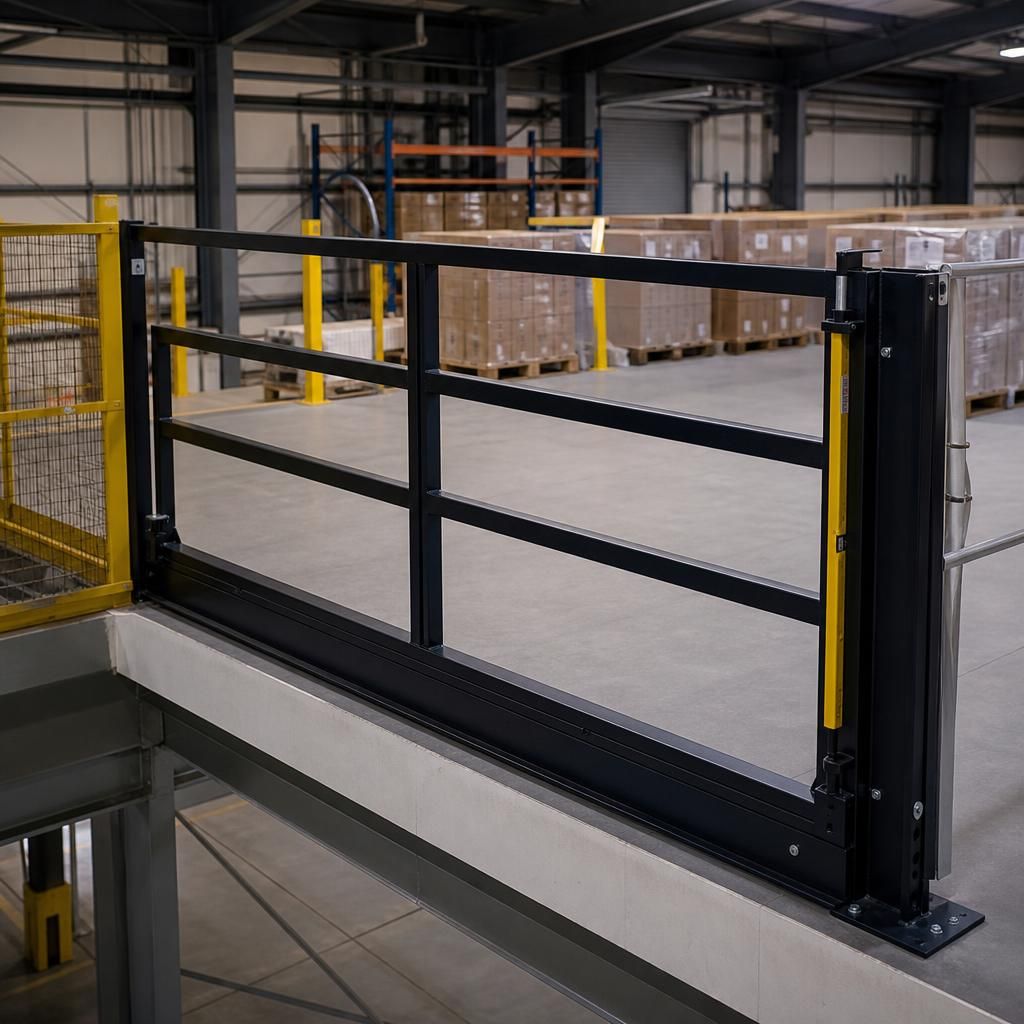
Mezzanine sliding gates improve space efficiency because they move sideways along the gate line instead of requiring a swing arc. This keeps nearby walkways, work areas and handling routes clearer, which is particularly useful where the loading point is close to a staircase, column, conveyor or busy aisle.
By reducing the space needed to open the gate, the sliding design can make pallet and goods transfer more predictable. The track, travel path and receiving area must remain unobstructed, and the gate must be secured whenever the opening is not being used. Good design therefore combines the space-saving movement with suitable edge protection, guarding and clear operating procedures.
Discuss your mezzanine sliding gate requirements
Discuss your mezzanine sliding gate requirements with our experienced team to confirm the most suitable design, layout and safety features for your facility.