
What safety standards are applicable to mezzanine floor loading gates to ensure compliance?
Mezzanine floor loading gates should be designed, installed and used in accordance with the Work at Height Regulations 2005, PUWER 1998 where applicable, relevant structural and guarding standards, and the manufacturer’s instructions. A documented risk assessment should confirm that the gate prevents falls, provides secure pallet transfer and is inspected and maintained throughout its service life.
Mezzanine floor loading gates should be designed, installed and used in accordance with the Work at Height Regulations 2005, the Provision and Use of Work Equipment Regulations 1998 (PUWER) where applicable, relevant structural and guarding standards, and the manufacturer’s instructions. A suitable risk assessment should demonstrate that the gate prevents falls, allows loads to be transferred securely and can be inspected and maintained throughout its service life.
There is no single standard that applies to every loading gate. The correct compliance requirements depend on the gate’s design, whether it is manually operated or powered, the loads being transferred, the surrounding edge protection and the way people work near it. Compliance should therefore be assessed as part of the complete mezzanine floor and loading process, rather than by considering the gate in isolation.
Work at Height Regulations 2005
The Work at Height Regulations 2005 are central to loading gate safety because an open edge is created whenever goods are moved between the floor and the level above or below. The gate must provide effective protection against people and goods falling from the edge. The design should prevent access to the unprotected opening when the gate is not in the safe loading position, while allowing authorised operators to transfer goods without unnecessary exposure to the edge.
The Regulations require work at height to be properly planned, supervised and carried out by competent people. Employers must avoid work at height where reasonably practicable and, where it is necessary, select suitable equipment and protective measures. For a loading gate, this includes considering how pallets are presented, how the gate is opened and closed, where operators stand, and what happens if a load is unstable or incorrectly positioned.
PUWER 1998 and powered equipment
PUWER may apply where the loading gate is work equipment used by employees. It is particularly relevant to gates with moving, counterbalanced, hydraulic, pneumatic or electrically powered components. The equipment must be suitable for its intended use, maintained in an efficient condition and inspected where deterioration could create a risk. Operators should receive adequate information, instruction and training.
Powered gates should also be assessed for foreseeable risks such as trapping, crushing, shearing, unexpected movement and unauthorised operation. Controls should be clearly identified and positioned so that the operator can use the gate safely. Where safety devices, interlocks or protective barriers are fitted, they must not be bypassed during normal operation.
Not every manually operated loading gate will be machinery for the purposes of PUWER. However, the same principles of suitability, maintenance, safe use and competent operation remain important under general health and safety duties.
Structural design and guarding requirements
The gate, its posts, hinges, counterbalance system, fixings and supporting floor structure must be designed for the loads and forces expected in service. This includes the weight and movement of transferred goods, accidental impact, foreseeable misuse and any forces applied to the guarding. Structural calculations should be prepared or verified by a suitably competent structural engineer, using the applicable British Standards, Eurocodes and UK National Annexes for the project.
Guarding should be continuous and suitably connected to the loading gate so that the protected edge is not compromised when the gate is operated. The arrangement should prevent people from reaching or stepping into the opening and should not create additional trip, snagging or entrapment hazards. Applicable guidance and standards for permanent access, guardrails and barriers should be selected according to the gate type and the wider installation. BS EN ISO 14122 and BS 6180 may be relevant in some designs, but they should not be treated as a universal substitute for a project-specific assessment.
Where the gate forms part of a new construction project or a significant alteration, the design should also be coordinated under the Construction (Design and Management) Regulations 2015. Building control, structural design and fire-safety requirements may apply to the wider mezzanine installation, even where they do not prescribe the detailed operation of the loading gate itself.
Risk assessment and safe operating arrangements
A documented risk assessment should cover the complete loading process. It should consider:
- the types, sizes and weights of goods transferred;
- the method used to move goods, including pallet trucks, lifting equipment or conveyors;
- the position of operators before, during and after gate operation;
- falling objects, unstable loads and accidental impact;
- gaps between the gate, floor and adjacent guarding;
- trapping, crushing and manual-handling risks;
- access by unauthorised people;
- lighting, visibility, housekeeping and emergency arrangements; and
- reasonably foreseeable misuse, faults and maintenance activities.
The assessment should lead to clear operating instructions. These should explain when the gate may be opened, how loads must be positioned, when the opposite side must be clear, and how the gate is secured after each transfer. If a lifting appliance is used to raise or lower goods, that equipment may also be subject to the Lifting Operations and Lifting Equipment Regulations 1998 (LOLER). LOLER applies to the lifting equipment and lifting operation; it does not automatically apply to a standalone loading gate.
Inspection, maintenance and records
Loading gates should be inspected before use where the risk assessment or manufacturer requires it, and formally inspected at suitable intervals based on the environment, frequency of use, impact risk and equipment design. Inspections should check the structure, welds, fixings, hinges, locks, counterbalance components, guarding, stops, interlocks and warning labels. Powered systems require additional checks of controls, sensors, hydraulic or pneumatic components and emergency functions.
Any defect that could affect safe operation should be reported and assessed promptly. The gate should be taken out of service where necessary, with a safe alternative arrangement used until competent repairs are completed. Alterations, repairs and replacement parts should retain the original level of protection and should be recorded. Inspection and maintenance records should identify the equipment, date, findings, actions taken and person completing the work.
Competence and evidence of compliance
Installation, structural assessment, electrical work and repairs should be completed by suitably competent professionals. Operators need practical instruction specific to the installed gate, including its limitations and the correct response to faults. Employers should retain the design information, risk assessment, manufacturer’s instructions, examination or inspection records, maintenance history and training records.
For an existing installation, a professional safety inspection can help establish whether the gate remains suitable and whether its guarding, fixing and operating arrangements meet current expectations. Standards can change, but the essential test remains the same: the loading gate must provide effective protection, be suitable for its intended use, and be supported by safe systems of work, competent users and documented inspection.
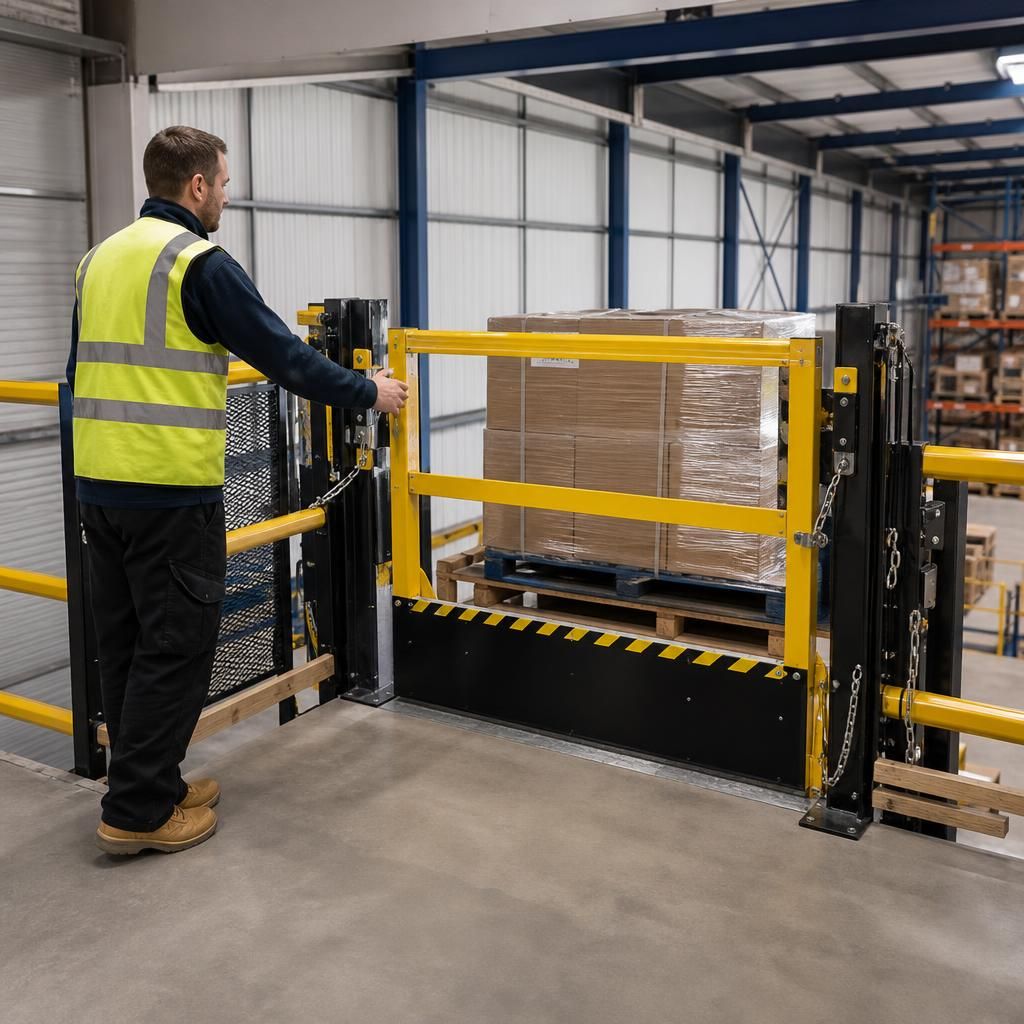
Compliance for mezzanine floor loading gates depends on the complete transfer arrangement, not the gate alone. A documented risk assessment should confirm that the gate prevents falls, keeps people away from the open edge and allows goods to be transferred without exposing operators to avoidable crushing, trapping or impact risks.
The assessment should reflect the gate’s design, the loads being moved, the equipment used for transfer and the way operators work. It should support clear instructions covering when the gate may be opened, where people must stand, how loads are positioned and how the gate is secured after use. Reviewing these arrangements during inspections and after any alteration provides practical evidence that the installation remains suitable and compliant.
Arrange a Compliance Assessment for Your Mezzanine Floor Loading Gate
Arrange a compliance assessment for your mezzanine floor loading gate to review its guarding, operation, condition and supporting safety documentation. Contact Able Racking to discuss the appropriate inspection and any corrective action required.