
What safety features should I look for when selecting mezzanine floor loading gates?
When selecting mezzanine floor loading gates, look for robust edge protection, a self-closing or interlocked gate, secure locking, and a design that prevents people or loads falling from the open edge. The gate should also suit the intended load-handling method, provide clear visibility, and be installed and inspected to the manufacturer’s instructions and applicable workplace safety requirements.
The key safety features of a mezzanine floor loading gate are effective edge protection, a barrier that remains secure when the loading side is open, controlled access, and a design suited to the way goods are transferred. A suitable gate should prevent people, pallets and loose items from falling from the platform while allowing authorised operators to load and unload materials efficiently.
Selection should begin with a documented assessment of the loads, handling equipment, operating method and surrounding workplace. The gate must be compatible with the mezzanine structure and installed in accordance with the manufacturer’s instructions. A gate that appears robust may still be unsuitable if its opening, operating movement or safe working load does not match the intended use.
Look for the following safety features when comparing loading gates:
- Continuous edge protection: The design should maintain a physical barrier at the open edge whenever goods are not actively being transferred. The protected sides of the loading area should include suitable guardrails, a mid-rail where required, and protection against objects being pushed or dropped beneath the barrier.
- A positive closing action: A self-closing gate reduces the risk of the opening being left unprotected after a load has been moved. The closing mechanism should operate consistently without relying on an operator remembering to shut the gate manually.
- Interlocking or controlled operation: Where the risk assessment requires it, an interlock can prevent the gate from being opened unless the safe operating conditions are met. Depending on the design, this may prevent access to the exposed edge, restrict simultaneous unsafe movements or indicate when the gate is not fully secured.
- Secure locking: The gate should have a positive latch or locking arrangement that cannot be easily displaced by contact with a pallet, load or handling equipment. It should be clear when the gate is fully closed and locked, rather than relying on friction alone.
- Protection against falling loads: The barrier should be strong enough for the foreseeable impact and loading conditions. It should help contain pallets, boxes and loose materials, with openings and clearances designed to prevent items passing through or becoming trapped.
- Appropriate load capacity: The manufacturer’s stated safe working load must be suitable for the heaviest intended load and the way it will be placed on the platform. Consider dynamic forces from powered handling equipment, loads that may be unevenly distributed, and any impact risk during positioning.
- Safe separation from the open edge: The operating position should allow employees to open, close and monitor the gate without needing to lean over the edge or stand in a fall-risk area. Controls and handles should be reachable from a safe position.
- Visibility: Operators should be able to see the platform, the load and the area below before opening or moving the gate. Where the gate or its frame restricts visibility, the working method may need additional communication controls, supervision or physical safeguards.
- Compatibility with handling equipment: The opening must suit the pallet dimensions, trolley, forklift attachment or other transfer equipment being used. There should be enough clearance to position loads without striking the gate, guardrails or platform structure.
- Protection from trapping and crushing: Moving sections, hinges, counterweights and closing mechanisms should minimise accessible pinch points. Any unavoidable hazards should be guarded or addressed through safe operating instructions and suitable training.
- Stable construction and suitable materials: The gate should resist deformation, corrosion and wear in the conditions where it will be used. Welds, fixings, hinges, latch components and protective finishes all need to be suitable for the expected loading and environment.
The type of gate is also important. A pallet gate, swing gate, lift-out barrier or vertical gate may each be appropriate in different circumstances. A swing design may provide straightforward operation but needs sufficient clearance and control of its travel. A lift-out design can be simple to use but must prevent removal when the opening is exposed and must provide a secure place for the barrier when it is not in use. A vertical design may preserve floor space, but its movement, counterbalance and guarding require particular attention.
Do not assess the gate in isolation. The complete loading point should include suitable protection at the sides and rear, a stable platform surface, adequate lighting, clear markings and enough room for operators to manoeuvre safely. The surrounding structure must be capable of accepting the gate loads and any forces generated during normal use. Fixings should be specified for the actual supporting steelwork or concrete, rather than selected only because they are convenient to install.
Safety devices should be practical for the work being carried out. If a gate is difficult to operate, obstructs normal loading or requires excessive force, employees may be tempted to bypass it, wedge it open or work around it. The preferred arrangement is one that provides a clear loading sequence: position the load, secure the receiving area, operate the gate from a safe location, transfer the load, and restore the barrier before anyone approaches the exposed edge.
Before approval, check that the supplier provides clear information covering the gate’s safe working load, permitted load dimensions, operating method, installation requirements and inspection points. Instructions should explain what operators must do if the latch fails, the gate does not close correctly, a component is damaged or a load becomes obstructed. Safety signs at the loading point should support the procedure without replacing proper physical protection.
Installation and commissioning should include checks of alignment, fixings, clearances, latch engagement, self-closing action, interlocks and the condition of the surrounding edge protection. The completed arrangement should be reviewed against the original risk assessment and the manufacturer’s requirements. Where the design is unusual or integrated into an existing structure, competent engineering advice may be needed to confirm that the supporting structure and gate arrangement are suitable.
Ongoing safety depends on inspection as well as initial specification. Operators should report damaged barriers, bent frames, worn hinges, loose fixings, failed latches, missing guards and unusual operating resistance immediately. Formal inspections should be carried out at intervals based on use, environment and risk, with defects recorded and corrected before the gate is returned to service where safety may be affected.
The final choice should therefore be based on the complete system rather than appearance or purchase price. A suitable mezzanine floor loading gate combines reliable edge protection, positive closure, secure locking, controlled access, adequate capacity, safe visibility and compatibility with the site’s handling process. It should also be supported by competent installation, clear operating procedures, appropriate training and a planned inspection regime aligned with current workplace safety duties and the manufacturer’s instructions.
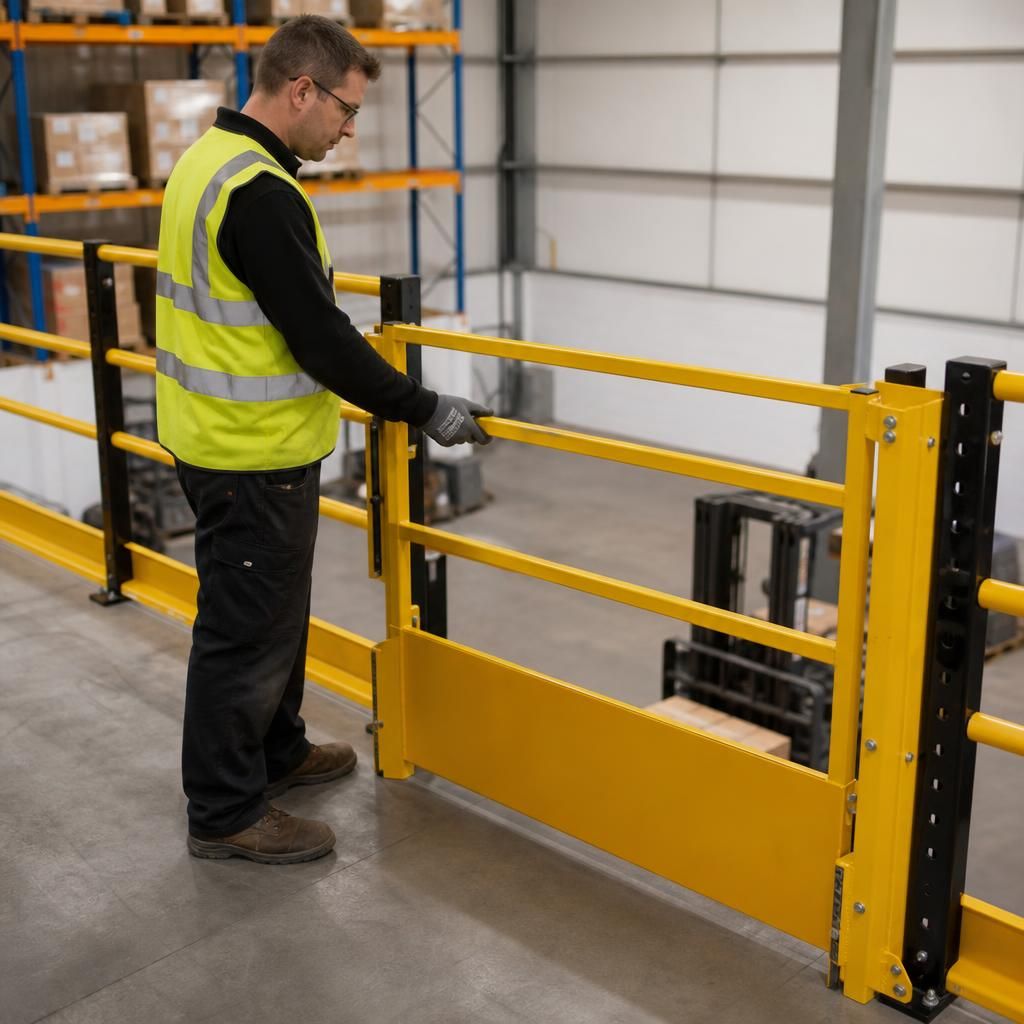
Positive closure is a key safety feature in a mezzanine floor loading gate because it restores the physical barrier as soon as the load has passed through. A self-closing mechanism should operate reliably without depending on the operator remembering to shut the gate, while a positive latch should clearly confirm that it is fully closed and secure.
Where the risk assessment requires additional control, an interlock can prevent the gate opening unless the safe loading conditions are met. During commissioning, check the closing action, latch engagement, clearances and any interlock functions. Operators should report gates that fail to close, need excessive force or show damaged hinges, latches or frames, and the loading point should be taken out of use until the defect is assessed.
Discuss Your Mezzanine Floor Loading Gate Requirements
Discuss your mezzanine floor loading gate requirements with our experienced team to confirm the most suitable safety features, operating method and installation approach for your site.